
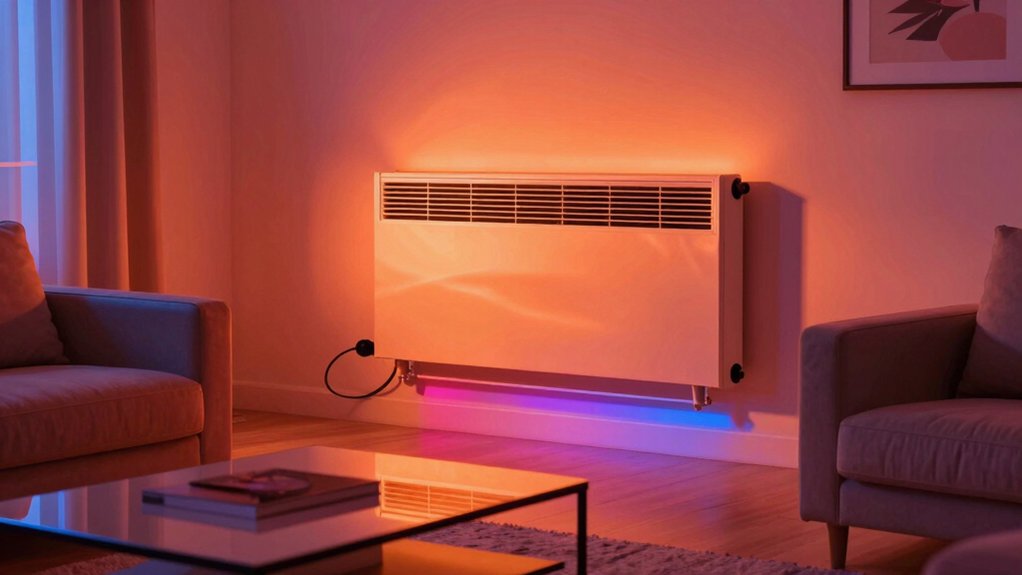
Infrared heating delivers quick, targeted warmth with simple installation and lower upfront costs, while heat pumps move heat to provide whole-home comfort with higher efficiency and long-term savings. Infrared shines for spot heating, rapid warm-up, and intermittent occupancy, benefiting spaces with thermal mass or outdoor areas. Heat pumps excel in year-round comfort, low running costs in moderate climates, and cooling in warmer months. If you continue, you’ll uncover how to choose and pair them for best results.
How Infrared Heating Works in Real Terms
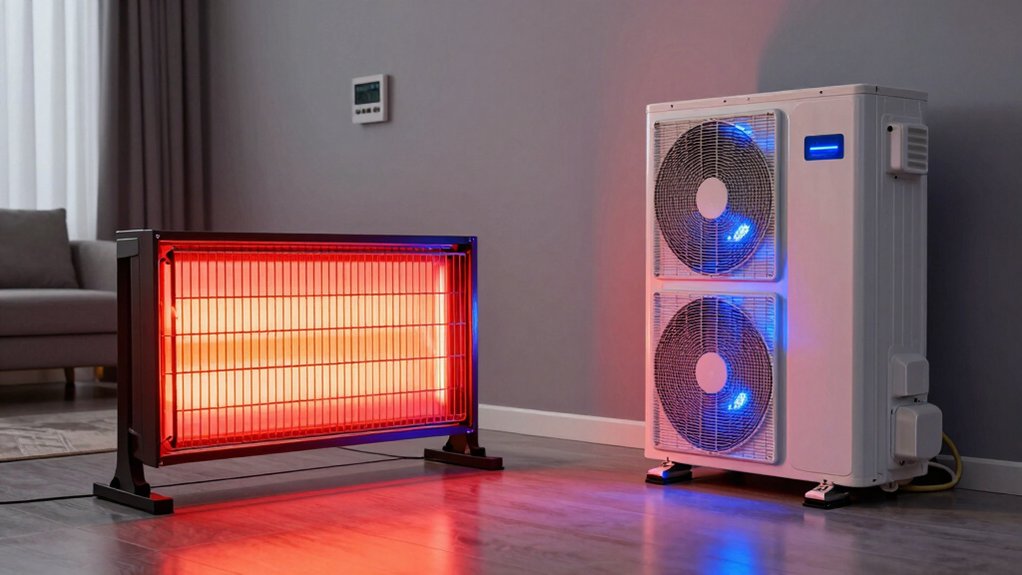
Infrared heating works by emitting electromagnetic waves that directly heat objects and surfaces in its path, rather than warming the surrounding air. You experience warmth when rays strike a panel, piece of furniture, or person, converting energy into heat at the surface. This process reduces heat loss from convection, so you notice a quicker, more focused comfort.
Wavelength selection matters: shorter waves heat near-field surfaces, while longer waves penetrate deeper into materials. Efficiency hinges on emissivity, target temperature, and exposure; high-emissivity elements absorb more energy for the same input.
You monitor control strategies—zone heating, timed schedules, and duty cycles—to maintain stable comfort with minimal overshoot. In practice, performance depends on installation, orientation, and reflective surfaces, which influence heat distribution and perceived comfort across spaces.
How Heat Pumps Move Heat: A Practical Primer
Heat pumps move heat by circulating refrigerant in a closed loop, driven by the compressor to transfer energy from one side to the other.
You’ll see heat flow directional—from outdoor to indoor in cooling mode, and from indoor to outdoor in heating mode—through phase changes and fluid pressures.
We’ll cover the practical aspects of heat transfer, including how rate and efficiency depend on temperature differences, refrigerant properties, and system design.
How Heat Moves
When a system moves heat, you’re watching three main mechanisms at work: conduction, convection, and, in some cases, radiation.
Conduction transfers energy through material contact, with heat flow proportional to temperature difference and material conductance.
Convection transfers heat via fluid movement, driven by density differences or mechanical pumps, forming boundary layers that affect efficiency.
Radiation moves energy through electromagnetic waves, requiring no medium and depending on emissivity and view factors.
In heat pumps, the primary transport is backward: electrical work powers a cycle that extracts internal heat from a source and rejects it at a higher temperature.
Closed-loop refrigerant circulation enables phase changes, boosting temperature lift without bulk temperature rise in the surroundings.
System design balances these mechanisms to optimize coefficient of performance and response under load, ambient conditions, and component limits.
Practical Heat Transfer
You’ve seen the basic mechanisms at play; now we focus on how heat pumps actually move heat in practice. In operation, a cycle compresses the refrigerant, raising its pressure and temperature. The hot gas releases heat in the condenser to the destination, while the refrigerant cools and condenses into a liquid.
The expansion device then lowers pressure, cooling the liquid into a low-temperature, low-pressure mixture that absorbs heat in the evaporator. The pump’s performance depends on refrigerant properties, heat exchanger area, and throttling losses, not on mechanical heating alone.
Coefficient of performance (COP) captures efficiency: higher COP means more heat moved per unit input. System matching—compressor size, refrigerant choice, and loop temperatures—limits operation near extremes.
In frost conditions, auxiliary controls prevent performance drops and maintain delivery temperature.
Which Is More Efficient: and When It Counts
You’ll see efficiency shift with usage patterns, heat-source economics, and system sizing, so the choice hinges on when it counts.
Infrared heating tends to excel for spot heating and rapid warm-up, while heat pumps shine in whole-space cooling and year-round comfort with lower operating costs.
Consider your application scenarios for efficiency to determine which technology delivers the most value in your context.
Efficiency Dynamics When It Counts
In practical terms, efficiency dynamics hinge on how and when a system operates: heat pumps excel at high-demand, moderate-to-low external temperatures, while infrared heating delivers immediate, targeted heat with lower standby losses.
You compare systems by coefficient of performance during peak loads and by surface heat delivery efficiency under steady states. Heat pumps optimize energy use when cooling or heating environments, converting ambient warmth to usable heat with relatively high COP but diminishing returns as outdoor temps plummet or when auxiliary heat engages.
Infrared sources provide rapid zoning, reducing parasitic losses but consuming more electricity for sustained space warming. Consider control strategies, response times, and thermal mass interactions to determine overall energy cost, comfort, and emissions across typical operating envelopes.
Application Scenarios For Efficiency
Infrared heating and heat pumps each shine in different application scenarios, so selecting the most efficient option hinges on load profile and operating environment. You’ll find infrared excels for rapid, localized heat, low-mass loads, and intermittent use with minimal standby energy. It delivers direct radiant warming to people and objects, reducing the need to heat air extensively.
Heat pumps, by contrast, win with steady, whole-space conditioning, high heat demand, and cooler ambient conditions where latent and sensible loads are substantial. Consider control complexity; infrared favors straightforward on/off operation, while heat pumps benefit from modulation and zoning.
Evaluate peak demand, energy tariffs, maintenance costs, and temperature stability. In mixed loads, combining both can optimize efficiency by aligning each technology to its strongest scenario.
Best Use Cases for Infrared vs. Heat Pumps
Infrared heating and heat pumps shine in different roles, so choosing between them hinges on load type, installation context, and operating goals. You’ll favor infrared when surface heating, rapid response, or zoned comfort matters, especially for opaque walls, equipment bays, or outdoor spaces.
Infrared provides near-instant heat, lower mass energy use, and minimal air movement, which suits occupant-sensitive environments and high-temperature needs. Heat pumps excel for modest-cost, low-temperature heating across whole spaces, with heat recovery potential and efficiency advantages at steady loads.
Use cases split by load profile: infrared for spot heating, dry or drafty locales, and where thermal mass isn’t central; heat pumps for whole-room heating, large areas, and season-long efficiency. Consider coexistence when specific zones require targeted infrared comfort alongside central, low-temperature distribution.
Costs, Installation, and Running Expenses Compared
When you weigh infrared versus heat pumps, upfront costs, ease of installation, and ongoing operating expenses matter as much as performance.
Infrared systems typically have lower material costs per unit, with rapid deployment and minimal-site disruption. However, they may require additional zoning controls and surface area for even heat distribution.
Heat pumps usually demand higher initial investment due to equipment efficiency ratings, refrigerant handling, and potential system integration. Yet benefits include longer service life and lower daily operating costs in moderate climates.
Running expenses hinge on electricity prices, usage patterns, and efficiency metrics (COP or SEER).
Maintenance is generally simple for infrared panels, while heat pumps need periodic refrigerant checks and professional servicing.
Consider total cost of ownership, climate, and desired comfort profile to compare economically.
How to Decide: Infrared or Heat Pump for Your Home
To decide between infrared and a heat pump for your home, start with your climate, usage patterns, and comfort goals. Infrared excels at rapid, localized heating and zone control, making sense in spaces that aren’t occupied continuously or where quick warmth is valued.
Heat pumps offer whole-house efficiency, lower running costs in moderate climates, and consistent indoor temperatures via air-to-air or ground-source cycles. If your winters are harsh, you’ll want to compare insulation, thermal mass, and heating needs over peak periods to determine if supplemental infrared panels reduce overall energy use.
Consider initial costs, maintenance, and equipment lifespan. Align selection with load calculations, desired comfort, and potential energy incentives.
In many homes, a hybrid approach pairing infrared with a heat pump provides balanced performance.
Conclusion
Infrared heating and heat pumps each have their place, but you’ll feel the difference in how quickly warmth arrives and how it’s sustained. If you resist upfront costs but crave instant comfort, infrared delivers fast, direct warmth to objects and people. For whole-home efficiency and year-round use, a heat pump shines, pulling heat from the outside air. Consider your priorities: immediate comfort vs. long-term efficiency, and choose the system that fits your home and budget.