
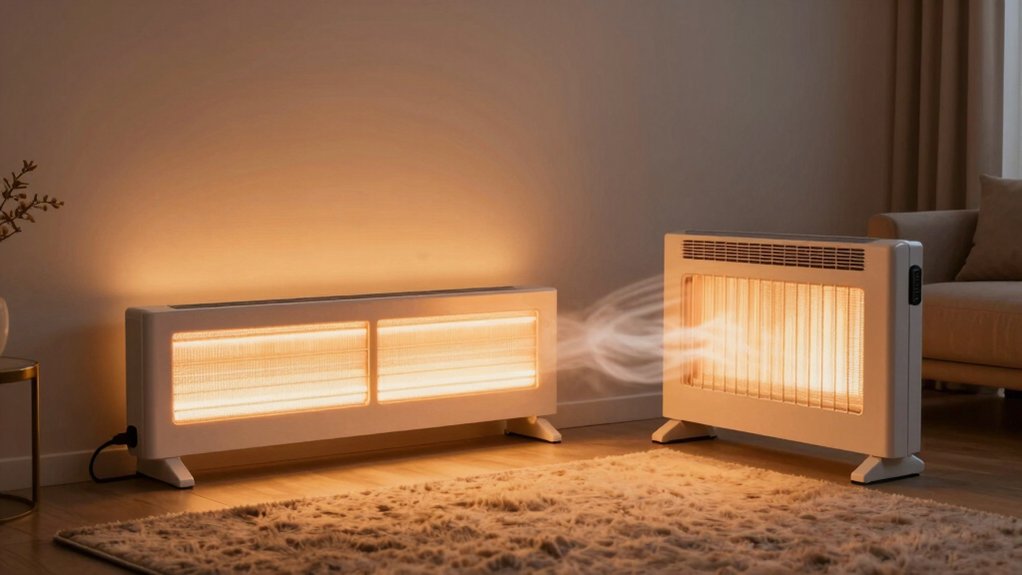
Infrared heaters deliver warmth directly to people and surfaces via radiant energy, offering rapid, localized comfort with minimal air movement. Convection units heat the surrounding air, creating a steady, whole-room temperature through circulating currents and slower response. Infrared shines where you need fast relief in drafts or outdoor spaces, while convection suits consistent, long-lasting comfort in enclosed rooms. Consider heat delivery, response time, and occupancy patterns. If you keep exploring, you’ll uncover practical, side‑by‑side comparisons and decision criteria.
What Infrared and Convection Heaters Do Differently
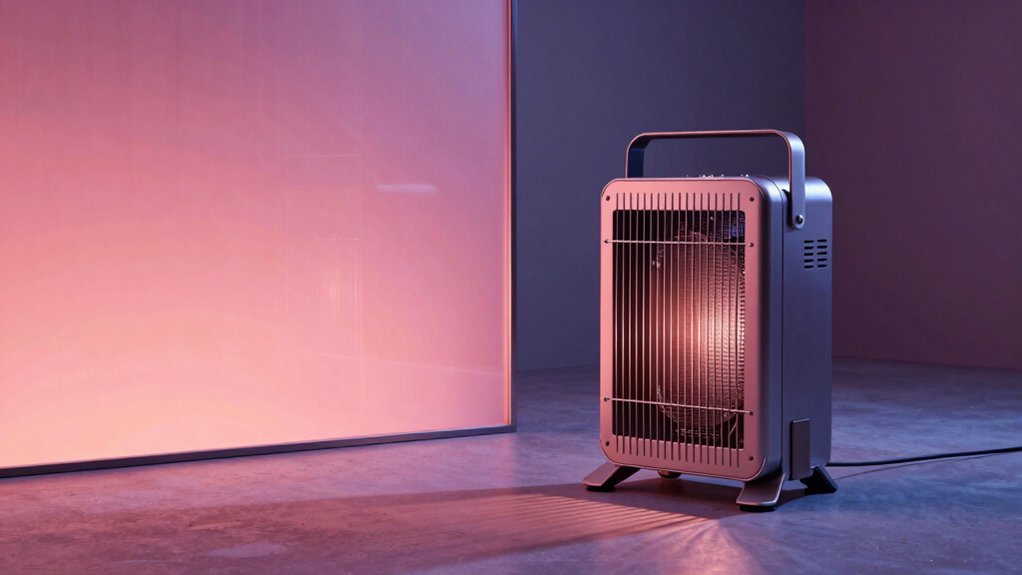
Infrared and convection heaters differ in how they transfer heat and interact with space. You experience infrared heat as radiant energy emitted by a surface, warming objects directly without relying on air movement.
Convection heaters warm the surrounding air, creating a buoyant plume that circulates warmth through the room. Infrared targets occupants and objects at line-of-sight, producing localized comfort while minimizing initial air stratification.
Convection relies on air as the primary medium, promoting uniform temperature distribution but potentially increasing drafts and heat loss through open spaces.
Efficiency, response time, and heat dissipation paths diverge: infrared converts electrical input to radiant energy with minimal airflow, whereas convection converts energy into circulating air, enhancing uniformity at the expense of faster heat loss via ventilation.
How Each Type Delivers Heat to People and Space
You’ll see infrared heaters warm people and objects directly through radiant transfer, while convection units heat the air, creating a moving temperature gradient.
This first look connects Heat Transfer Mechanisms with Comfort Delivery Dynamics, showing how each type prioritizes rapid warmth, surface feel, and sustained ambient comfort.
Heat Transfer Mechanisms
Heat transfer mechanisms differ for infrared and convection heaters. You experience heat delivery differently: infrared systems emit radiant energy that travels through space and warms objects and bodies directly, reducing ambient air temperature changes.
Convection units heat the air, creating a circulating flow that transfers heat to surfaces and occupants through air movement. Infrared efficiency hinges on emissivity, wavelength, and line-of-sight; reflections and selective absorption influence reach and uniformity.
Convection effectiveness depends on heating element placement, ducting, and room air stratification, which can yield uneven distribution if airflow patterns are disturbed. You should expect faster perceptual warmth from infrared when objects dominate the environment, while convection yields steadier air temperatures with broader coverage.
Both rely on thermodynamic principles, yet their transfer pathways differ fundamentally in medium and trajectory.
Comfort Delivery Dynamics
When you compare infrared and convection systems, you’ll notice distinct delivery patterns shaped by their physics: infrared transfers energy directly to objects and people along line-of-sight, creating rapid warmth where exposure occurs, while convection circulates heated air to raise ambient temperatures and create a more uniform thermal field.
In practice, infrared feels immediate but localized, with intensity declining with distance and obstruction. Convection delivers more evenly across space, offset by slower onset due to air heating and mixing dynamics.
Infrared efficiency depends on surface emissivity, angle, and exposure; occupied zones receive direct flux, reducing reliance on room air temperature. Convection efficiency hinges on airflow distribution, heater placement, and thermal stratification.
Overall comfort hinges on exposure patterns, task intensity, and occupancy distribution, balancing rapid localized warmth with uniform ambient conditions.
Pros and Cons: Infrared vs Convection for Spot vs Whole-Room Heating
Infrared and convection heaters each have distinct strengths and limitations for spot vs whole-room heating.
For spot heating, infrared delivers rapid, targeted warmth with minimal air movement, so you feel direct heat without circulating dust or allergens. Convection, though slower to respond, creates consistent warmth by circulating air, reducing cold spots when warm air accumulates unevenly.
Whole-room performance favors convection, which blankets the space through sustained air exchange, but may warm empty areas less efficiently if poorly sized or positioned. Infrared excels in zone control, offering immediate comfort where people sit or work.
Consider operating costs: infrared’s static heat concentrates energy delivery, while convection spreads heat, potentially lowering surface temperatures but increasing energy usage during extended cycles. Both systems benefit from proper sizing and placement.
Energy Efficiency: Which Heats Smartest Over Time
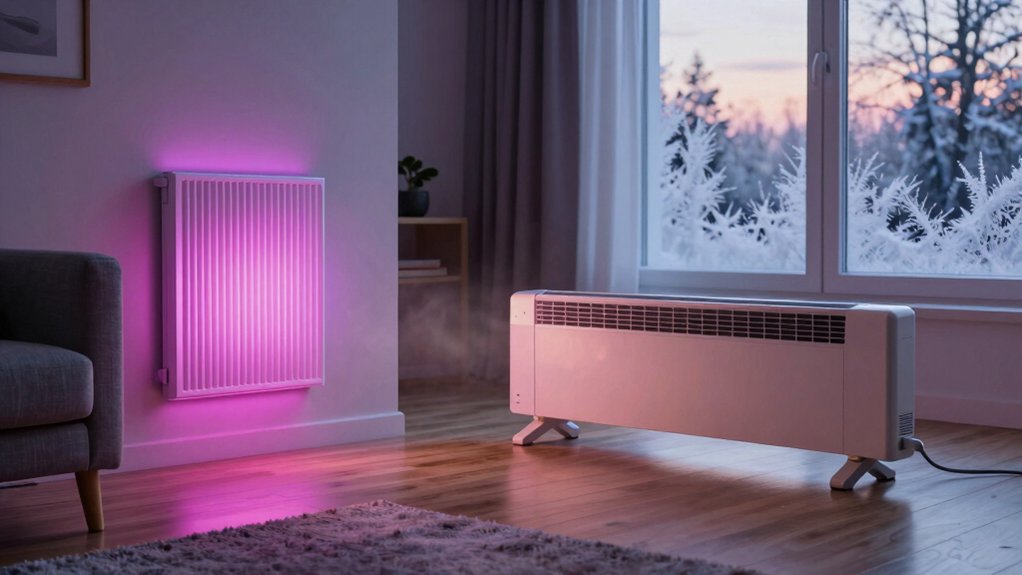
Choosing the smarter option over time depends on how each system converts electricity into usable heat and how that heat is delivered and retained. Infrared heaters convert electrical power into radiant energy that directly warms objects and people, reducing energy lost to air if spaces are variable or intermittently occupied.
Convection heaters circulate heated air, producing more uniform room temperatures but with ongoing standby losses and potential heat stratification. Over time, infrared can minimize heat losses in short occupancy windows, while convection sustains comfort with continuous operation in larger, constant-use spaces.
Efficiency metrics must account for thermostat control, load factor, and insulation stability. Consider system response time, cycling frequency, and thermal inertia.
In total, energy efficiency hinges on matching heat delivery mode to occupancy pattern and enclosure quality.
Practical Use Cases: When to Choose Infrared or Convection
Infrared use cases are most effective for spot heating, direct warmth, and uninsulated or draft-prone zones where you need fast, targeted output.
Convection contexts excel in whole-room comfort, consistent ambient warmth, and spaces with airflow distribution challenges that benefit from gradual temperature rise.
In practice, you’ll choose infrared for quick, localized comfort and convection for uniform, long-duration heating across a controlled space.
Infrared Use Scenarios
When deciding between infrared and convection heating, you should match the energy delivery method to the space and task at hand: infrared excels for spot heating and long-range warmth in spaces with unobstructed lines of sight, while convection distributes heat more evenly through air movement in enclosed areas.
Infrared use scenarios prioritize direct radiant transfer to targets, minimizing thermal lag and ambient loss. Select infrared for heating occupied zones with minimal furnishings, outdoor adjuncts, or machinery enclosures where rapid, localized warmth is required.
Evaluate line-of-sight reliability and surface emissivity to predict performance. Conduction from nearby objects can augment radiant effectiveness, but misalignment reduces efficiency.
For transient occupancy or high-ceiling rooms, infrared offers immediate comfort without conditioning the entire volume.
Finally, assess safety, control integration, and maintenance implications for sustained operation.
Convection Heating Contexts
Convection heating excels in enclosed spaces where air movement can uniformly distribute warmth, making it the practical choice for occupied rooms with furniture, occupants, and moderate to high ceiling height.
You evaluate thermal mass, air exchange, and surface temperatures to predict comfort outcomes.
In smaller, draft-prone areas, convection minimizes dead zones by circulating air continuously, offsetting localized cold spots.
For rooms with low ceiling height, expect quicker response but potential stratification near ceilings, requiring targeted airflow management.
When you prioritize even temperature profiles over fast heat-up, convection provides stable baselines with lower surface temperatures on furnishings, reducing burn risk and nuisance heating.
You’ll select this method for hallways, offices, and open-plan layouts where repeated occupancy patterns demand consistent, controlled warmth.
Safety and Maintenance You Should Know
To guarantee safe operation, understand the common failure modes and routine maintenance tasks for infrared and convection heaters, then implement a regular inspection schedule.
You should check electrical connections for looseness, corrosion, and signs of overheating. Inspect heating elements or emitters for pitting, coating degradation, or glazing that reduces efficiency. Verify thermostat and control wiring respond accurately across the operating range.
Clean vents, grills, and fins to prevent airflow restriction that elevates temperatures and shortens life. Test safety interlocks, overheat sensors, and circuit protection, replacing components that show drift or damage.
Monitor mounting hardware for vibration-induced loosening. Track runtime hours and perform filter changes, if applicable, per manufacturer recommendations.
Document inspections, repairs, and replacements to support traceability and predictive maintenance.
Operating Costs: Real-World Cost Comparisons
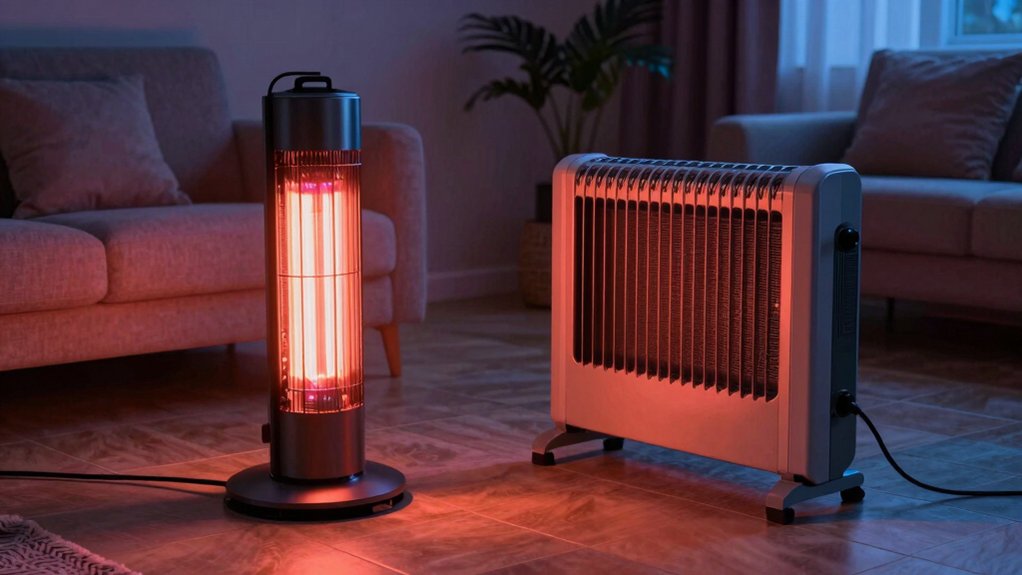
While operating costs are influenced by climate and usage, infrared and convection heaters show distinct cost profiles driven by efficiency and maintenance needs. In practice, infrared units convert electricity to radiant heat with minimal standby loss, so annual energy use can be lower for localized heating, reducing skews from air stratification.
Convection models circulate air, delivering broader space heating but typically incur higher continuous fan and heat-up energy, increasing hourly operating costs in the same space. Maintenance costs differ: infrared elements tend to have longer service intervals and fewer moving parts, while convection units rely on fans and filters, adding scheduled upkeep.
Electricity price sensitivity matters: kilowatt-hour costs dominate, but insulation, setpoint strategies, and usage patterns substantially influence total expenditures for both technologies. Overall, real-world costs hinge on load density, occupancy, and thermal envelope performance.
Buying Guide: Features to Compare in Each Type
When comparing infrared and convection heaters, start by identifying the heating goal and space layout, since infrared excels at targeted, zone-specific heat while convection delivers more uniform, whole-room warmth.
In this buying guide, focus on core features: heat delivery method, response time, and thermal output consistency. For infrared, assess wavelength bands, emitter types (ceramic vs. quartz), and radiant efficiency, noting how surface temperature and glare affect comfort.
For convection, compare airflow design, fan noise, and heat distribution patterns, including thermostatic control and setback accuracy.
Evaluate safety features (tip-over, overheat, child lock), build quality, and enclosure materials. Consider control interfaces, remote access, and energy mode options.
Finally, prioritize maintenance needs, warranty terms, and compatibility with space specifications to inform a precise choice.
Decision Framework: Pick the Right Heater for Your Space
Evaluating your space means matching heating goals to each option’s strengths and limitations. To pick the right heater, identify room size, insulation quality, occupancy patterns, and heat-up requirements.
Infrared units excel at spot heating and quick warm-up for occupied areas, but they offer limited ambient warmth in unoccupied zones.
Convection models deliver more uniform air temperature across a room and better performance in drafty or large spaces, yet may take longer to reach comfort levels.
Consider operating costs, noise, and safety features, such as tip‑over and overheat protection.
Evaluate control options, including thermostats, scheduling, and remote access.
Finally, align your choice with usage scenarios: short, targeted warmth favors infrared; sustained, whole-room comfort favors convection.
Choose the option that minimizes heat loss and maximizes perceived comfort per watt.
Conclusion
In the glow of your room, you’ll feel heat where you want it, not wasted energy spreading thin. Infrared spots warmth like sunbeams on a granite countertop, while convection lifts the air to cradle you with steady comfort. Use infrared for targeted spots; convection for whole-room consistency. Weigh efficiency, cost, and safety, then balance immediate comfort against long-term bills. Choose the method that matches your space, your routines, and your energy goals. Your comfort, precisely tuned.