
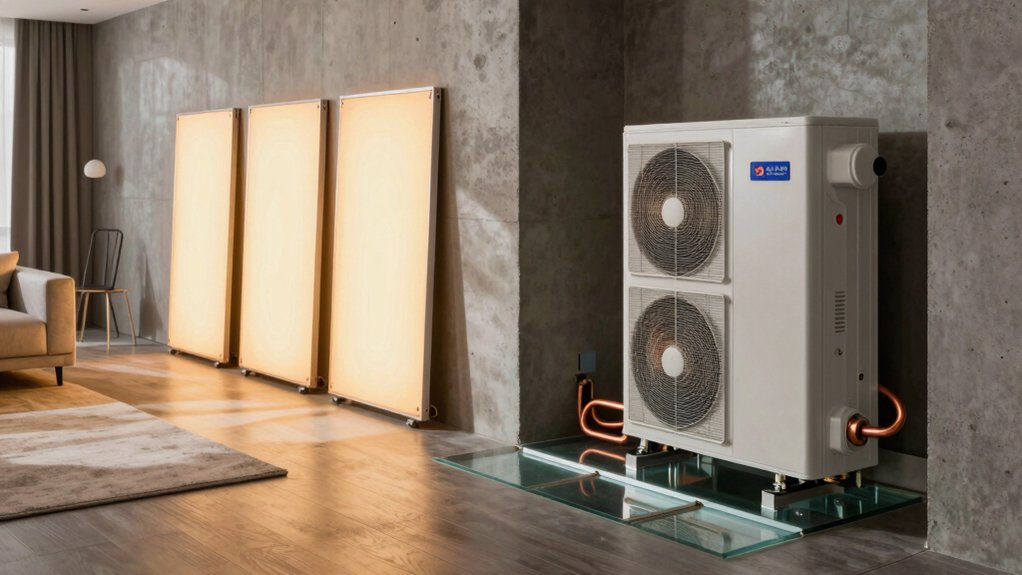
Infrared heating delivers rapid, targeted warmth by radiant energy, with simple installation and minimal disruption, but it offers less thermal buffering and depends on exposure, surface emissivity, and room layout. Ground-source heat pumps provide high efficiency and climate-stable comfort via buried loops, yet require substantial upfront investment and outdoor work. Infrared is best for small, well-insulated zones; GSHPs suit larger homes with steady heating and cooling needs. If you keep exploring, you’ll uncover how to choose based on cost, space, and climate.
What Infrared Heating Is and How It Works
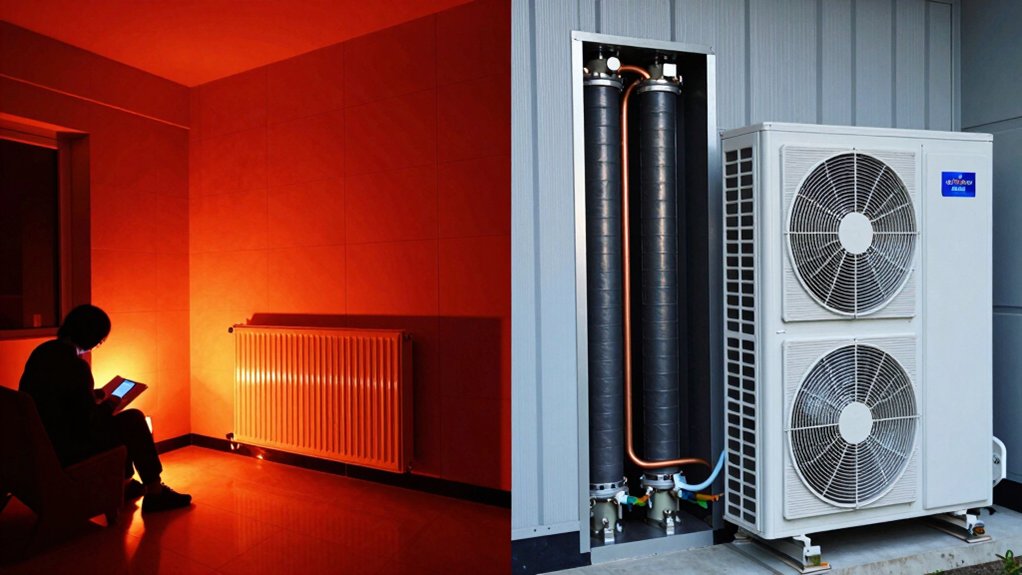
Infrared heating is a method that transfers thermal energy directly via radiant waves, rather than by warming air or surrounding materials. You observe a radiative emitter converting electrical energy into infrared photons, which propagate and deposit energy when they encounter objects with specific emissivity.
Heat transfer here is governed by the inverse-square law for distance and by surface properties, not bulk air convection. You experience warming primarily at the contacted surface or illuminated area, with temperature rise dependent on power density, duration, and material absorption.
System efficiency hinges on radiant spectrum alignment with target surface emissivity and on minimizing reflective losses, so installation geometry matters. In practice, infrared heating yields rapid, controllable surface heating, immediate perceived comfort, and reduced air movement compared with convective heaters.
How Ground-Source Heat Pumps Function in Homes
Ground-source heat pumps use a closed loop to exchange heat with the ground, starting with the ground-loop, which serves as the heat reservoir.
You’ll see how heat transfer occurs between the loop fluid and the refrigerant, enabling efficient extraction or rejection of thermal energy via the outdoor and indoor components.
This section outlines the key system components, the loop configurations, and the core steps in the heat transfer process.
Ground-Loop Basics
Ground-loop systems transfer heat between your home and the earth or groundwater through a network of buried pipes filled with a refrigerant or brine solution. These loops form either a closed, sealed circuit or, rarely, an open configuration depending on geology and design intent.
In closed systems, a circulating fluid absorbs ambient thermal energy from the ground at a stable temperature, then releases it inside via a heat exchanger. Pipe layouts vary: horizontal trenches, vertical boreholes, or pond loops, each chosen for soil conductivity, available space, and depth constraints.
You’ll encounter single- or double-loop configurations, with anti-freeze additives reducing liquid viscosity and preventing freezing. System efficiency hinges on loop length, fluid properties, and pump design, while pressure and temperature controls protect equipment and optimize performance.
Heat Transfer Process
Geothermal heat pumps move thermal energy between your home and the earth by circulating a working fluid through buried loops, so heat is absorbed from low-temperature ground in heating mode and rejected back to it in cooling mode.
The loop fluid absorbs latent soil and groundwater heat to raise its temperature, then transfers that energy to a refrigerant-side evaporator via a ground-loop exchanger.
In heating, a performance-mapped compressor raises the refrigerant’s temperature and pressure, enabling heat transfer to the indoor air via a cascaded condenser.
In cooling, the cycle reverses, extracting indoor heat and rejecting it to the ground.
Heat transfer efficiency is governed by temperature differential, loop design (horizontal, vertical, or pond), fluid properties, and ground thermal conductivity.
Accurate sensor placement and control logic minimize losses and maintain stable supply temperatures.
System Components Overview
A ground-source heat pump system centers on a closed loop, a circulating refrigerant and fluid network that exchanges heat with the earth and air through a heat pump unit. You assess components by function: the outdoor loop field, which absorbs subterranean or groundwater temperatures; the circulating pump, maintaining flow; the indoor heat pump module, which compresses and rejects heat; the desuperheater optional path for domestic hot water; and the distribution system, delivering conditioned air or water to living spaces.
Controls and sensors monitor temperatures, pressures, and flow, enabling sequence control and fault detection. System integrity relies on tight joints, leak testing, antifreeze management, and proper loop sizing. Maintenance focuses on pump operation, refrigerant charge, filter replacement, and validating heat exchange efficiency under seasonal loads.
Energy Efficiency: Comparing How Warmth Is Delivered

Infrared heating systems deliver warmth directly to occupants and objects, which can reduce overall energy use by minimizing heat loss from unheated spaces. In this comparison, you assess delivery mechanisms, thermal mass interaction, and transient response.
Infrared transfers energy via radiation, so the source efficiency translates quickly into usable comfort at occupied zones with limited wall or ceiling losses. GSHPs move heat through circulating fluids, trading distribution losses for high COPs across a broader area, but with reliance on ground temperatures and load matching.
You evaluate seasonal performance, peak demand, and control strategies, noting that infrared’s effectiveness hinges on exposure geometry and emissivity, while GSHPs depend on borefield capacity and system hydraulics.
Installation Footprint and Time: Infrared vs GSHP
When comparing installation footprint and time, infrared systems typically require minimal site disruption and faster deployment than ground-source heat pumps (GSHPs). You’ll install infrared panels directly onto walls or ceilings, avoiding trenching, boreholes, or ground works. This reduces permit considerations and surface preparation needs, enabling a mostly clean, indoor workflow.
GSHP installation demands substrate access for loop placement, borehole drilling, or horizontal trenches, plus outdoor unit placement; logistics expand with property size and soil conditions. With infrared, you can pre-fit panels or mats and commission in a single site visit, whereas GSHPs often require staged work, pressure testing, and system balancing after looping is complete.
Cost To Buy, Install, and Run Over Time
Initial capital costs for infrared heating are generally lower per unit of installed area due to the absence of boreholes, trenches, and outdoor plant equipment, though true totals depend on panel efficiency, coverage area, and mounting complexity. You evaluate upfront expenditure by panel cost, installation labor, and electrical infrastructure, noting infrared systems avoid drilling, cooling, and heat pump cores.
Over time, running costs hinge on efficiency, usage patterns, and electrical tariffs; infrared typically consumes electricity with steady heat delivery, while GSHPs leverage higher efficiencies but require energy for circulating fluids and maintaining groundwater loops.
Maintenance tends to be lower for infrared, with fewer moving parts, yet service life and replacement cycles of panels matter. When projecting total cost of ownership, model climate, occupancy, and control strategy to compare annualized energy expenses and capital amortization.
Suitability by Home Type and Climate
Despite differing installation requirements, suitability is highly contingent on home type and climate. Your assessment begins with space, insulation, and load distribution.
Infrared heating excels in well-insulated, smaller or zoned spaces where spot heating and rapid temperature responses align with occupancy patterns. It demands adequate surface area exposure and minimal thermal loss pathways to be cost-effective.
Ground-source heat pumps, by contrast, suit larger homes or retrofits with persistent heating loads across seasons, provided land or space supports loop installations and groundwater concerns are addressed.
Climate dictates efficiency: milder or variable temperatures favor moderate COP gains for GSHPs, while extreme cold reduces performance unless auxiliary systems are integrated.
System controls, thermal storage, and building envelope quality must be evaluated to avoid oversized or undersized configurations, ensuring stable comfort and predictable energy use.
Environmental Impact: Emissions, Resources, and Longevity
Infrared heating and ground-source heat pumps differ markedly in environmental footprint, affecting emissions, resource use, and longevity metrics. You assess emissions by lifecycle phase: manufacturing, operation, and end of life.
Infrared panels emit few direct pollutants during use, but production and disposal vary with materials and coating durability.
Ground-source systems incur substantial embedded energy from drilling and loop installation, yet operational emissions drop with electricity decarbonization.
Resource use hinges on materials and efficiency: infrared relies on industrial glass and resistive elements, while GSHPs depend on heat exchangers, boreholes, and refrigerants with potential leaks.
Longevity metrics favor GSHPs when properly installed, offering decades of stable performance but requiring monitoring for refrigerant integrity.
Infrared longevity concentrates on element aging and surface coatings.
Overall environmental impact shifts with electricity mix, installation quality, and maintenance practices.
Decision Framework: Which System Fits Your Priorities
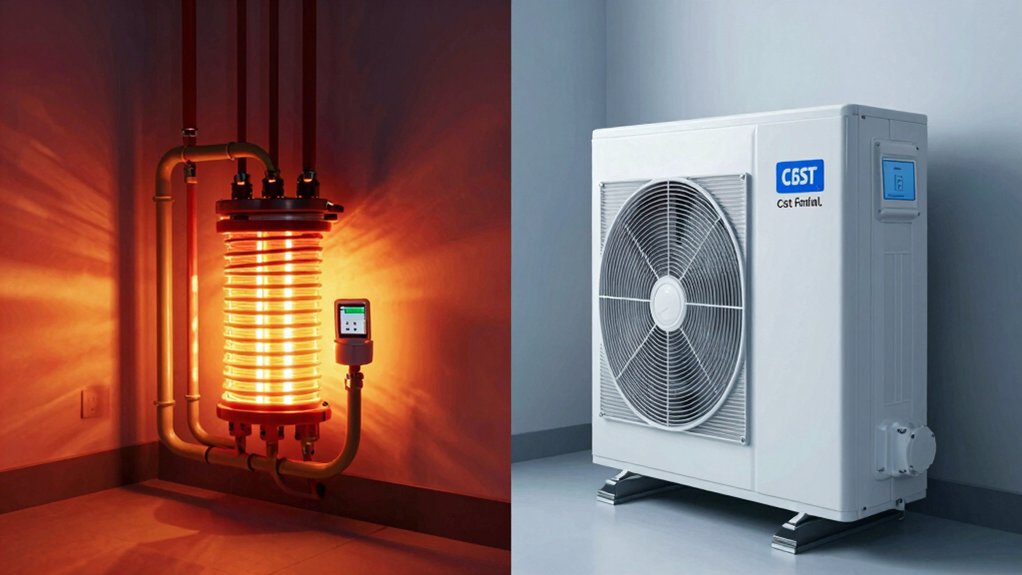
Choosing between infrared heating and a ground-source heat pump hinges on your priorities and site constraints: upfront cost versus long-term operating stability, maintenance requirements, and how you value flexibility across seasons.
You assess efficiency curves, load profiles, and climate variability to determine which system delivers predictable performance.
Infrared heating excels with rapid on/off control, lower install costs, and minimal indoor disturbance, but it trades off year-round efficiency and thermal buffering.
Ground-source heat pumps offer higher coefficient of performance, stable off-peak operation, and longer-term energy cost predictability, yet require boreholes or loops, upfront capital, and ongoing pump maintenance.
Your decision hinges on tolerance for capital expenditure, site feasibility, maintenance bandwidth, and desired seasonal resilience.
Map priorities to metrics: upfront, annualized cost, supplier warranty, upgrade paths, and service accessibility.
Conclusion
You want warmth you can feel instantly? Infrared is a quick flicker of comfort, like sunlight snapping to life on a cold day, but it forgets the long-term costs and energy diversity your home needs. Ground-source pumps sip steady energy from beneath, turning chill into a whisper of heat with scientific rigor. If you crave reliability, efficiency, and longevity, GSHP dominates; if you crave instantaneous coziness and simple install, infrared wins—until the next cold snap demands more.