
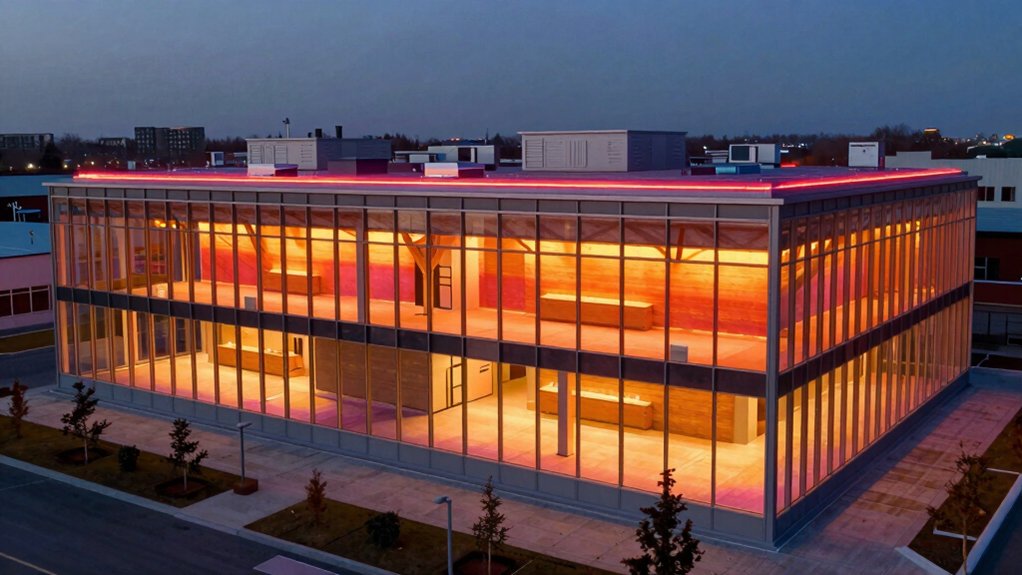
Infrared heating delivers targeted radiant warmth, cutting energy use and reducing ductwork, which helps you meet LEED energy targets and supports BREEAM, Living Building Challenge, and net-zero goals. It improves occupant comfort with localized heat, lowers peak electrical loads, and enables precise zoning aligned with performance prerequisites. By reducing embodied carbon through efficient materials and optimized panel density, it also enhances IAQ and simplifies commissioning. If you keep exploring, you’ll uncover practical integration and lifecycle benefits in detail.
How Infrared Heating Aligns With LEED Energy Targets
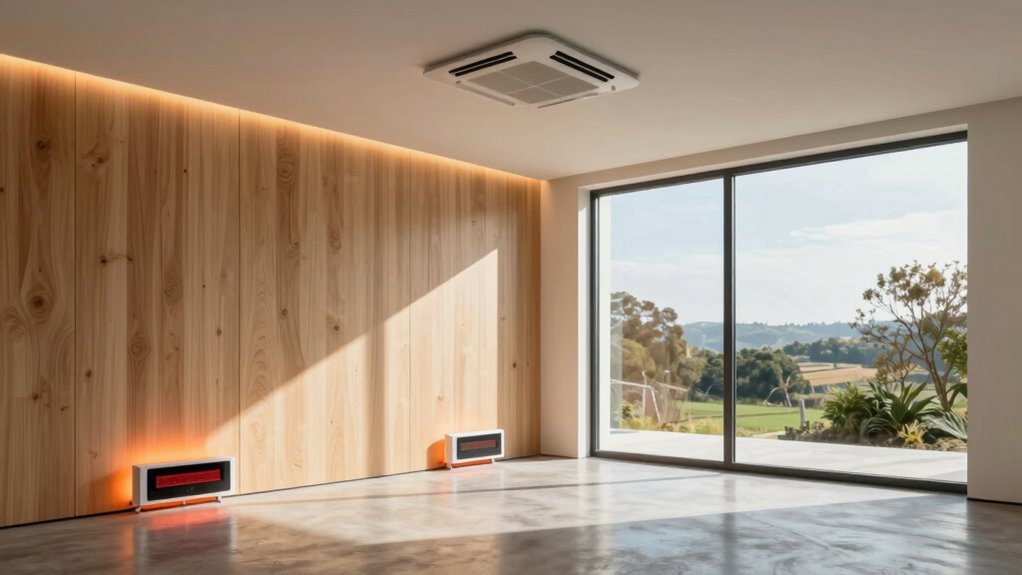
Infrared heating directly supports LEED energy targets by reducing source energy use and improving building envelope performance.
You optimize comfort with targeted radiant heat, lowering peak electrical loads while preserving daylighting and occupancy-driven needs.
By delivering heat to occupants and objects rather than solely to air, you minimize convective losses and mechanical ventilation demands, contributing to reduced HVAC runtime.
You can integrate infrared systems with zoning strategies that align with LEED’s energy performance prerequisites, enabling precise conditioning of occupied zones while avoiding over-conditioning unused spaces.
You’ll document system efficiency using measured input power, emission spectra, and thermal comfort metrics to satisfy performance credits.
You’ll also coordinate controls to maximize seasonal and occupancy adaptability, ensuring reliable energy savings without compromising occupant satisfaction or system resilience.
Reducing Embodied Carbon With Radiant Technology
Reducing embodied carbon with radiant technology hinges on material choices and system design that minimize manufacturing and lifecycle emissions. You select low‑embedded‑carbon conductors, insulation, and structural components, prioritizing recycled or recyclable materials with verified Environmental Product Declarations.
You optimize panel density and spacing to reduce overall material mass without sacrificing performance. You evaluate power electronics for efficiency and long service life, since wasted energy drives embodied impacts indirectly through production, transport, and end‑of‑life processing.
You model cradle‑to‑grave footprints early, iterating on module sizes, mounting methods, and grid‑integration strategies to lower embodied emissions. You balance radiant efficiency, operating temperatures, and control strategies, ensuring that higher upfront costs yield proportional lifecycle savings.
You document results for transparent lifecycle accounting and supplier due diligence.
Enhancing Indoor Comfort for BREEAM Certification
You’ll align indoor comfort strategies with BREEAM criteria to support certification readiness. By focusing on Indoor Comfort Optimization and BREEAM Comfort Alignment, you’ll balance thermal, acoustic, and surface comfort targets with energy efficiency requirements.
This discussion starts with measurable comfort metrics and clear performance thresholds linked to BREEAM credits.
Indoor Comfort Optimization
Indoor comfort optimization focuses on aligning thermal, visual, and acoustic conditions with occupant needs to support BREEAM criteria. You assess how infrared heating interacts with occupant zones, ensuring uniform temperatures without overshoot or cold spots.
You monitor sensible and latent loads to maintain acceptable draft, glare, and noise levels, balancing radiant comfort with HVAC operations. You select control strategies that respond to occupancy, time of day, and equipment schedules, minimizing energy use while preserving perceived comfort.
You implement localized heating in workstations and common areas to reduce thermal gradients, enabling faster setpoint stabilization after occupancy changes. You document performance metrics, such as thermal comfort indices, luminance levels, and acoustic measurements, demonstrating alignment with BREEAM comfort requirements and overall retrofit or new-build project goals.
BREEAM Comfort Alignment
How does aligning thermal comfort, lighting, and acoustics with BREEAM criteria improve indoor environments? You evaluate how radiant heat interacts with surface temperatures, preventing cold spots and drafts while maintaining required comfort ranges. Infrared systems deliver rapid, uniform warmth with low air movement, reducing thermal discomfort during occupancy shifts and peak loads.
You synchronize lighting levels and glare control with occupied hours, supporting circadian needs without compromising energy efficiency. Acoustic performance follows by selecting materials and layouts that minimize sound transmission and reverberation, enhancing perceived comfort.
You document performance against BREEAM metrics for thermal, acoustic, and lighting criteria, enabling a transparent path to certification. You adopt measurement protocols, validate occupant comfort surveys, and iterate system settings to sustain ongoing compliance.
Infrared Zoning to Support Living Building Challenge Goals
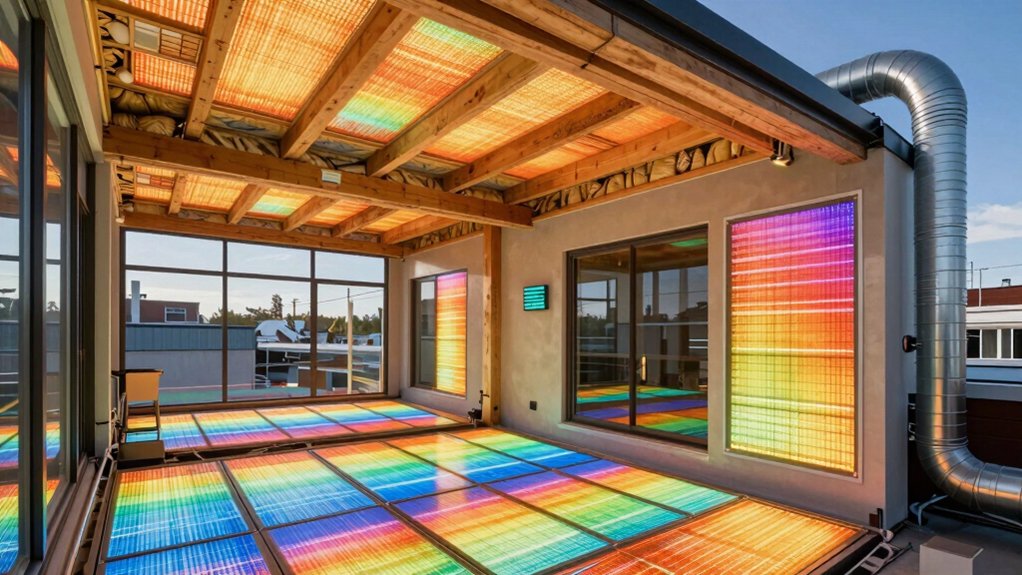
Infrared zoning supports Living Building Challenge goals by aligning thermal comfort, energy use, and indoor environmental quality through targeted, low-temperature radiant strategies.
You implement zoning to tailor heat delivery to occupancy patterns, room functions, and solar gains, reducing overshoot and standby losses. By separating spaces with distinct schedules and loads, you minimize unnecessary heating in unoccupied zones while maintaining immediate comfort at points of use.
You leverage wall, floor, or ceiling emitters to create consistent surface temperatures, avoiding hot air stratification and drafts. This approach enhances IAQ by lowering airflow requirements and enabling tighter control of humidity alongside temperature.
You document performance targets, monitor occupant feedback, and adjust setpoints to sustain efficiency without compromising perceived comfort.
Integrating Infrared With Renewables for Net-Zero Design
Integrating infrared with renewables enables net-zero design by aligning radiant heat delivery with variable solar and storage resources. You leverage infrared timetables to match heating demand with PV output and battery discharge, smoothing grid impact.
Use zone controls that respond to real-time solar forecast data and ambient conditions, ensuring radiant panels heat spaces during peak sun while storage covers evening needs. You’ll size emitters and control logic to minimize peak generation imports, prioritizing self-consumption and load shifting.
Integrate feedback from building energy models to tune emissivity, setback routines, and occupancy-adjusted schedules for *ideal* match to renewable availability. You’ll document performance metrics, such as seasonal COP improvements and reduced fossil-fuel usage, to verify net-zero alignment.
This approach preserves comfort, minimizes ductwork dependence, and supports grid resilience.
Minimizing Ductwork and Improving Air-Quality Credits
You’ll explore how duct-free air delivery can boost system efficiency and reduce leakage paths. Consider how air-quality credits respond to fewer duct joints, sealed distribution, and localized control of indoor air.
Expect quick gains in thermal comfort and reliability from streamlined layout and targeted ventilation aligned with the Duct-Free Air Benefits, Air-Quality Credits Impact, and Thermal Comfort Gains points.
Duct-Free Air Benefits
Duct-free design minimizes the distribution network, reducing material costs and energy losses while supporting tighter building envelopes. You benefit from simpler installation, fewer failure points, and lower maintenance compared with traditional ducted systems.
With infrared heating integrated near occupant zones, you eliminate long duct runs that cause thermal stratification and pressure imbalances, improving steady-state performance. You gain faster response times and more uniform temperatures because infrared emitters directly heat surfaces and occupants, not air.
In compact or retrofit projects, the reduced air leakage pathways contribute to airtightness targets and lower ventilation loads. You’ll simplify commissioning and ongoing operation, since control strategies can synchronize heating with occupancy, weather, and shading.
Air-Quality Credits Impact
Could minimizing ductwork improve indoor air quality credits? Yes, it reduces surface area for dust and microbial growth, cutting filter loads and blower energy.
With infrared heating, you can decouple thermal zones from air movement, limiting unnecessary air exchange and unnecessary contaminants entering occupied spaces. This approach lowers ventilation requirements without compromising comfort, provided you maintain proper filtration and occasional fresh-air make-up aligned with code.
Fewer ducts also diminish leak pathways, improving overall IAQ predictability and traceability for commissioning. When duct-related emissions or contaminants are minimized, you gain credits tied to reduced particulate carryover and improved occupant exposure.
Implementing robust control strategies and validated filtration ensures that IAQ credit criteria are met while preserving energy performance and system reliability.
Thermal Comfort Gains
Minimizing ductwork not only reduces emissions and error paths but also enhances occupant thermal comfort when paired with infrared heating.
With reduced air handling, you experience more uniform surface temperatures and fewer temperature swings, especially at occupied zones. Infrared panels deliver radiant heat directly to occupants and objects, enabling lower supply-air temperatures and improved perceived warmth without drafts.
You’ll notice faster acclimation after changes in load and occupancy, which supports stable comfort during varying schedules. The streamlined system lowers noise and eliminates conventional duct thermal losses, contributing to more precise control and fewer cold spots.
Combined with improved air filtration and targeted conditioning, this approach supports thermal comfort while aligning with green-building credits for energy efficiency and indoor air quality.
Cost Optimization and Lifecycle Benefits for Green Buildings
Cost optimization and lifecycle benefits in green buildings hinge on aligning upfront choices with long-term performance. Infrared heating contributes by reducing cooling and heating loads through targeted, radiant warmth, which lowers energy expenditure and equipment cycling.
When you model energy performance early, you can size systems to match actual demand, avoiding overspecification that inflates capital costs. Lifecycle cost analysis favors materials and controls that maximize efficiency, reliability, and maintenance intervals, yielding lower total cost of ownership.
You’ll gain predictable energy budgets, improved occupant productivity, and resilience to occupancy shifts. Operational savings compound with rebates and performance-based incentives tied to measurable standards.
Infrared systems, when integrated with envelope improvements and smart controls, deliver durable, low-variance savings, supporting ongoing compliance with green-building criteria and stakeholder return on investment.
Practical Case Study Roadmap: From Design to Commissioning
A practical case study roadmap from design to commissioning builds on early energy modeling and lifecycle insights to guarantee infrared heating is sized, integrated, and validated before construction begins.
You begin with a design brief that anchors performance metrics to green standards, then translate them into an infrared strategy.
In design phases, you map load profiles, surface temperatures, and control sequences, ensuring equipment selection aligns with building envelope performance.
During documentation, you detail integration with mechanical, electrical, and controls systems, including commissioning protocols, safety checks, and rollback plans.
Construction teams execute with traceable acceptance criteria, while commissioning verifies steady-state and dynamic responses under simulated occupancy.
Finally, you close with post-occupancy performance tracking and a feedback loop to refine models, maintaining compliance and operational efficiency for lifecycle benefits.
Conclusion
Consider infrared influence in your project: precise performance, placed panels, powered plaisir—practical, proven, pioneering. Pairing radiant radiance with renewable readiness reduces risks, revises budgets, and reinforces ratings. This targeted technique trims ducts, chillers, and carbon while boosting comfort, compliance, and creativity. With careful commissioning, you’ll witness measurable metrics, resilient results, and streamlined stakeholder buy-in. Infrared integration inspires innovation, delivering sustainable spaces that satisfy standards, support certifications, and strengthen your building’s green footprint.