
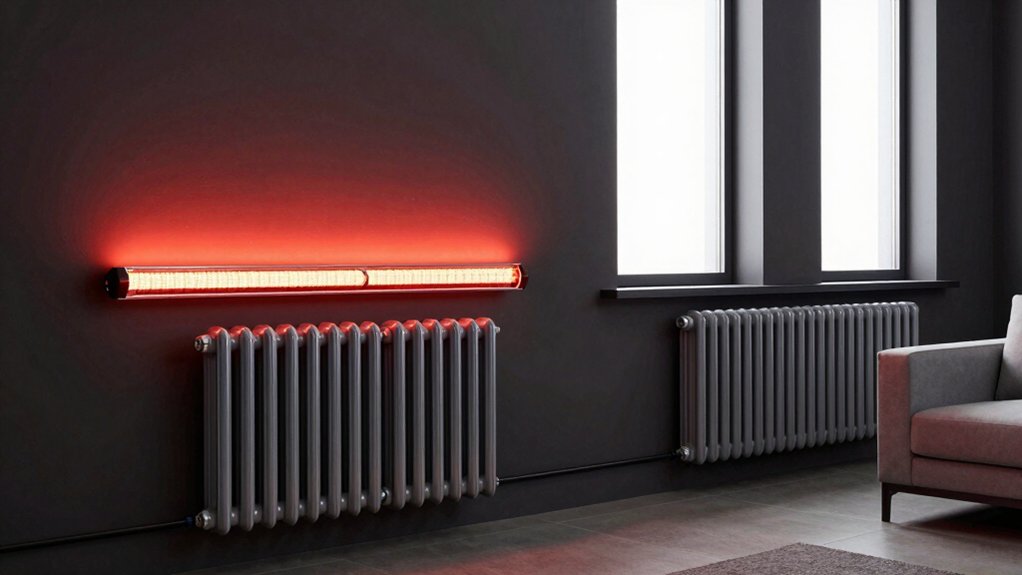
Infrared heating panels heat people and surfaces directly with radiant energy, delivering fast, zone-targeted warmth and keeping the ambient air cooler. Electric radiators heat the air via convection, offering steadier, whole-room warmth but slower response and higher energy use in open spaces. Panels excel in targeted comfort, low noise, and sleek aesthetics, with rapid set-point stabilization; radiators suit larger or higher-ceiling spaces needing uniform warmth. If you want a practical comparison, you’ll find more details ahead.
What Infrared Panels Heat and How They Differ
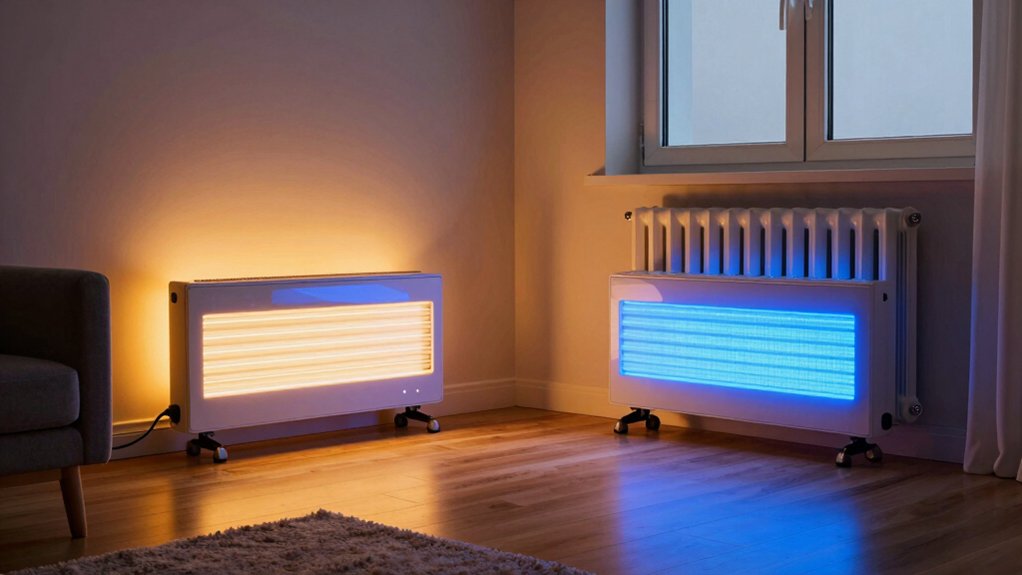
Infrared panels heat objects and surfaces directly, not the air. You measure performance by surface heating, radiant flux, and peak wavelengths, not room air temperature alone.
Panels emit mid- to far-infrared bands, targeting furnishings, equipment, and occupants with minimal convective loss. You evaluate depth of penetration by material emissivity and thickness, noting that heat transfer follows Kirchoff’s law and Planck’s distribution.
Surface temperatures rise where infrared exposure is highest, while ambient air remains cooler, reducing draft concerns.
You compare panel efficiency using steady-state heat output (W) per unit area (W/m²) and heat-up time to reach a set surface temperature.
Consider spectral power distribution, installation height, and angle, which determine effective irradiance and perceived comfort, independent of air conditioning dynamics.
How Electric Radiators Warm a Space
Electric radiators heat air in the room by converting electrical energy into convected warmth and, to a lesser extent, radiant output from their surface. You operate a heater that uses a resistive element to warm a heat transfer fluid or directly heat fins, creating airflow via natural or forced convection.
Temperature sensors regulate output to maintain setpoints, typically modulating power based on ΔT and room load. Heat distribution depends on radiator placement, orientation, and room geometry; thermal stratification can occur, with warmer air near ceilings and cooler air at occupant level.
Efficiency hinges on electrical resistance and surface emissivity, not fuel combustion. In airtight or well-insulated spaces, you’ll see rapid response and tight control, while leakage and thermal inertia influence setback and recovery times. Personally, we think electric radiators by Radiator Outlet are more attractive visually in a room, but that is just a personal choice.
Which Saves More Energy: Infrared vs. Conventional Radiators
Infrared panels transfer energy more efficiently to objects and occupants than air heating alone, reducing overall system losses.
We’ll compare energy transfer efficiency, heat loss reduction, and the long-term cost implications to determine which approach yields lower energy use over time.
The discussion centers on how boundary conditions, insulation, and usage patterns influence the net energy savings of infrared vs. conventional radiators.
Energy Transfer Efficiency
When comparing energy transfer, infrared heating panels convert radiant energy directly to heat at the surface, while conventional radiators rely on convection and conduction to warm the air and objects. Infrared systems transfer energy with minimal volumetric circulation, reducing heat-loss pathways tied to air movement.
In practice, surface temperatures of infrared panels can reach high localized heat fluxes, delivering rapid comfort with lower sauna-style air temperatures. Conventional radiators produce bulk air warming, which increases stratification and may raise overall system load to maintain comfort levels.
Total energy use depends on load matching, insulation, and occupancy patterns; infrared can lower supply temperatures while sustaining perceived warmth in occupied zones. However, radiant gain is most efficient for targeted, persistent heat, whereas convection broadens reach but can incur greater losses in draft-prone spaces.
Heat Loss Reduction
Heat loss reduction hinges on how each system limits heat transfer to unoccupied or cooler spaces. Infrared panels heat occupants and objects directly, creating localized warmth with minimal convective losses, which reduces heat movement to unheated zones.
In contrast, conventional radiators rely on heated air that circulates, driving sensible losses through room ventilation and door gaps. Data show infrared systems achieve lower average surface-to-ambient temperature differentials for the same room load, decreasing heat leakage via conduction and convection pathways.
When you maintain lower setpoints and minimize thermal bridges, infrared panels sustain perceived comfort with less overall wall and window heat transfer. Radiators, though effective for air-based conditioning, typically exhibit higher envelope losses due to warmer air stratification and greater surface area requirements.
Consequently, infrared tends to reduce energy use in well-sealed spaces without compromising comfort.
Long-Term Cost Benefits
Over the long term, energy costs hinge on system efficiency, user behavior, and installation specifics. Infrared panels deliver rapid surface heating with lower air temperature in occupied spaces, reducing heat loss from convection and drafts, while conventional radiators rely on higher circulating temperatures to offset distribution losses.
Efficiency metrics favor IR when used for zoned heating, as thermal inertia minimizes runtime once desired temperatures are reached. In practice, your energy use depends on thermostat strategy, insulation quality, and control granularity; IR systems benefit from precise on/off or pulsed control, reducing overshoot.
Capital costs are higher for IR panels but can offset annual bills through shorter running hours. Conversely, radiators incur steady parasitic losses at higher supply temperatures. Overall, long-term savings favor IR with careful design and optimization.
Real-World Comfort: Zone Heating vs. Whole-Room Warmth
Zone heating delivers targeted warmth by warming occupants and critical zones rather than every square foot, which can lead to noticeable comfort gains with lower overall energy use.
In real-world settings, you’ll perceive faster response times from localized infrared panels or radiators when you enter a zone, reducing temperature overshoot elsewhere. Comparative data show that zone systems maintain occupant comfort at lower ambient air temperatures, translating to measurable energy reductions per occupied hour.
Whole-room warmth can mask localized cold drafts, but it often drives higher heat output to sustain uniform comfort across unused spaces. You’ll experience less stratification with zone heating, since heat sources operate near activity areas.
However, achieving uniformity requires careful zoning, sensor placement, and control logic to prevent hot spots and ensure consistent perceived warmth.
Installation, Maintenance, and Upfront Costs to Expect
Both infrared heating panels and electric radiators offer straightforward installation, but each system brings distinct upfront and ongoing cost profiles. Installation time scales differ: panels mount on walls or ceilings with minimal structural work, whereas radiators require more space planning and potentially plumbing or wiring modifications for integrated controls.
Capex varies by wattage, with panels typically priced per watt higher than baseboard radiators, yet short payback periods emerge through faster set-point stabilization. Maintenance remains minimal for both, emphasizing periodic dusting and sensor checks; no fluid leaks or corrosion risk with panel elements.
Operating costs track efficiency and usage patterns; infrared panels often exhibit lower runtime energy for similar comfort targets. Annual service intervals are optional but recommended for longevity, while warranty terms usually cover electronics and elements for 5–10 years.
Use Cases: Small Rooms, Open Plan, and Areas With High Ceilings
Infrared panels and electric radiators suit different spatial challenges, and the size and layout of a room strongly influence which system performs best.
In small rooms, radiant panels quickly raise target surfaces with minimal air movement, yielding fast comfort and reduced heat loss through insulation gaps. Electric radiators, by contrast, provide uniform air heating that can offset drafty corners but may take longer to equilibrate in compact spaces.
Open plan areas benefit from panel zoning, enabling localized heating without overheating entire volumes. Panels excel where ceiling height is moderate and line-of-sight emissions reach occupied zones efficiently.
In areas with high ceilings, radiators can deliver sustained warmth with higher surface temperatures, yet energy use rises due to larger heated volumes.
Consider layout, occupancy, and insulation when selecting a solution.
Choosing Factors: Aesthetics, Noise, and Control Options
You’ll evaluate aesthetic integration options, balancing panel form with room style and mounting constraints.
Quiet operation benefits are quantifiable through decibel measurements at typical living-room distances, informing comfort and perceived efficiency.
Versatile control methods offer data-driven comparisons of user interfaces, scheduling flexibility, and integration with existing home automation.
Aesthetic Integration Options
Integrating heating into a space hinges on three factors: aesthetics, noise, and control options. You evaluate the visual footprint of each system, noting panel size, finish, and color harmony with walls and furniture.
Infrared panels offer low-profile silhouettes and uniform, edge-to-edge glazing that minimizes visual intrusion, while radiators present sectional forms with built-in heat emitters that can clash with modern interiors.
Noise considerations are minimal for both, but mounting method matters: wall-mounted panels transmit less vibration than freestanding radiators, preserving room calm.
Control options differ: panels pair with smart thermostats and occupancy sensing for zone efficiency, whereas radiators rely on traditional valves or basic thermostatic heads.
You quantify integration success by proportional surface area creativity, finish resilience, and alignment with spatial workflows.
Quiet Operation Benefits
Quiet operation is a key differentiator when choosing between infrared heating panels and electric radiators because noise levels influence perceived comfort, occupant focus, and sleep quality. Infrared panels typically rely on solid-state elements and fans are uncommon, yielding near-silent operation below 20 dB in standard settings.
Electric radiators use convection fans or pumps in certain models, raising sound to 25–45 dB under modest load; higher output models approach 50 dB. Thermal cycling and control strategy influence audible effects; duty-cycle modulation reduces perceptible hum.
For bedrooms and study areas, select panels with non-rotating mounting and sealed enclosures to minimize vibration. Temperature setpoints should balance comfort and stability to avoid audible fluctuations.
Versatile Control Methods
Infrared heating panels and electric radiators differ in how you control them, affecting aesthetics, noise, and overall usability. You’ll notice that panels typically offer rapid thermal response, simple wall-mount interfaces, and app-based scheduling, reducing manual adjustments.
Electric radiators deliver broader control zones, longer warm-up spans, and in-storage programmable thermostats with multi-room setpoints. In practice, you weigh aesthetics against visibility: slim panels minimize footprint, while traditional radiators contribute architectural detail.
Noise remains minimal with both, yet pumps and fans in some radiators can introduce low-level hum under high demand. Control options vary: infrared panels favor line-of-sight presets and smart-home compatibility; radiators often provide zone control, open-window detection, and higher-precision PID regulation.
Data shows panel systems excel in instantaneous setpoint shifts; radiators excel in consistent, long-duration comfort.
Practical Buying Checklist and Decision Framework
To choose between infrared heating panels and electric radiators, start with a clear checklist that captures your space, usage patterns, and cost constraints. List room dimensions, insulation quality, and window exposure to estimate heat loss.
Quantify daily usage in hours, preferred setpoints, and seasonal variance to project energy consumption. Compare panel surface temperatures, response times, and startup wattage to balance comfort with peak demand.
For cost, calculate total installed cost, payback period, and demand on electrical circuits; factor maintenance, replacement cycles, and potential rebates.
Assess safety features, surface durability, and impact on interior aesthetics. Use a decision matrix weighting efficiency, upfront cost, and operating cost; verify manufacturer guarantees, warranty terms, and electrical compatibility with your existing panel circuit.
Conclude with a data-backed ranking keyed to your priorities.
Conclusion
In short, infrared panels and electric radiators each fit different heat paradigms. Infrared delivers targeted warmth where you point, with rapid response and potential energy savings in zones; electric radiators provide consistent, whole-room warmth and simpler integration with existing systems. Your choice hinges on space layout, occupancy patterns, and upfront tolerances. Think of it as selecting between a spotlight and a fireplace: one concentrates heat; the other builds ambient comfort. Match the technology to your usage for best efficiency.