

You’ll test the theory that you can do more with less by prioritizing renovations that deliver the biggest payoff. Start by defining goals, identify pain points, and separate quick wins from long-term upgrades. Use a simple scoring system to weigh cost, impact, and urgency, then phase projects, get multiple quotes, and secure permits early. If you allocate wisely now, you’ll avoid overextending your budget—and the next decision point will be clearer.
Setting Clear Goals and Identifying Pain Points

Setting clear goals starts with defining what success looks like for your renovation and identifying the pain points that hinder progress. You map outcomes, not whims, then translate them into measurable targets: completion date, budget tolerance, and quality benchmarks.
Pinpoint bottlenecks—scope creep, unavailable trades, or unclear responsibilities—and document their impact on schedule and costs. You categorize goals by priority: must-haves vs. nice-to-haves, ensuring every decision aligns with your core objectives.
To maintain momentum, draft actionable milestones and assign owners. When considering DIY ideas, test feasibility against your timeline and skills, avoiding overreach that stalls progress.
Material selection becomes a leverage point, balancing durability, cost, and compatibility with existing systems. Clarity up front prevents backtracking and guides focused, cost-conscious choices.
Assessing Cost, Impact, and Urgency
Evaluating cost, impact, and urgency requires a disciplined, data-driven approach. You start by identifying all tangible and hidden costs, performing a rigorous cost analysis that covers procurement, downtime, and long-term maintenance.
Next, you quantify potential benefits and risks to gauge impact, conducting an objective impact assessment that links outcomes to resident wellbeing, energy use, or durability.
Establish clear urgency signals by mapping timing, dependency, and opportunity costs; differentiate “must-do now” items from “can wait” tasks. Use conservative assumptions and stress-test scenarios to prevent optimistic bias.
Rank projects by a composite score reflecting cost, benefit, and urgency, ensuring transparency with stakeholders. This disciplined method supports prioritisation decisions that maximize value under budget constraints and align with strategic goals.
Building a Simple Scoring Rubric for Prioritization
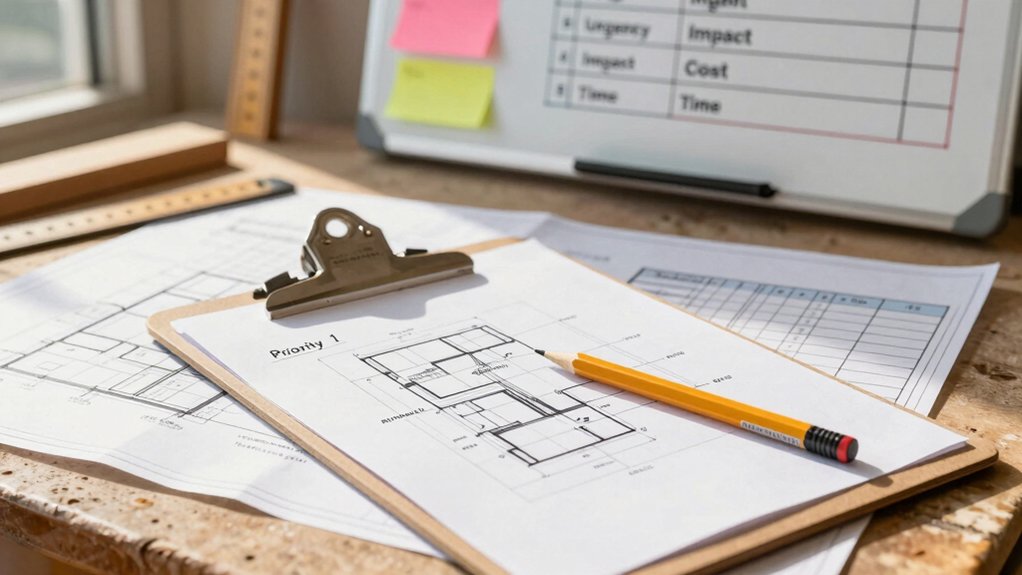
To build an effective prioritization framework, start from the disciplined data you already gathered on cost, impact, and urgency.
Build a simple scoring rubric that translates those inputs into comparable scores.
Assign clear scales (e.g., 1–5) for each criterion, with explicit definitions to avoid ambiguity.
Weight the criteria to reflect your constraints—cost often receives higher emphasis when funds are tight, while impact should reflect strategic value.
Calculate total scores for each project, and rank accordingly.
Use straightforward thresholds to categorize projects as high, medium, or low priority.
Involve stakeholders early to validate weights and interpretations; this is where stakeholder engagement adds rigor.
Incorporate creative strategies to adjust scores when new information emerges, ensuring the rubric remains practical, transparent, and decision-ready.
Planning for Quick Wins and Minimizing Disruption
You can kick off quick wins by selecting high-impact, low-disruption projects that mock up fast wins and build momentum. Start with a tight scope, focusing on tasks that yield visible improvements without displacing occupants or delaying core operations.
Map each win to measurable outcomes—costs saved, time reduced, or aesthetic uplift—and track progress daily. Prioritize designs that align with current design trends so changes feel modern yet economical, avoiding overinvestment in speculative features.
Your plan should minimize disruption through modular work, off-hours scheduling, and clear sequencing to prevent bottlenecks. When evaluating options, lean on contractor selection criteria that emphasize reliability, repeatable processes, and transparent timelines.
Document decisions succinctly, and reassess after each milestone to preserve momentum and prevent scope creep.
Budgeting, Quotes, Permits, and Phased Renovations

You’ll build on prioritizing quick wins by bringing budgeting, quotes, permits, and phased renovations into clear focus. In this phase, you align costs with outcomes, establishing a baseline budget, as-built timelines, and milestone gates.
Create a tight budgeting framework that differentiates essential versus optional work, enabling phased renovations without compromising safety or code compliance. Gather multiple quotes to benchmark pricing, interrogate inclusions, and surface potential value-adds.
Prioritize material selection that balances durability, cost, and availability to reduce rework and delays. Secure permits early, track approvals, and build contingencies for unforeseen expenses.
In negotiations with contractors, pursue clear scopes, defined pay schedules, and performance-based incentives. Document decisions succinctly to support accountability and avoid scope creep, ensuring projects advance on schedule and within budget.