

Efficiency and renewables aren’t competing sides. You reduce demand with efficiency, lowering bills and easing grid stress, while renewables cut fuel costs and emissions by supplying clean power. Together, they stabilize prices, improve reliability, and enable smarter grid operations through demand response and storage. Efficiency flattens peaks; renewables fill them with zero-fuel generation and local resilience. Balance investments with clear metrics, risk checks, and incentives. If you want practical paths, you’ll find more insights ahead.
What Efficiency and Renewables Do to Your Energy Bill
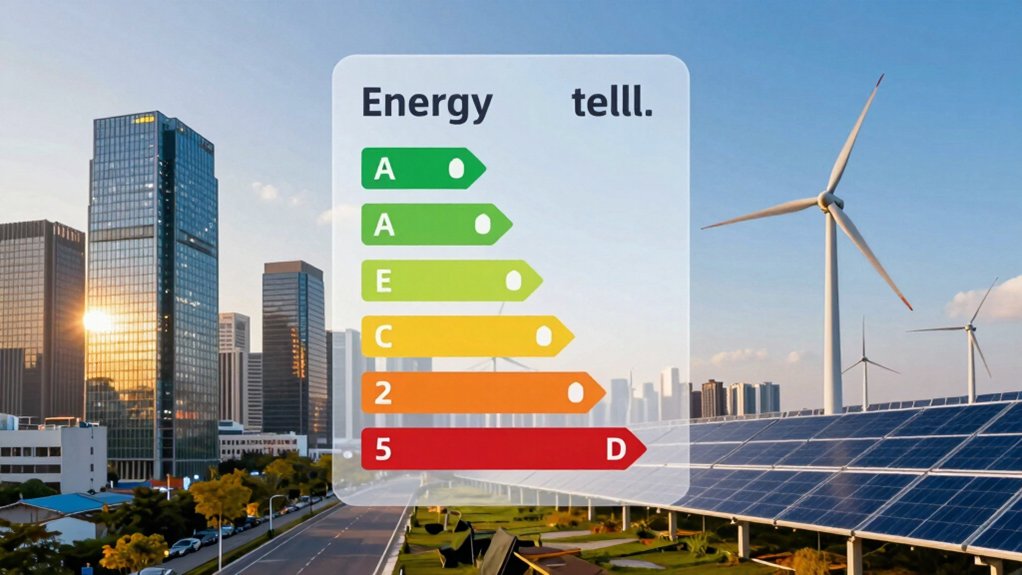
Improving efficiency or adopting renewables directly affects your energy bill by lowering the amount you pay for electricity and gas. You’ll see reduced consumption from efficient equipment and optimized usage patterns, which cuts base charges and per‑unit rates.
Renewables shift a portion of generation to zero‑fuel costs, stabilizing long‑term expenses even when energy prices spike. The result is a clearer, less volatile bill, with potential savings from demand reductions and time‑of‑use pricing.
Market incentives, such as rebates or tax credits, encourage upfront investments and faster payback. Policy impacts shape eligibility, implementation timelines, and grid integration requirements, influencing project costs and return periods.
You should quantify savings through a detailed assessment, accounting for equipment, installation, financing, and projected energy price scenarios.
The Basic Concepts: How Efficiency and Renewables Work Together
You’ll see how energy-intensive efficiency measures interact with supply from renewables, shaping overall system losses and consumption patterns.
Renewables complementarity dynamics create smoother demand when grids coordinate timing, capacity, and storage.
System-level efficiency gains emerge when device-level improvements align with grid design, operation, and market signals.
Energy-Intensive Efficiency
How do effectiveness and renewable sources reinforce each other when energy consumption is high? When you promote energy-intensive effectiveness, you decrease overall demand, which enhances the value proposition of renewables by reducing ramp pressures and signaling better capacity planning.
You’ll want strict control over equipment loads, real-time oversight, and highly efficient end-use devices to minimize waste during peak periods. Industrial decarbonization benefits from deploying high-efficiency processes that use less electricity without sacrificing throughput, enabling cleaner operation at scale.
Grid modernization supports this by improving measurement, visibility, and response times for demand-side management, allowing faster integration of variable generation. In this context, effectiveness functions as a stabilizing load counterpart to renewables, creating a lower, smoother peak and more dependable supply.
Renewables Complementarity Dynamics
Renewables complementarity rests on how efficiency and variable generation interact to shape demand and supply. You observe that efficiency reduces overall energy needs, while renewables introduce intermittency, so timing matters.
When generation exceeds immediate demand, grid constraints emerge unless flexibility mechanisms exist. You focus on grid integration as the structural link between variable output and reliable service, ensuring power flows align with approved thresholds and transmission paths.
Simultaneously, you consider storage solutions to bridge short-term gaps, smoothing protean renewable profiles into usable, continuous energy. This dynamic creates operational windows: high daytime solar can offset evening peaks, while wind ramps require rapid response.
You prioritize coordinated dispatch, forecasting accuracy, and demand response to sustain stable equilibrium without sacrificing efficiency gains.
System-Level Efficiency Gains
System-level efficiency gains arise when improved energy-use practices and renewable generation are coordinated across the grid, not just within individual assets. You’ll leverage the synergy between demand response, storage, and dispatchable renewables to reduce curtailment and ramp rates, improving overall reliability.
By aligning generation schedules with flexible loads, you minimize losses and strengthen reserve sufficiency. This approach relies on real-time analytics, advanced forecasting, and interoperable controls to optimize power flow and voltage profiles.
Grid modernization enables centralized monitoring, faster contingency response, and enhanced asset utilization. Policy incentives drive investment in smart infrastructure, grid-scale storage, and communications.
You should design incentives that reward efficiency gains, not just capacity additions, ensuring that every megawatt generated pairs with proportional reductions in energy waste and system losses.
A Practical Decision Framework: When to Save vs. When to Grow

You’ll weigh Save-Or-Grow tradeoffs against Growth-Oriented costs to identify where conserving resources wins versus where expansion accelerates value.
In practice, you’ll quantify upfront costs, operating savings, and risk to decide when to defer or accelerate investments.
This framework seeds a disciplined discussion on when to save parts of the system now and when to grow capacity for future gains.
Save-Or-Grow Tradeoffs
What determines whether you should save or grow? You evaluate marginal return, risk, and timing, then align with capital availability and policy signals.
In practice, savings prioritize resilience, efficiency retrofits, and storage solutions that flatten demand and reduce exposure to price volatility.
Growth bets hinge on scalable capacity, market demand, and accelerated capability to capture economies of scale.
Use a simple hurdle rate to compare alternative uses of funds, including operating savings versus expansion costs.
Consider project horizons, depreciation schedules, and option value under uncertainty.
Policy incentives and regulatory context shape payback and risk.
Decide with a disciplined, portfolio-like view: reserve liquidity, quantify incremental value, and defer growth when certainty is low, or when savings achieve comparable risk-adjusted returns.
Growth-Oriented Costs Analysis
Growth-oriented costs require a disciplined framework that distinguishes between value-adding investments and unnecessary spend. You evaluate incremental capacity versus efficiency gains, framing decisions around a practical cost curve rather than abstract growth aims.
Start with a clear business case: quantify payback, risk, and optionality, then map scenarios to preferred strategies. When to save or when to grow hinges on marginal returns, capital availability, and time horizons.
Storage optimization emerges as a central lever, because buffering data and energy peaks reduces capex while preserving service levels.
Leverage policy incentives to accelerate prudent expansion or optimization projects, aligning incentives with measurable milestones.
Maintain discipline through stage-gate reviews, objective benchmarks, and transparent assumptions. Use a decision framework that prioritizes high-ROI, low-uncertainty actions to sustain long-term efficiency.
Real-World Trade-Offs: Costs, Reliability, and Equity in Practice
Real-world trade-offs in energy strategy hinge on three interrelated factors: costs, reliability, and equity. You evaluate each dimension against practical constraints—budget cycles, grid capabilities, and social outcomes—without overestimating benefits of any single technology.
You’ll balance upfront and lifecycle costs, recognizing that low capital outlays may shift expenses to maintenance or fuel. Reliability demands robust infrastructure, diversified generation, and contingency planning to minimize outages and price spikes.
Equity considerations force you to address access, affordability, and regional impacts, ensuring that pricing or project siting doesn’t disproportionately burden vulnerable communities. You weigh cost implications against reliability gains and distributional effects, selecting mixes that sustain performance while expanding energy equity.
In practice, incremental deployments, clear metrics, and transparent stakeholder input guide disciplined decision making.
Case Studies: Cities and Utilities Pairing Smarter Use With Clean Power
Cities and utilities are pairing smarter energy management with clean power to shrink costs, boost reliability, and advance equity. In these case studies, you see how demand response, on-site generation, and grid-edge analytics reduce peak demand and defer upgrades, enabling cleaner power without sacrificing service.
Urban resilience emerges when cities deploy microgrids and distributed energy resources that island during outages, keeping critical services online. Utilities pursue technological innovation through real-time telemetry, predictive maintenance, and automated dispatch, tightening operational control and safety.
You’ll note cross-sector collaboration—public agencies coordinating with private providers—to scale pilot projects into lasting programs. The result is a more flexible, lower-emission system, where urban resilience and technological innovation drive measurable reliability gains and cost containment.
Practical Pathways to a Resilient, Affordable Energy System

Practical Pathways to a Resilient, Affordable Energy System focuses on concrete steps utilities, policymakers, and communities can take to balance reliability with cost containment.
You implement grid modernization to reduce outages, cut latency in dispatch, and enable high-renewable operation.
You design behavioral incentives that reward efficiency, demand flexibility, and customer engagement, aligning customer actions with system needs.
You quantify risk, set clear performance targets, and monitor outcomes with precise metrics.
1) Prioritize interoperable grid modernization projects that enable rapid integration of distributed resources.
2) Deploy demand response and dynamic pricing to flatten peaks while preserving reliability.
3) Align procurement and asset strategies with long-term affordability, including lifecycle cost analyses.
4) Use transparent, data-driven governance to adjust incentives and ensure measurable progress.
Conclusion
You stand at the grid’s edge, where watts drift like fidgety clouds. Efficiency trims the peak, a patient scalpel shaping demand; renewables fan out a hopeful sunrise, steadying the core with bold, clean power. Together, they form a tight, practical fuse—lower bills now, resilient growth later. When you plan, you map trade-offs clearly: save where it hurts least, invest where it pays most. The result is a reliable, affordable system you can actually rely on.