
In the UK, government grants support energy-efficient heating, including heat pumps, boilers, insulation, and retrofits, with eligibility tied to income, property type, and installation standards. Schemes focus on low-to-moderate income households, energy deprivation, and safety-compliant installations, often requiring proof of residence and energy assessments. Applicants typically compare options, gather documents, and follow deadlines to secure funding, with total costs influenced by subsidies, specialist quotes, and regional rules. Understanding performance guarantees helps safeguard long-term savings as you proceed. More specifics await.
What Energy-Efficient Heaters Grants Exist in the UK
In the UK, several grants and schemes support energy-efficient heating, though availability varies by location, household income, and property type. You’ll find programs targeting heat pump installations, boiler upgrades, and insulation improvements, with different eligibility criteria and funding caps.
The most prominent schemes are designed to lower upfront costs and reduce long-term fuel waste, yet uptake hinges on demonstrated need, property suitability, and energy efficiency assessments. Policy relevance hinges on aligning grant design with decarbonisation targets, ensuring works meet performance standards, and mitigating regional disparities.
Evidence-driven evaluations show that grants with clear installation requirements and follow-up monitoring achieve sustained emissions reductions. You should compare grant terms, timelines, and co-payment expectations to identify choices that maximize both heat comfort and cost effectiveness.
Who Qualifies for UK Heating Grant Schemes
Eligibility criteria set the baseline for who can access UK heating grant schemes, tying qualifications to household status, residency, and program-specific rules. You’ll assess income considerations, housing type, and whether the heating options meet energy-efficiency thresholds, as these factors drive eligibility determinations.
This opening frames how policy priorities and evidence on cost-effectiveness shape who qualifies and which heating options are supported.
Eligibility Criteria Overview
Despite variations across schemes, eligibility generally hinges on residency in the UK, household income or benefit status, and property type or energy use profiles. Applicants must also meet criteria related to energy efficiency, rent status, and previous participation in related programs.
You’ll find that schemes typically require primary residence, with long-term eligibility tied to demonstrated need or vulnerability. Evidence criteria often include energy performance or efficiency measures, such as insulation standards or prior upgrades.
Some programs require occupancy at applicant’s address, limiting eligibility for landlords or second homes. Benefit-related thresholds frequently align with standard governmental support bands, and households in rented accommodation may need landlord consent.
While specifics vary, the overarching framework emphasizes reach to low-to-moderate income households, energy-deprivation risk, and potential delivery constraints, ensuring targeted, policy-aligned deployment.
Household Income Considerations
Household income is a central gatekeeper for UK heating grant schemes, with most programs targeting low-to-moderate income households and those facing energy deprivation. You’ll find income thresholds and means-testing mechanisms shape eligibility, not just appliance needs.
Policy design aims to maximize reach while preserving program integrity, balancing universality with targeted support. In practice, applicants often prove income via recent tax returns, benefit awards, or council assessments, with some schemes using household disposable income or energy costs as proxies.
Higher earners generally face reduced or no access, while households in fuel poverty are prioritized. You should expect periodic updates as budgets shift and living-costs rise, creating residual effects on who can apply.
Transparent criteria and clear assessment timelines boost equity and public trust in the grants.
Eligible Heating Options
To determine who can access UK heating grant schemes, it helps to map eligible heating options against program rules and objectives. You’ll find that options typically include boilers and heat pumps meeting efficiency criteria, district heating in eligible areas, and microgeneration devices with verified performance.
Eligibility often hinges on property type (owner-occupied, private rented, or social housing), household income thresholds, and fuel poverty indicators. Programs may require assessments by accredited advisers, safety checks, and compatibility with existing wiring or plumbing infrastructures.
You should note that some funds target low-income households or historic or hard-to-timbered properties, while others emphasize energy efficiency upgrades alongside heating replacements. Policy relevance rests on measurable energy savings, reduced emissions, and aligned supplier commitments.
Evidence suggests grants favor integrated retrofit packages over standalone replacements.
How to Apply for Boiler and Heat Pump Incentives
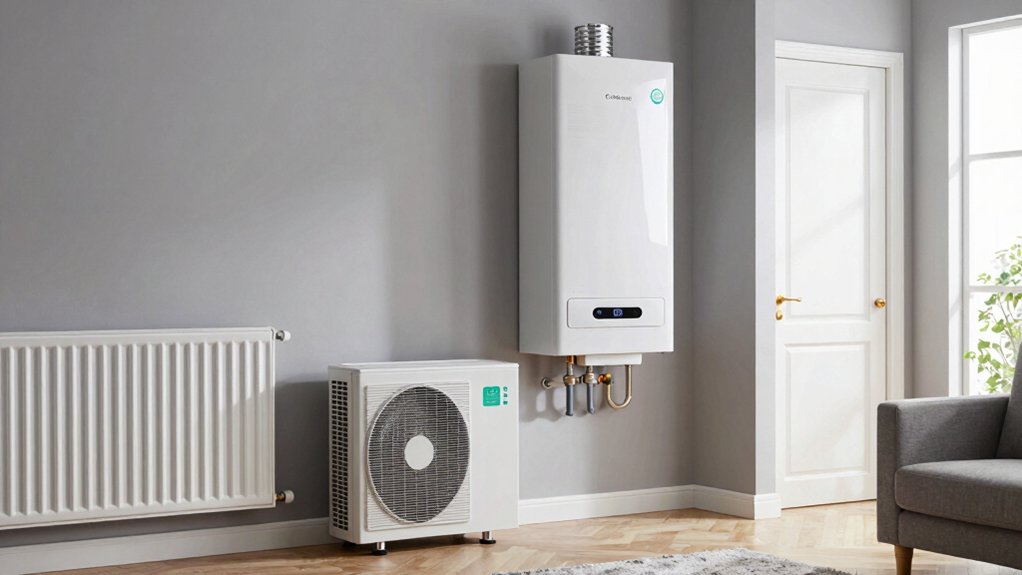
Understanding boiler and heat pump incentives begins with understanding the eligibility criteria, application steps, and documentation required by UK programs. You assess whether your property qualifies, including occupancy, insulation levels, and install type.
Then you compile essential documents: proof of income or benefit status if applicable, property ownership, planning permissions when needed, energy assessments, and contractor quotes.
You’ll choose eligible measures, compare grant schemes, and note caps, regional variations, and whether combined incentives apply.
The next step is submitting applications—online or via mail—ensuring accurate manufacturer and installer details, installation timelines, and financing disclosures.
You track progress with reference numbers and respond promptly to requests for additional information.
Finally, you verify approval, schedule installation, and retain documentation for audits or future program checks.
Differences Between Boiler Grants, Heat Pump Grants, and Solid Fuel Schemes
You’ll see how boiler grants, heat pump schemes, and solid fuel options differ in eligibility, costs, and long-term savings.
The analysis weighs each pathway’s policy aims, funding levels, and practical implications for households and installers.
This sets the stage for comparing details like boiler grant specifics, heat pump scheme nuances, and solid fuel scheme scope.
Boiler Grant Details
There are several distinct boiler-related grant options, each with different eligibility, funding streams, and installation standards, and understanding these differences is essential for policy relevance and practical decision-making.
You’ll find that boiler grants typically target upgrade efficiency, often requiring certain boiler types (condensing, gas or oil) and a verified home energy assessment.
Funding streams vary: some schemes provide upfront discounts, others reimburse after installation, and several impose caps per household.
Eligibility hinges on income, residence type, and existing heating systems, with attention to retrofit readiness and safety compliance.
Installation standards are explicit, demanding accredited installers and leak tests, plus adherence to local building regulations.
Evidence suggests uptake improves bill savings but depends on accurate energy performance documentation and ongoing maintenance commitments.
Vigilance on fraud controls remains essential for policy integrity.
Heat Pump Schemes Compared
Heat pump schemes differ markedly from boiler grants and solid-fuel programs in how they address decarbonisation, upfront costs, and long-term carbon savings. You’ll compare eligible technologies, installation timelines, and performance guarantees to understand policy trade-offs.
Heat pumps cut fossil dependence through electricity‑based heating, but require heat‑loss controls, well‑designed distribution, and electricity pricing considerations; these factors influence actual operating costs and carbon outcomes.
Boiler grants focus on retrofitting fossil systems with lower emission options, often with simpler retrofit needs but smaller decarbonisation impact.
Solid‑fuel schemes emphasize fuel-switching and fuel‑quality controls, yet face ongoing emissions and supply‑chain variability.
Across all, evidence shows long‑term savings hinge on building retrofit completeness, user behavior, and grid decarbonisation.
Policymakers should weigh upfront incentives against total cost of ownership and system resilience.
Solid Fuel Scheme Overview
Solid Fuel Scheme Overview: this section unpacks how solid-fuel programs differ from boiler and heat-pump grants in purpose, scope, and expected emissions outcomes. You’ll see that solid-fuel schemes target retrofitting and replacement of older, coal- or oil-based systems with compliant solid-fuel options, often prioritizing home safety and local air quality.
Compared with boiler grants, they emphasize fuel type and appliance class rather than overall energy efficiency alone. Against heat-pump grants, solid-fuel schemes typically offer smaller, technology-specific incentives, with tighter performance thresholds and stricter emissions criteria.
Policy relevance arises from balancing energy security, fuel switching barriers, and environmental goals. Evidence suggests limited decarbonisation impact unless paired with fuel-switch policies and robust monitoring of wood-burning and pellet-fuel installations.
How to Estimate Your Savings and Payback Period
To estimate your savings and payback period, start by establishing a baseline: your current energy consumption, fuel type, and heating costs. Then compare them with the projected performance of an energy‑efficient heater.
Use standardized efficiency metrics (e.g., seasonal performance factors) and credible input data to model annual operating costs.
Calculate annual savings by subtracting the projected energy use of the efficient unit from your baseline, multiplied by the relevant unit price.
Determine payback by dividing the upfront cost (including installation) by annual savings, accounting for maintenance differences.
Consider sensitivity analyses for price volatility, usage shifts, and potential rebates.
This approach informs policy relevance by clarifying cost‑effectiveness, guiding decisions for households and program designers alike.
Ground conclusions in transparent assumptions and verifiable data.
Step-by-Step Plan to Upgrade Your System Responsibly
You should map a sustainable upgrade plan that minimises energy use and cost, starting with clear goals and timelines.
We’ll weigh grant eligibility, upfront costs, and maintenance implications to inform a rational sequence of improvements.
Plan Your Upgrade Sustainably
Planning your upgrade sustainably begins with a clear, evidence-based plan that aligns with current energy-efficiency standards and funding opportunities. You should map system performance targets against measured needs, considering occupants, usage patterns, and climate risk.
Conduct a life-cycle assessment to compare heat sources, controls, and installation complexities, emphasizing embodied emissions and end-of-life options. Prioritize standards-compliant components, such as efficient boilers, heat pumps, or hybrid setups, and document expected payback based on energy savings, maintenance, and incentives.
Engage stakeholders early, gather supplier validation, and reference official policy guidance to ensure defensible choices. Attach a risk register for supply chain, installation, and disruption.
Finally, set a review cadence to update the plan as standards evolve.
Navigate Grants And Costs
Have you mapped the available grants and their eligibility criteria to your upgrade plan, so you can compare total costs against potential subsidies and payback? You should systematically catalog grant types, caps, and application windows, then align them with your chosen heater and installation timeline.
Assess subsidy stacking rules, eligibility checks, and regional variations to avoid missteps. Analyze cost components—equipment, labor, permits, and maintenance—with and without incentives to reveal true net expenditure.
Consider anticipated energy savings, fuel-switch implications, and potential tariffs or levies. Use policy documents and independent reviews to estimate real payback, factoring uncertainty in grant acceptance and project delays.
Synthesize findings into a decision matrix to guide procurement, contractor selection, and risk management, ensuring compliance and transparent budgeting.
How to Combine Grants With Other Energy-Saving Programs
Combining grants with other energy-saving programs can amplify impact and stretch limited funds, but it requires careful alignment of eligibility, timing, and project scope. You should map program rules to avoid duplicative funding and conflicting requirements, focusing on complementary outcomes like efficiency upgrades and renewable heat integration.
Prioritize programs with aligned performance metrics, such as verified reductions in energy use or emissions, to strengthen the funding case and avoid gaps in support. Build a unified project timeline that sequences grants to maximize rebates, matched funding, and installation readiness.
Documented cost savings, lifecycle benefits, and risk controls improve credibility with evaluators. Finally, monitor reporting obligations across programs and adjust scope if required to maintain compliance and safeguard future eligibility. This evidence-driven alignment supports durable, scalable energy improvements.
What to Prepare Before Applying: Documents and Eligibility Proofs
To move from coordinating multiple funding sources to starting an application, you’ll need to assemble and verify the documents that prove eligibility and project scope. You should gather proof of residence, identity, and energy efficiency measurements, plus a costed project plan with clear heat‑replacement or upgrade details.
Collect supplier quotations, product specifications, and EPC or energy assessments that align with program criteria. Prepare receipts or invoices showing eligible costs and dates, and confirm any domestic or business eligibility flags.
Documentation should demonstrate project boundaries, anticipated savings, and the project timeline. Confirm consent for data checks and any required declarations about previous grants.
Review eligibility rules before submission to minimize back‑and‑forth and support transparent scoring.
Common Pitfalls and How to Avoid Them
Common pitfalls in applying for energy-efficient heaters typically stem from incomplete documentation, unclear project scope, and misaligned cost assumptions. You’ll avoid delays by ensuring grant criteria are interpreted correctly and that all supporting evidence matches your stated goals.
Documentation gaps often trigger rework; pre‑empt this by cross‑checking supplier quotes, energy assessments, and installation timelines. Ambiguity about eligible measures leads to overstated budgets or disallowed costs, so you should define the exact equipment types, efficiency ratings, and installation locations up front.
Be wary of underestimating ongoing maintenance or running costs, which can skew cost‑benefit analyses. A clear project plan aligned with policy objectives improves decision timelines and compliance posture, increasing your chances of approval and smoother later reporting.
How to Monitor Savings and Stay Compliant After Installation
With the prior focus on avoiding common pitfalls, you now need a robust framework for tracking performance and maintaining compliance after installation. Establish clear baselines for energy use before and after the heater upgrade, then implement regular measurements against those baselines.
Use accessible data sources—utility bills, smart meters, and installer reports—to quantify savings, and document any deviations with dates and causes.
Align monitoring with grant requirements by preserving receipts, warranties, and certification records for at least the mandated period.
Schedule periodic audits to verify proper operation, safety compliance, and correct fuel or electrical connections.
When savings drift, investigate promptly, adjust usage plans, and report findings to relevant authorities as required.
Continuous transparency supports policy objectives and strengthens future funding eligibility.
Conclusion
You’ve reviewed the policy landscape, quantified eligibility, and weighed costs against guaranteed savings. By aligning grants with proven energy‑efficiency strategies, you can decarbonize heating while minimizing payback gaps. The evidence supports targeted boiler, heat pump, and solid-fuel schemes as catalysts for emission reductions and consumer bill relief. Stay vigilant for updates and document your progress; this is your foothold to compliant, cost‑effective upgrades. Don’t miss opportunities, but don’t rush—steady progress now, steady savings later. It’s a prudent path forward, rain or shine.