
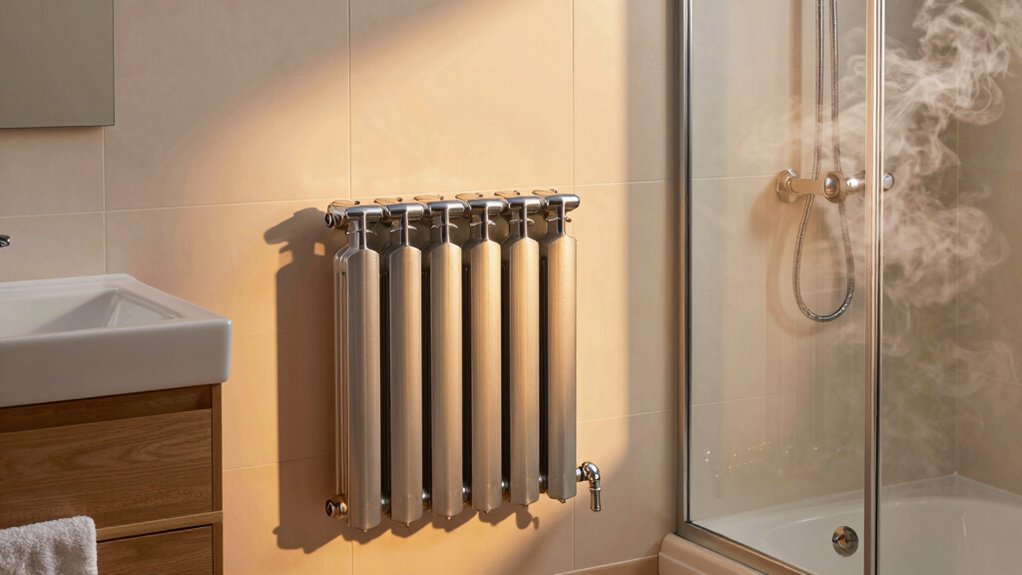
Infrared bathroom heaters save energy by warming people and surfaces directly, not the entire air volume. You experience rapid comfort at contact points, so you reduce thermostat cycling and heat loss through vents. Unlike convection heaters, radiant energy targets skin, towels, and tiles, boosting efficiency with smaller wattages and faster onset. Proper placement, high-emissivity panels, and moisture-rated models minimize wasted heat. Learn how to optimize wattage, placement, and safety to maximize savings and performance.
Why Infrared Heaters Save Energy in Bathrooms
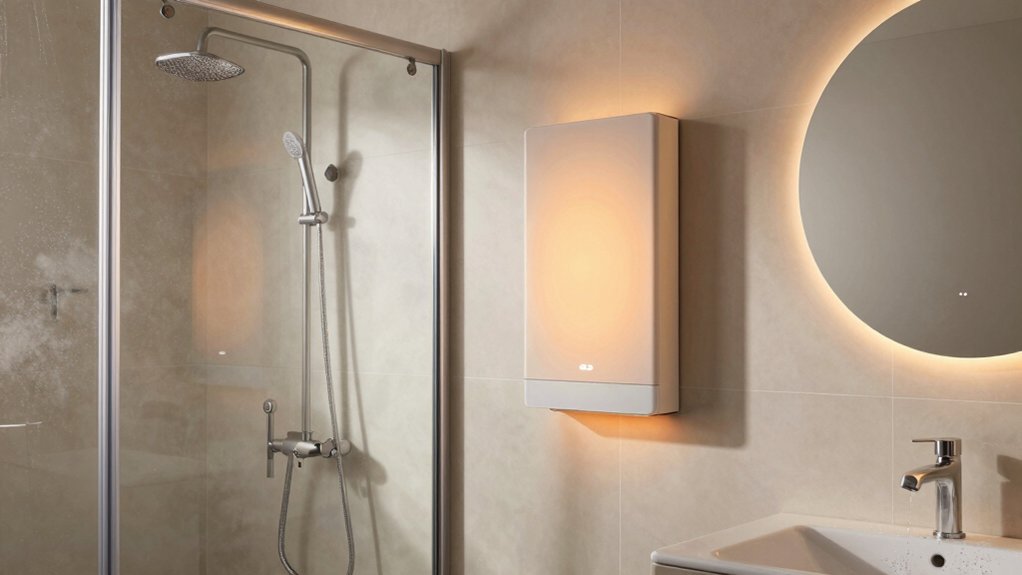
Infrared heaters save energy in bathrooms primarily by heating objects and people directly rather than warming the air. You target heat where it’s needed, reducing overall air temperature changes that waste energy through convection.
Instead of sustaining a uniform room rise, you experience immediate warmth on skin, towels, and tiles, which lowers the required thermostat offset and minimizes heat loss through vents or drafts. With a fast-response element, you avoid prolonged cycling, improving duty cycles and efficiency ratings.
The system concentrates energy transfer via radiant waves, so you pay for heat you use rather than heating empty space. This approach lowers standby losses and supports shorter, targeted heating intervals, delivering comfort while preserving energy and reducing utility costs.
How Infrared Warmth Differs From Traditional Heaters
Infrared warmth heats objects and people directly, unlike convection heaters that warm air first.
You’ll notice faster, targeted comfort through direct heat transfer, which can reduce overall energy usage.
This section compares infrared vs conventional heat, explains the direct transfer mechanism, and highlights energy efficiency benefits.
Infrared vs Conventional Heat
Conventional heaters warm air, then rely on convection to circulate and transfer heat to objects and people. In contrast, infrared heaters emit radiant energy that directly warms you and surrounding surfaces without heating the air first.
You experience faster, targeted comfort because radiant heat transfers energy at the surface level, reducing heat loss through ducts or mixed drafts. Infrared systems deliver steady, stone-like warmth to people and objects, improving perceived comfort per watt.
Temperature regulation emphasizes surface warmth with less air movement, lowering ambient drafts and dust circulation. In space-limited bathrooms, infrared units minimize vertical space impact and avoid overheating ceilings.
Maintenance focuses on element integrity and reflective surfaces, not air filtration. Overall efficiency hinges on visible-surface exposure, occupancy patterns, and strategic placement for uniform radiant coverage.
Direct Heat Transfer Mechanism
In this setup, heat moves directly from the emitter to targets without preheating the surrounding air. Infrared radiators emit energy in wavelengths that couple with typical skin, clothing, and object surfaces, raising those targets’ temperatures rather than the ambient air.
You experience warmth when radiant photons are absorbed, transferring energy across a short distance with minimal convection. This mechanism minimizes air stratification; you won’t rely on a heated bulk air column to feel comfortable.
The physics is selective, as ceramic or quartz emitters peak at near- to mid-infrared bands that match common materials, maximizing transfer efficiency. You’ll notice rapid onset of comfort at the point of contact or exposure, with zone-specific heating possible without heating unused spaces.
This direct transfer underpins steady, predictable warmth.
Energy Efficiency Benefits
Because infrared warmth targets objects and people rather than heating the entire room, these heaters use far less energy to achieve the same comfort levels as traditional space heaters, leading to lower overall consumption. You’ll notice rapid heat delivery directly to targets, minimizing standby losses and thermal drift.
Unlike convective systems, infrared devices convert most input power into usable radiant energy with minimal air movement, reducing heat waste when doors open or ventilation shifts occur. This efficiency translates to smaller heat bills and improved thermostat stability, since ambient air temps stay cooler while occupants feel warm.
System design emphasizes insulation compatibility, quick warm-up, and zone-focused operation. For bathrooms, efficient infrared units deliver consistent comfort with lower wattage, longer service life, and safer, localized heating.
What Makes an Infrared Bathroom Heater Efficient?
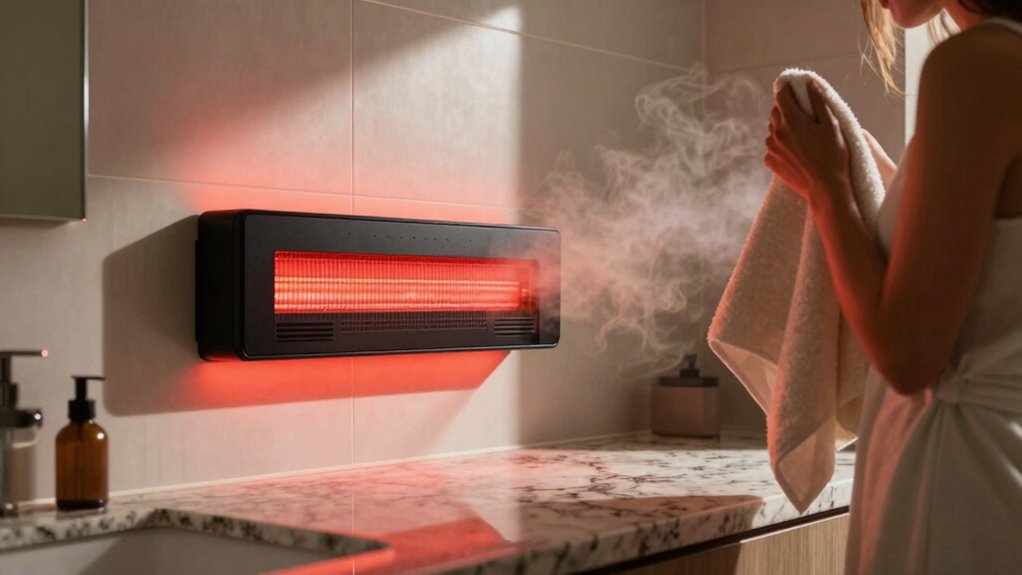
Efficient infrared bathroom heaters maximize heat transfer efficiency by directing radiant energy where you need it and minimizing losses to surrounding air. They also boast a quick warm-up time, so you feel comfort sooner without wasting energy idling.
Focus on components and design that optimize radiant delivery and low standby power to sustain reliable, efficient performance.
Heat Transfer Efficiency
Heat transfer efficiency in infrared bathroom heaters hinges on how effectively radiant energy is delivered to occupants and surfaces while minimizing losses. You achieve this by selecting panels with high emissivity in the target spectrum and low surface-to-occupant distance, reducing spacetime dispersion.
Insulation around the heater enclosure minimizes conductive and convective losses, ensuring most energy reaches the intended area. Focus on directional coating and reflector geometry to concentrate radiant flux toward users without unnecessary hot spots.
For installation, maintain proper clearance and line-of-sight paths, because obstruction degrades transfer efficiency. Material stability at bathroom temperatures preserves emissivity over time, preventing performance drift.
In operation, calibrate output to the kitchen or bath size, using proportional control or phase-cut dimming to sustain comfortable warmth with minimal energy waste.
Quick Warm-Up Time
Quick warm-up is a practical measure of how rapidly an infrared bathroom heater becomes comfortable after activation. You’ll notice that ceramic emitters or quartz elements reach peak radiance quickly, minimizing the delay between switch-on and perceived warmth.
The system’s control electronics modulate output to match ambient conditions, avoiding overshoot or heat waste. Insulation quality and surface reflection influence initial sensation; a well-insulated enclosure reduces heat loss during warm-up, delivering faster comfort with lower energy.
Low thermal mass components accelerate response without sacrificing stability. Consider a timer or eco mode that preloads heat for predictable readiness.
Shorter warm-up times correlate with higher perceived efficiency, since you expend less energy before the space feels usable. In practice, select heaters with fast heat-up, precise control, and robust insulation.
Key Features That Impact Running Costs
Key features that determine running costs center on insulation needs, heat output efficiency, and control strategy. You should evaluate how well the bathroom is insulated, since better insulation reduces heat loss and overall runtime.
Choose models with high radiant efficiency, optimized wattage, and low standby draw to minimize waste. Look for precise wattage ratings and thermal response curves that match your bathroom size and heat-up expectations.
Control strategy matters: programmable timers, adaptive thermostats, and eco modes prevent unnecessary cycling and over-irradiation. Prioritize quick-on, steady-off performance without overshooting comfort.
Consider maintenance implications of elements like reflectors and seals, as degraded components raise running time for same comfort.
Finally, verify that installation aligns with safety standards to avoid efficiency penalties from improper setup.
Room Size, Insulation, and Placement Best Practices
To maximize efficiency and comfort from an infrared bathroom heater, size the unit to the room and optimize insulation first. Correct sizing ensures the heater delivers steady heat without overshoot or short cycling, reducing energy waste. Measure floor area and ceiling height, then refer to the manufacturer’s heat-output guidance in BTU or watts.
Prioritize airtight doors, double-pane or laminated windows, and minimal thermal bridging; seal gaps with low-expansion caulk and weatherstripping. Position the panel away from direct moisture, drafts, and buried objects, ideally on a wall with unobstructed line-of-sight to the target zone. Avoid placing behind towels or fixtures that absorb or block infrared radiation.
Use a thermostat setpoint that maintains comfort without excessive cycling, and consider wall mounting for stable, even coverage. Regularly verify insulation integrity after changes to room use.
Safety, Install, and Maintenance Tips for Longevity
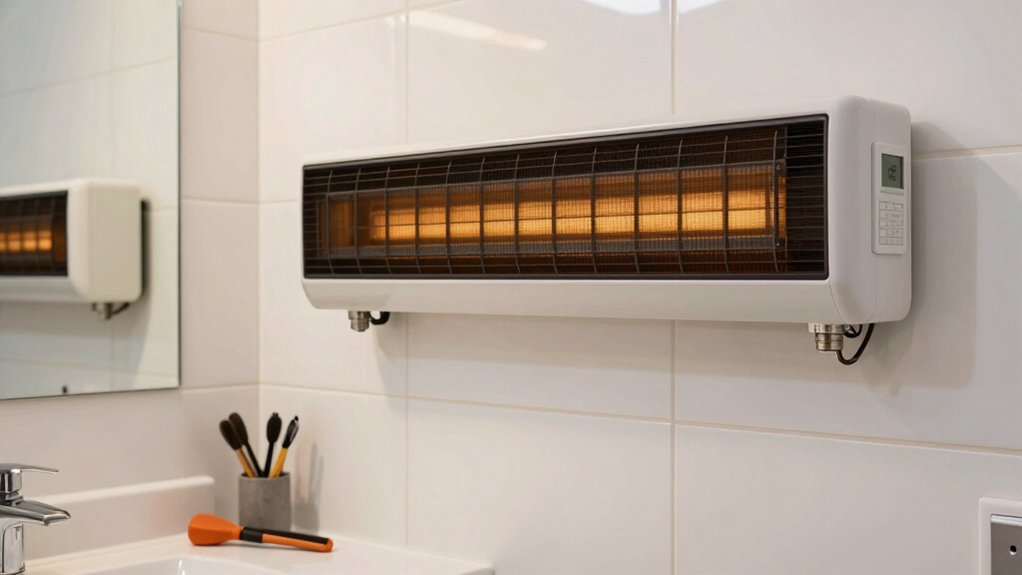
Heating safety and reliable operation go hand in hand with proper install and maintenance. You’ll guarantee safe placement, keep clearance clearances documented, and verify mounting to support weight and vibration resistance.
Use manufacturer-recommended hardwiring or plug setup, and install a dedicated circuit with appropriate amperage, breakers, and GFCI protection where required.
Regularly inspect housings, seals, and wiring for signs of damage, corrosion, or heat discoloration; replace components immediately if found.
Test thermal cutouts and built-in safety features monthly, and keep a log of results.
Clean vents and reflectors to maintain efficiency, avoiding cleaners that could degrade seals.
Schedule professional servicing at least once a year to recalibrate controls, verify electrical integrity, and confirm enclosure integrity for longevity.
Comparing Popular Infrared Bathroom Heater Models
Choosing the right infrared bathroom heater hinges on balancing heat output, safety features, installation fit, and energy efficiency. This comparison focuses on model capabilities, mounting options, and built-in protections.
You’ll evaluate wattage ranges, radiant efficiency, and responsive thermostats to predict comfort delivery in small spaces. Look for models with sealed electrical connections, corrosion‑resistant housings, and IP ratings appropriate for damp environments.
Mounting options vary from recessed ceilings to surface walls and adjustable tracks. Confirm clearances and ceiling heights align with your ceiling or wall architecture.
Built‑in protections should include overheat cutoffs, tip‑over switches, and auto‑reset thermal limits. Consider noise levels, dual‑element configurations, and compatibility with existing controllers or smart home ecosystems.
This section concentrates on capabilities; detailed installation steps appear in later guidance.
Quick Decision Guide: Choose the Right Model for You
When you’re selecting an infrared bathroom heater, start with your space: ceiling height, square footage, and dampness level determine wattage needs, mounting options, and IP rating requirements.
In a quick decision guide, pinpoint core specs first: wattage range, element type, and installation method.
For small baths, choose 300–600W with recessed or wall-mount options; for larger rooms, 600–1000W may be necessary, with vented or sealed-wall clearance.
Check IP ratings; bathrooms demand at least IP44, higher for steam-rich zones.
Consider surface temperature limits and safety features—tip-over and overheat protection add reliability.
Prioritize response time and efficiency; look for responsive thermostats and smart-control compatibility.
Finally, confirm service availability, warranty terms, and maintenance needs to ensure durable, consistent warmth.
Conclusion
You’ll love how simple it seems to save energy—until you realize you forgot the timer. Infrared bathroom heaters heat objects, not air, so you’ll feel warmth fast and waste less energy, right? If you ignore insulation, you’ll still itch for the thermostat. So, pick a model with proper wattage, safety features, and smart controls. Place it well, seal drafts, and enjoy efficient comfort without theatrics. In short: precise, proactive heat, minus the drama.