
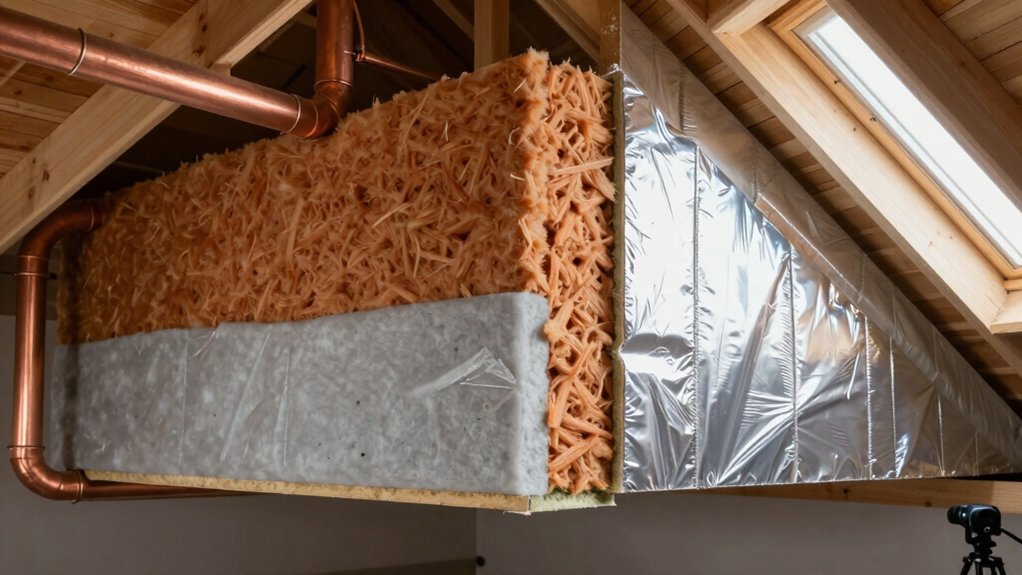
A guide to modern attic insulation materials helps you tailor assemblies to climate, moisture, and budget. Start with climate-appropriate R-values and airtightness goals, then choose between high-performance foams for continuous insulation and rigid boards for long-term stability. Consider dense-pack or mineral wool for retrofit cavities, balanced with proper air sealing and moisture control. Prioritize recyclability and lifecycle metrics, plus verification via blower-door and thermal imaging. You’ll discover options that expand comfort while lowering risk, and more insights await.
Attic Insulation Decisions: Key Questions and Climate Guidance
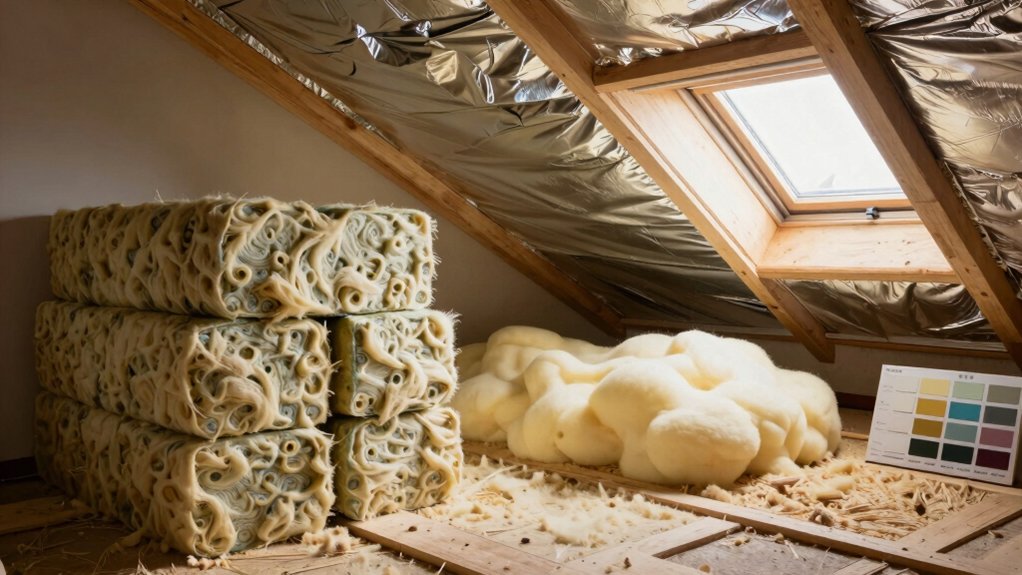
When deciding attic insulation strategy, start by clarifying your climate zone, home design, and current attic conditions to determine target R-values and air-sealing needs.
You’ll map performance goals to enclosure integrity, air leakage budget, and ventilation load, then select materials and assemblies that meet code and long-term durability.
Initiate with ventilation strategies that manage moisture, stratification, and pressure differentials, recognizing how soffit, ridge, and gable configurations interact with intake and exhaust routes.
Review historical insulation methods to appreciate moisture management lessons and retrofit feasibility, but anchor choices in current codes, tested R-values, and installation tolerances.
Prioritize sealed, radiant-heat control layers, vapor retarders appropriate to climate, and compatible fastening systems.
Document performance criteria, inspection checkpoints, and warranty coverage to enable predictable results.
How to Compare Insulation by R-Value and Climate
To compare insulation by R-value and climate, you’ll translate the numeric R-value into real-world performance by accounting for heat transfer mechanisms, moisture risks, and service conditions specific to your climate zone.
In practice, you evaluate conduction paths, convection currents, and radiation losses, then adjust expectations for attic assembly gaps and thermal bridging.
Recognize that identical R-values can underperform in humid or extreme temperatures due to vapor barriers and moisture migration, or overperform in dry, temperate sites where latent loads are minimal.
Use climate-specific deratings to select assemblies that meet year-round demand.
Consider airflow, stack effect, and ventilation strategy to avoid convective losses.
Document performance targets, then verify with field testing and thermal imaging to confirm reduced heat flux and controlled moisture risk.
When to Use High-Performance Foams: Spray Foams and Rigid Boards
High-performance foams deliver superior air sealing and insulation continuity, making them worth considering when you face complex attic topography or tight retrofit schedules.
For spray foams, assess substrate compatibility, ventilation requirements, and cure behavior to minimize off-gassing and movement during installation.
Rigid boards excel where long-term stability and fire-rated assemblies are priorities.
You’ll weigh cost, installation logistics, and expected performance gains to decide when spray foams or rigid boards best meet your performance targets.
High-Performance Foam Benefits
Spray foams and rigid foam boards offer superior insulation performance by delivering excellent R-values per inch and reducing air leakage when installed correctly. You’ll gain higher thermal resistance in compact assemblies, enabling tighter envelope control without excessive thickness.
High-performance foams resist convection paths, stabilize in cavity irregularities, and maintain continuity across junctions, which supports long-term insulation durability. In practice, use closed-cell spray foams where structural contribution and vapor control matter, and employ rigid polyiso boards for strategic continuous insulation across complex geometries.
Both materials exhibit excellent dimensional stability and low permeance, with careful detailing to avoid gaps, voids, or compatibility issues with substrates. Consider service conditions, moisture loads, and fire-safety requirements to select the appropriate foam system for durable performance.
When to Use Spray Foams
When you’re choosing insulation for performance-critical assemblies, spray foams are favored where air sealing, high R-per-inch, and continuous insulation matter most. Use spray foam in retrofit or new construction when detailing complex geometries, penetrations, or high-load assemblies that benefit from minimal gaps.
Closed-cell formulations deliver higher density, enhanced vapor control, and structural support, supporting long-term envelope performance. Consider application temperature, substrate compatibility, and blower-door verified air leakage targets to optimize outcomes.
Fire safety remains a priority: select products with tested fire ratings and proper installation clearances, and coordinate with ignition barrier requirements where applicable. Balance cost, installation speed, and long-term durability; combine with continuous insulation strategies to realize robust, durable attic assemblies.
Spray foam complements rigid boards where density and air tightness drive performance.
Dense-Pack, Loose-Fill, and Mineral Wool: Which Fits Your Attic
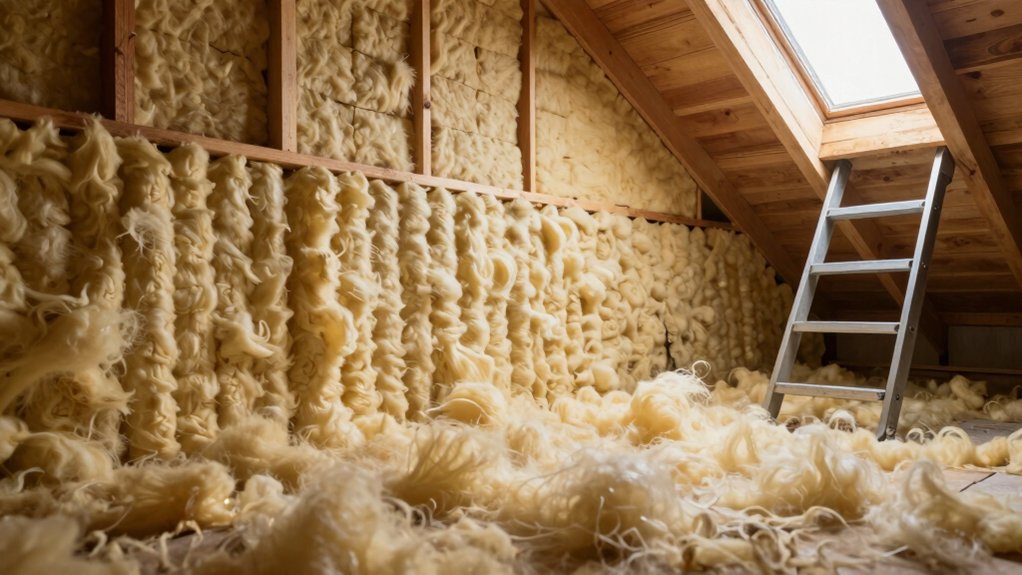
Dense-pack suitability hinges on control of install density, cavity size, and airflow compatibility, so you’ll assess canopy gaps and chimney/penetration risk first.
Weigh loose-fill limits for attic holdup versus mineral wool’s non-combustible stability, focusing on performance metrics, ease of retrofit, and moisture tolerance.
This discussion frames how Dense-Pack, Loose-Fill, and Mineral Wool choices map to your attic’s layout, occupancy, and ventilation strategy.
Dense-Pack Suitability Factors
Dense-pack, loose-fill, and mineral wool each provide distinct performance profiles for attic insulation. Your decision hinges on substrate condition, cavity geometry, and air-sealing integrity, with material behavior guiding suitability.
Dense-pack demands controlled compaction to achieve high insulation density and reduced voids; it’s suited for retrofit cavities with irregular framing or older, settled assemblies.
Loose-fill offers rapid coverage but variable density, relying on installation techniques to maintain uniformity and prevent bridging.
Mineral wool provides noncombustible stability and moisture tolerance, yet requires compatible carrier systems and spacing to reach target density.
Consider long-term thermal performance, potential for settling, and serviceability for future air leakage testing.
Align material choice with accessible attic access, blower compatibility, and jobsite metrics to optimize performance and code compliance.
Loose-Fill vs Mineral Wool Benefits
Loose-fill and mineral wool each bring distinct advantages to attic insulation, and choosing between them hinges on fire safety, moisture management, and installation practicality.
You gain rapid coverage with loose-fill for irregular joist bays and full-depth filling, reducing thermal bridging when properly dense-packed to target R-values. However, loose-fill demands well-sealed moisture barriers and consistent blower-compaction to avoid settling gaps that undermine performance.
Mineral wool delivers superior non-combustibility and dimensional stability, resisting moisture ingress and maintaining performance under humid conditions. Though installation is denser and less forgiving in awkward cavities, it offers reliable performance.
Consider air-permeance and potential fiber fatigue in high-traffic attic zones. For moisture control, pair either option with robust moisture barriers and careful detailing around vent penetrations and rafter bays to minimize heat loss and air leakage.
Eco-Friendly Options and Sustainability in Attic Insulation
Eco-friendly options in attic insulation prioritize materials with low embodied energy, high recycled content, and proven long-term performance. You assess product data sheets for cradle-to-gate lifecycle metrics, selecting solutions with minimal environmental footprints and verifiable credits.
Prefer recyclable materials that maintain thermal efficiency without compromising structural compatibility, and favor open-source, industry-tested formulations over proprietary blends with uncertain end-of-life handling.
Look for renewable resources sourced responsibly, ensuring traceability and compliance with regional green building standards.
You’ll evaluate insulation density, R-values per inch, and vapor-permeance to balance moisture resilience with energy savings.
Consider regional waste-to-product pathways and landfill diversion rates to maximize circularity.
In practice, this means prioritizing suppliers that document recyclability, refill or remix programs, and transparent material declarations.
Air Sealing and Moisture Control: Essential Installation Practices
Air sealing and moisture control form the backbone of attic performance once insulation choice—whether dense-pack, loose-fill, or other materials—is made.
You target envelope integrity by locating and eliminating air leaks with continuous seam seals, gasketed framing penetrations, and proper sealing around electrical boxes.
Implement a deliberate moisture strategy using vapor barriers where appropriate, oriented to climate and ventilation goals, to regulate vapor drive without trapping condensation.
Guarantee overlap and taped seams meet category-rated standards, minimizing diffusion through joints.
Use mechanical ventilation harmonized with insulation layers to maintain balanced air exchange, preventing stack and wind-driven drafts.
Inspect for perched moisture pockets after installation and test for airtightness with a diagnostic blower door approach.
Document junction details, materials, and installation tolerances for ongoing performance monitoring.
Cost, Durability, and Long-Term Performance You Can Trust
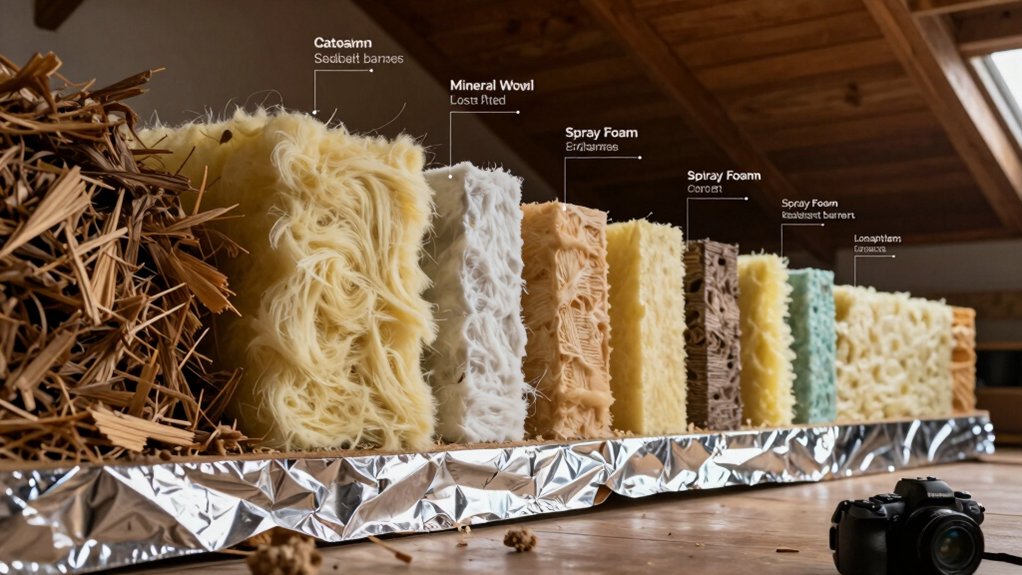
Cost, durability, and long-term performance hinge on material choice, installation quality, and ongoing maintenance. When you select an appropriate insulation system and apply it correctly, you secure sustained thermal resistance, reduced energy costs, and predictable service life.
- Thermal bridging mitigation strategies align with continuous insulation and stud-path detailing to preserve R-values.
- Vapor barriers are configured to control moisture migration without creating condensation risk in cold climates.
- Material lifecycle metrics—aging, degradation rates, and fire ratings—guide replacement intervals and warranty scope.
- Installation quality assurance, in-situ compaction control, and air-permeability testing drive consistent dollars-per-degree efficiency.
This approach yields durable performance, minimized retrofit frequency, and stable performance across seasonal cycling.
Conclusion
You’ve got choices, but one truth stands: proper attic insulation changes your climate, comfort, and bills overnight. With precise R-value targets, moisture-smart sealing, and the right mix of high-performance foams, dense-pack, and mineral wool, you’ll outsmart heat leaks and cold drafts like a weather wizard. Durability meets responsibility as eco-friendly options prove cost-effective long-term. Insulation isn’t a guess—it’s a quantified, install-first, performance-driven investment that pays you back in comfort and savings, year after year.