
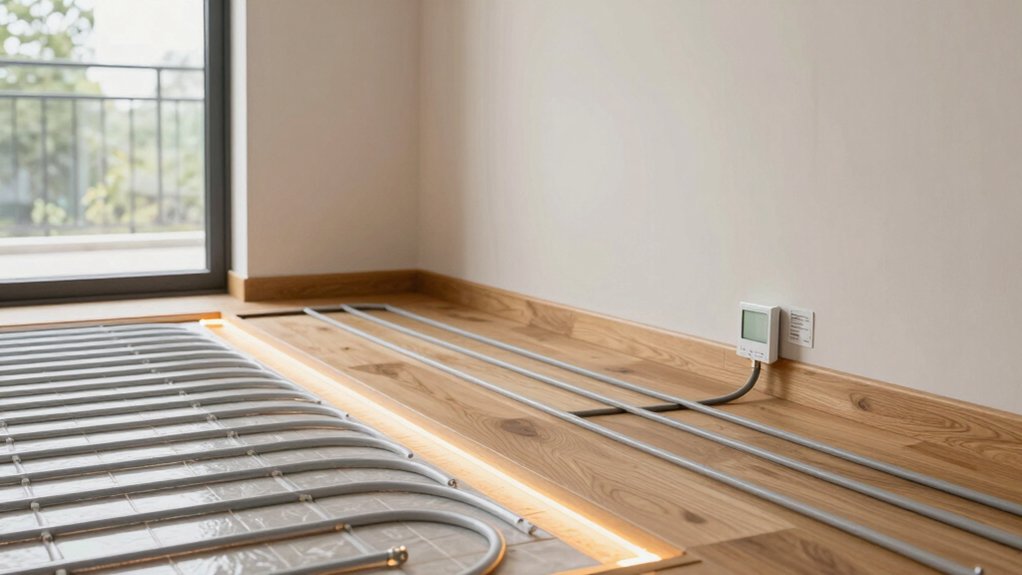
Electric underfloor heating uses embedded mats or cables that heat up quickly, with lower upfront install costs and simple retrofits, but higher running costs per kWh. Hydronic systems circulate warm water via a boiler and pumps, offering lower long-term operating costs in large areas, yet they require higher upfront investment and more complex installation. Electric heats fast and suits retrofits; water-based systems deliver steady, economical heat over time. If you keep exploring, you’ll see how to align with your home and budget.
How Electric Underfloor Heating Works
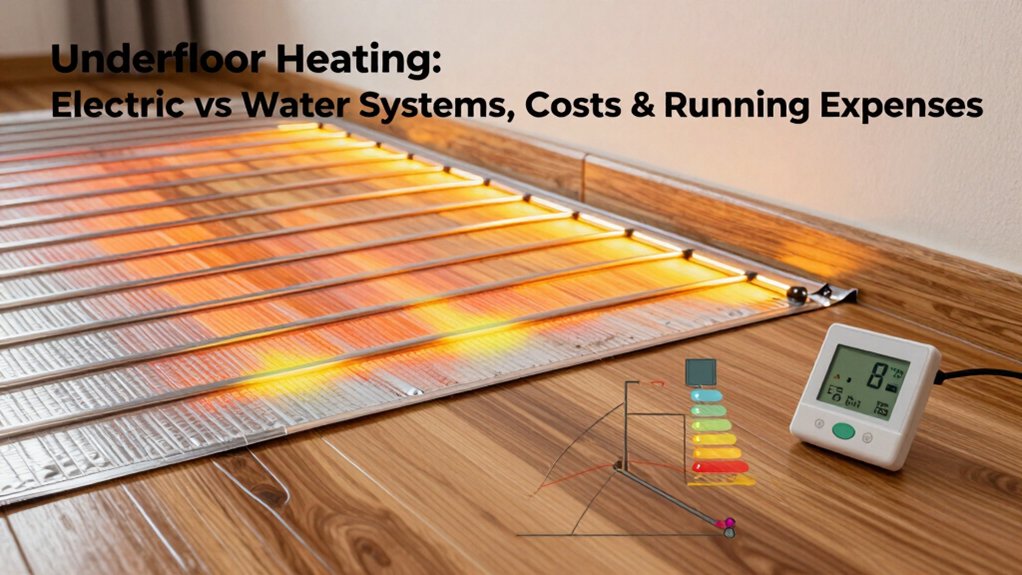
Electric underfloor heating uses electrical resistance elements embedded in or beneath the floor surface to generate heat. You install thin, flexible mats or compact coils that connect to a dedicated thermostat and power supply. When you set a target temperature, the control system modulates current to achieve consistent heat output across the area.
The elements convert electrical energy into infrared and conductive heat, warming the floor and surrounding space. You’ll notice rapid response when you adjust settings, with surface temperatures that support comfortable stepping without hot spots.
System design emphasizes uniform heat distribution, low air movement, and reduced stratification, which enhances thermal comfort. Energy savings come from precise zoning, efficient insulation, and low standby losses, yielding predictable operating costs and improved comfort, especially in well-insulated rooms.
How Hydronic (Water) Underfloor Heating Works
Hydronic (water) underfloor heating uses a closed-loop system to circulate heated water through an array of tubing embedded in or beneath the floor. You control heat delivery through a boiler or heat source, a weather-compensated controller, and a pump that maintains flow.
The system relies on low-temperature water to balance efficiency, comfort, and material compatibility. Key parts include manifold distribution, tubing layout, insulation, and a primary/secondary circuit design to prevent imbalance between zones.
During operation, water temperature is adjusted to meet desired room setpoints with minimal fluctuation, reducing cycling and energy use.
Proper hydronic installation guarantees even temperature transfer, predictable response times, and reliable shutoff sequencing.
Regular maintenance focuses on leaks, air removal, pressure checks, and system purge to sustain performance.
Initial Installation Costs: Electric Vs Water
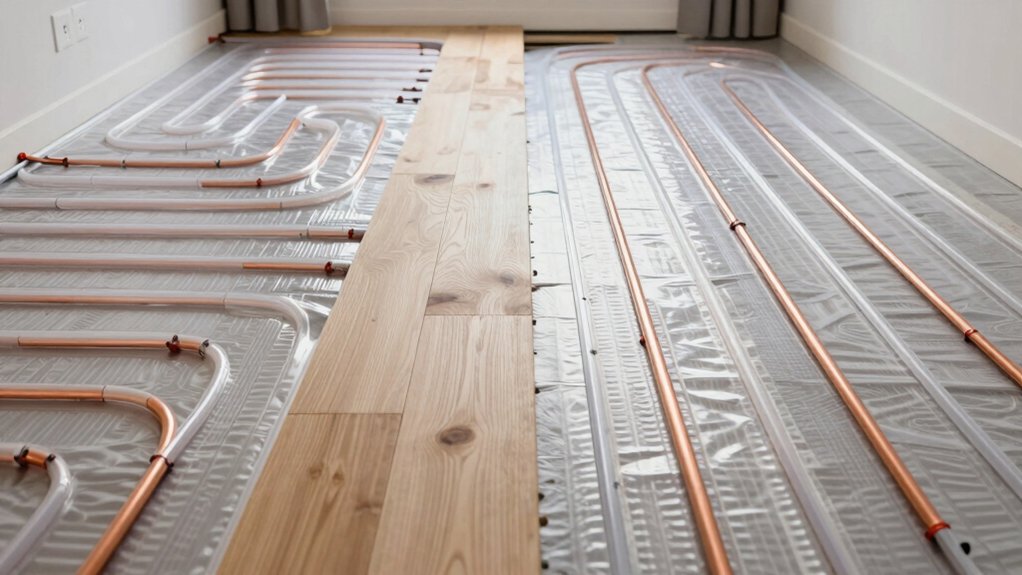
On the upfront cost comparison between electric and water-based underfloor heating, you’ll see notable differences in equipment, installation complexity, and long-term economics.
Electric systems generally incur lower material costs and simpler deployment, because mats or loose cables install directly over subfloors with minimal plumbing or boiler integration.
Water systems demand more extensive components, including manifolds, pumps, and heated-water loops, plus professional pipe routing and floor build-up adjustments.
Installation complexity is typically higher for hydronic setups, requiring floor height considerations, insulation payback, and pressure testing.
Electrical solutions often justify faster tilting toward completion and reduced labor, while water systems spread costs over longer lifespans and potential boiler compatibility.
Running Costs and Energy Efficiency Compared
Running costs hinge on how efficiently each system converts electricity or boiler-heated water into comfortable heat, with hydronic setups typically offering lower operating costs when paired with modern, efficient boilers and low-temperature floor assemblies.
In practice, a cost comparison shows electric matrices incur higher unit energy costs, while water-based loops leverage heat exchange and thermal mass to reduce consumption.
Energy savings depend on controllability: on/off vs. zone control, setback strategies, and insulation quality around floors.
Electric systems shine in rapid response but often lose efficiency with prolonged low-demand periods.
Hydronic systems benefit from weather-compensated controls and high-efficiency boilers.
Maintenance and Longevity
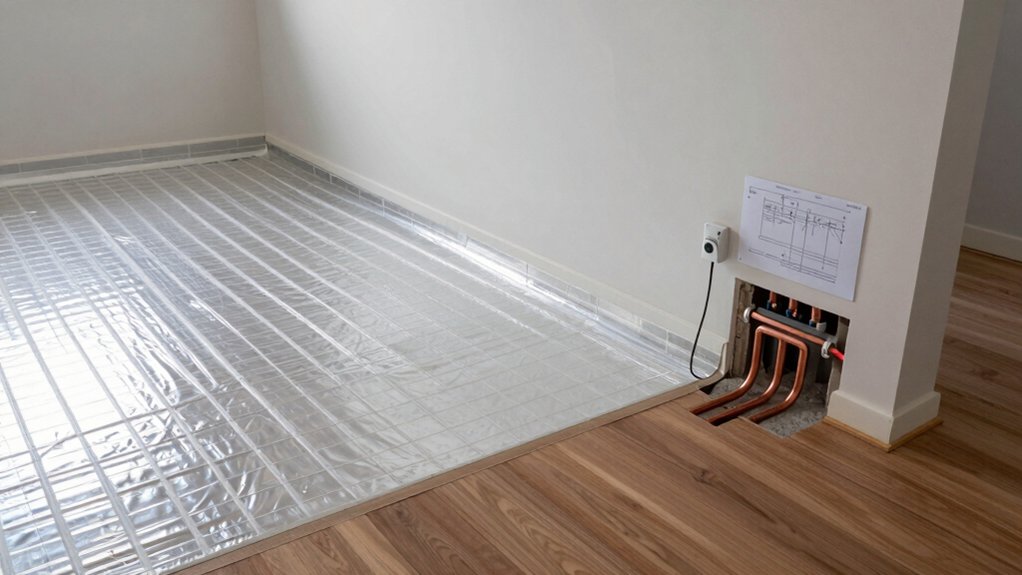
Regular maintenance is essential to sustain performance and extend lifespan in underfloor heating systems; neglect accelerates component wear and undermines efficiency. You’ll prioritize periodic inspections of electrical connections, valves, and pumps, ensuring tight seals and error-free controls.
For electric mats or cables, check insulation integrity and thermostat response, correcting drift promptly. In water-based setups, flush and balance the loop to prevent sludge buildup and corrosion, verifying flow rates meet design targets.
Monitor insulation compatibility and temperature distribution to avoid hotspots that shorten system lifespan. Track filter changes if present and replace aging circulators before failure.
Document maintenance actions to establish a clear maintenance requirements baseline, guiding future interventions. Effective upkeep minimizes downtime, preserves performance margins, and sustains long-term reliability.
Room and Zoning Considerations
You’ll start with room zoning basics to map heat demand across spaces and identify the zones that need independent control. Temperature zoning rules guide how you assign thermostats, actuators, and floor circuits to make certain of even comfort and efficient operation.
Space planning tips help you align layout, furniture, and floor area with pipe or mat runs, minimizing thermal bridges and shorts.
Room Zoning Basics
Room zoning divides a building into separate heating zones, each controlled independently to match occupancy, insulation, and usage. You’ll design zones based on room function, doors, and thermal boundaries, then assign controls that reflect real needs rather than uniform temperatures.
For effective operation, map heat generation and loss paths, noting that underfloor systems respond gradually to changes, so planning considers lag times between setpoints and occupancy. Thermostat placement matters: position away from drafts, direct sunlight, or heat sources to avoid skewed readings.
Insulation effectiveness influences zone sizing; high-performance insulation reduces crossover between zones and stabilizes temperatures, enabling smaller, more precise zones. Integrate zoning with your system’s controls to minimize energy waste while preserving comfort.
Temperature Zoning Rules
Temperature zoning rules hinge on aligning room function, occupancy patterns, and insulation performance with controlled heat delivery; effective rules translate physical boundaries into predictable, stable temps.
You set zones to match use profiles, minimizing overheat and heat loss. In practice, you assign each area a target range and a responsive delta, then integrate with feedback from sensors.
Smart thermostats automate setpoint adjustments while preserving comfort pockets during peaks and lull periods.
Zoning controls should account for door openness, solar gain, and equipment heat, avoiding cross-zone thermal bleed.
Use alternating circuit strategies for electric systems or dedicated manifolds for hydronic layouts to maintain balanced flow.
Documented protocols simplify commissioning, troubleshooting, and future upgrades, ensuring predictable running costs and reliable performance.
Space Planning Tips
Efficient space planning hinges on aligning room function with zoning strategies, so you map each area to its heat needs and occupancy patterns from the outset. Start by defining primary zones: high-occupancy living spaces, kitchens, and baths require tighter control and quicker response. For bedrooms or quiet zones, prioritize slower ramping and uniform temperatures.
Assess furniture placement to avoid obstructing underfloor cables or pipes, ensuring heat paths remain clear and evenly distributed. Use meters or zones to fine-tune cable or manifold placement, minimizing heat loss at exterior walls. Incorporate wall insulation data into zoning decisions to prevent thermal bridging and improve overall efficiency.
Document clear heat-load targets per room and verify alignment with system capacity before final installation. Regularly review shifts in layout or usage to preserve performance.
Practical Pros and Cons by Scenario
Considering scenario-based tradeoffs and system-type impacts helps you anticipate how underfloor heating performs across different builds and uses.
You’ll weigh installation choices, heat source compatibility, and zoning needs to gauge upfront costs against long-term efficiency.
This discussion sets a practical framework for comparing pros and cons in real-world conditions.
Scenario-Based Tradeoffs
Underfloor heating systems present distinct tradeoffs that vary by scenario, so evaluating setup, operation, and maintenance needs is essential.
In retrofit projects, you’ll face installation challenges due to floor buildup, requiring careful routing and potential structural checks.
Electric grids offer fast warm-up but higher operating costs, influencing cost comparison over time.
In new-build homes, embedded systems enable uniform heat delivery with minimal room disruption, yet they demand precise control strategies and upfront planning.
Hydronic layouts excel in large areas, delivering lower running costs but complex manifolding and longer installation timelines.
For tiled or stone floors, thermal mass amplifies response times, affecting temperature stability.
Regular maintenance is minimal for electric systems but more involved for water-based circuits, so plan for periodic inspections and guard against leaks.
System Type Impacts
System type drives practical pros and cons, and the impact varies by scenario. You’ll assess how electric mats, loose cables, or wet-systems differ in response to floor construction, load, and controls.
System type impacts efficiency, installation complexity, and response time. Electric systems typically offer simpler retrofits and quicker commissioning, but may incur higher running costs at scale and require precise mat placement to avoid hot spots.
Water-based circuits deliver stable heat with larger area coverage and predictable heat mass, yet demand careful structural considerations, accurate routing, and professional manifold work.
Scenario drivers—existing circuits, renovation versus new build, and floor finish—shape balancing upfront versus ongoing costs.
Choose based on achievable installation complexity, control accuracy, and long-term performance targets.
Making the Right Choice for Your Home
Choosing the right underfloor heating approach starts with your home’s layout, insulation, and intended use, then aligns with the heat output, installation method, and cost profile that best fit those conditions.
In this decision, you weigh performance, reliability, and maintenance needs. Electric systems offer rapid response and simpler retrofits, whereas water systems provide lower running costs at larger scales.
Consider room usage patterns, draft risk, and flooring constraints to select appropriate output targets and zoning strategies.
Evaluate insulation materials to minimize heat loss and maximize efficiency.
Factor in control options—such as a smart thermostat—to optimize comfort and energy use.
Finally, compare installation timelines, warranty terms, and long‑term serviceability to ensure the choice remains cost‑effective across decades.