
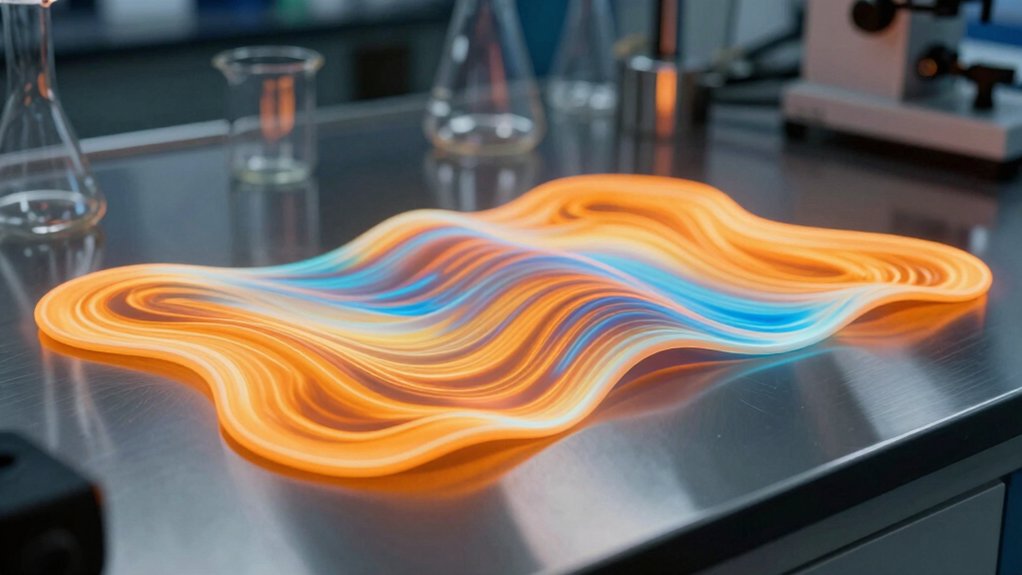
Radiant heat is energy transfer by electromagnetic waves between surfaces at different temperatures, not by contact or fluid flow. You measure it in W/m², scaling with temperature via the Stefan-Boltzmann law and emissivity. Geometry matters: flux falls with distance and angles, and view factors determine how much reaches a target. Materials absorb, emit, and reflect differently across the spectrum, especially in the infrared. If you keep exploring, you’ll connect theory to real-world heating designs and measurements.
What Is Radiant Heat and How It Differs From Other Heat Transfer
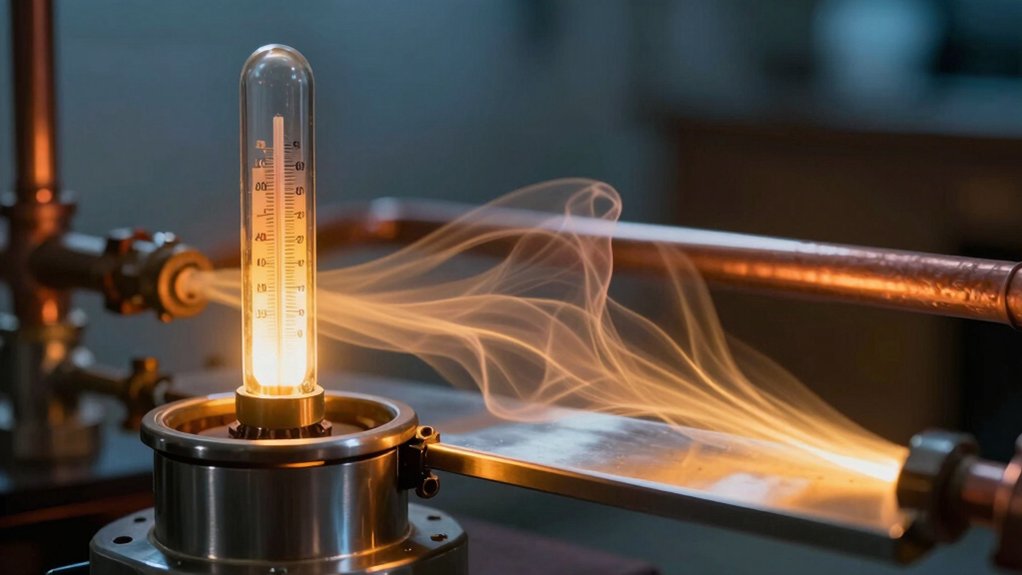
Radiant heat is the transfer of thermal energy through electromagnetic waves, not by direct contact or by the movement of a fluid. You quantify it as energy flow per unit area, measured in watts per square meter, across a surface.
Unlike conduction, which relies on molecular interaction, or convection, which uses fluid motion, radiative transfer travels through vacuum and transparent media with minimal attenuation over short distances. You evaluate sources by spectral power density and total radiant flux, integrating over the relevant wavelengths.
The key distinction is that temperature gradients drive emission, not fluid mixing, and your calculations use Stefan-Boltzmann principles for ideal emitters, with real surfaces modeled by emissivity between 0 and 1. You compare radiative transfer to other modes by considering surface temperatures, view factors, and optical properties.
How Electromagnetic Waves Carry Thermal Energy
Electromagnetic waves transport thermal energy by encoding temperature differences into oscillating electric and magnetic fields that propagate through space or transparent media.
You analyze radiant transfer by considering the spectral energy density in a given mode, described by Planck’s law for blackbody emission and modified by emissivity.
In practice, you quantify power flux as the Poynting vector magnitude, S = E × H, yielding units W/m².
The net radiative exchange between surfaces follows σϵ(T1⁴ − T2⁴) for idealized blackbodies, scaled by combined emissivities.
You model frequency-dependent radiance using Bν(T) and integrate over relevant bands.
You evaluate view factors, surface properties, and geometric configuration to compute total irradiance.
You recognize attenuation, reflection, and transmission alter net transfer, while material response governs absorption coefficients and thermalization depth.
Quantitative rigor anchors understanding without overextending beyond the subtopic.
The Visible and Infrared Spectrum: What Your Skin Feels as Heat
The skin perceives heat primarily through two spectral bands: the visible and near-to-far infrared. You experience radiant warmth when photons deposit energy in skin layers, raising local temperature by microkelvin to millikelvin scales per second, depending on flux.
In the visible band, energy transfer is minimal for typical heat sources, but bright sources can trigger photothermal receptors and perceived warmth via convection-enhanced perfusion.
More impactful is near-to-far infrared, where photon energy directly excites molecular vibrations and lattice modes, converting to heat in the epidermis and dermis.
Radiant flux density, measured in watts per square meter (W/m²), correlates with perceived intensity; 100–1000 W/m² yields noticeable warmth, while >5000 W/m² risks tissue damage.
Skin acts as a selective filter; wavelengths near 0.7–4 μm dominate absorption, shaping sensation and thermal response.
How Materials Absorb, Emit, and Reflect Radiant Heat
Materials interact with radiant heat through three core processes: absorption, emission, and reflection. You quantify absorption by the material’s absorptivity (α) at a given wavelength, describing how much incident radiance is stored as internal energy.
Emission follows Planck’s law, with spectral radiance proportional to the emissivity (ε) and the blackbody term B(λ, T); at equilibrium, ε ≈ 1 − reflectance for idealized surfaces.
You assess reflectivity (ρ) as the fraction of incident radiance reflected, so absorptivity + reflectivity + transmissivity = 1; for opaque materials, transmissivity ≈ 0, hence α ≈ ε + ρ.
Temperature elevates emitted power per area roughly by σT4, and spectral distribution shifts with temperature.
Practical selections optimize α, ε, and ρ to meet target heat transfer, regulation, or insulation goals.
Surfaces, Angles, and Distances: The Role of Geometry in Radiant Heating
In radiant heating, geometry governs how surface orientation, angular distribution, and distance sculpt the delivery of radiant flux. You assess a surface area A and its normal vector n relative to the emitter’s radiant intensity distribution I(θ, φ).
The incident flux density on a target point scales with cosθ times the inverse-square distance r2, modulated by emitter pattern P(θ, φ). When multiple surfaces share angular ranges, superposition yields total irradiance E = ∑ I(θ, φ) cosθ / r2.
Orientation errors of only a few degrees can alter E by measurable percentages, especially at short range. Distances determine penetration depth and thermal lag, while gaps and obstructions create shadowing factors S ≤ 1.
Accurately modeling geometry enables predictable, uniform heating and quantified temperature responses.
Practical Implications: Choosing Radiant Heating for Homes and Workplaces
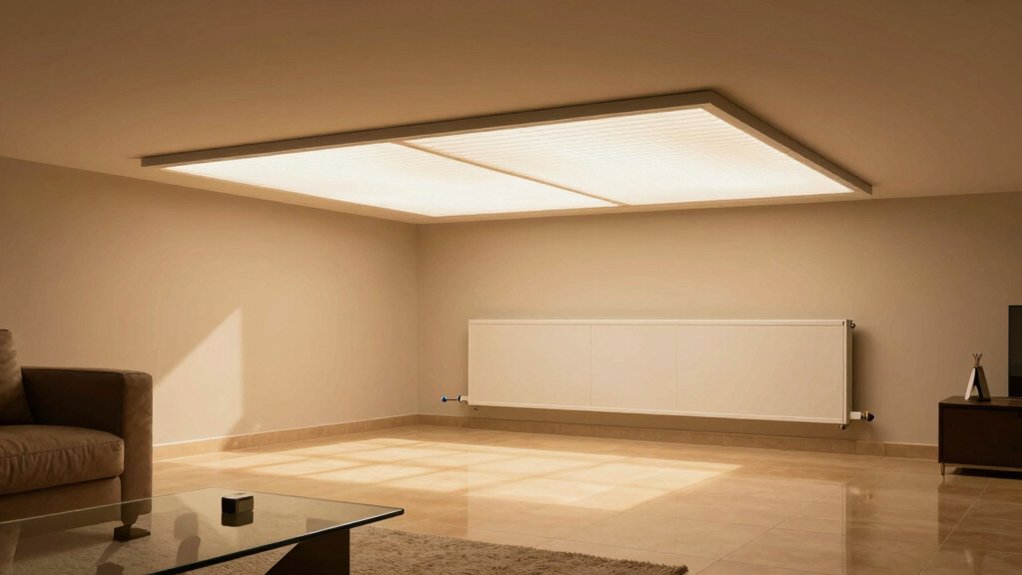
You’ll weigh efficiency and comfort by comparing system COPs, heat output per watt, and typical comfort metrics across spaces.
Consider installation costs, lifecycle energy savings, and zoning capabilities to tailor performance for rooms, offices, and common areas.
We’ll quantify benefits and trade offs to guide practical choices for homes and workplaces.
Efficiency And Comfort
Radiant heating can boost both comfort and energy efficiency by delivering steady warmth to occupants and surfaces with minimal temperature fluctuation. You’ll notice lower setback penalties, because surface temperatures stay near the setpoint even when outdoor conditions shift.
For a typical living space, aim for surface temperatures around 26–28°C and air temperatures in the 20–22°C range to maintain consistent comfort without draft. Heat loss resistance, measured as a U-value, should be minimized by properly insulated slabs, walls, and ceilings; target overall building performance in the 0.20–0.35 W/m²K band depending on climate.
System responsiveness matters: electric elements react within minutes, hydronic loops within tens of minutes, so calibrate controls for 0.5–2 °C hysteresis. In practice, radiant layouts should prioritize low-mass, uniform heat distribution across zones.
Installation And Zoning
How should you approach installation and zoning to guarantee reliable radiant heat across a home or workplace? Plan zones by space usage, occupancy, and heat load. Start with a detailed floor plan, calculate BTU requirements per room, and size mains with a 15–20% safety margin. Use continuous tubing or cables with uniform spacing—typically 6–12 inches for floors, 12–24 inches for walls—depending on assembly.
Separate thermostats for each zone, linked to a central controller, enable targeted control and energy savings of 10–30%. Insulate thoroughly; seal air leaks before tubing placement. Install manifolds, pumps, or controllers within 3–6 feet of primary lines to minimize pressure drops.
Commission after balancing, verify with pipe-temperature logs, and record operating setpoints for predictable performance. Regular maintenance schedules sustain efficiency and comfort.
Measuring and Controlling Radiant Heat: Tools and Best Practices
You’ll start by selecting calibrated tools for measuring surface and ambient radiant flux. Then, quantify output with standardized units and tolerances.
You’ll implement controls to adjust radiant power in precise increments, verify response times, and document deviations within specified thresholds.
You’ll follow proven protocol steps, log measurements, and compare against target ranges to guide optimization.
Tools For Measurement
Effective measurement of radiant heat hinges on selecting instruments that quantify flux, temperature, and emissivity with traceable accuracy. You follow a disciplined workflow: specify measurement goals, select calibrated sensors, and document uncertainty budgets.
For flux, use calibrated radiometers or calorimetric methods with known spectral response and directional sensitivity; report total and spectral components as appropriate.
For temperature, deploy contact thermocouples or noncontact pyrometers, ensuring emissivity corrections and view factors are consistent with the surface.
Emissivity assessments rely on reference standards or reflected-emittance techniques, with documented traceability.
Acquire data at stable exposure conditions, log environmental parameters, and apply standardized correction models.
Validate instruments against primary references, perform routine drift checks, and propagate uncertainties transparently.
Maintain metrological discipline, avoiding idiosyncratic methods that compromise comparability across studies or deployments.
Controlling Radiant Output
Controlling radiant output requires a disciplined approach to measurement and adjustment, ensuring that flux, temperature, and emissivity remain within defined targets.
You’ll quantify radiant power using calibrated sensors, logging real-time readings at fixed intervals to establish stable baselines. Compare measured flux to setpoints, applying proportional or integral corrections to maintain ±2% tolerance across representative load cases.
Monitor surface temperature gradients to prevent hot spots, enforcing uniformity criteria within 5°C across a defined illuminated area. Use emissivity-corrected radiance calculations to translate sensor data into true incident heat flux, adjusting material coatings or wavelength-selective elements only when necessary.
Document all calibrations, sensor placements, and drift trends. Validate control performance with repeatability tests, ensuring response times align with system dynamics and safety thresholds are preserved. Continuous auditing sustains reliable radiant output.
Best Practice Protocols
Best practice protocols for measuring and controlling radiant heat rely on standardized, repeatable methods and well-documented tools. You’ll use calibrated infrared thermometers, radiometers, and thermocouple arrays to capture spatial and temporal heat profiles with traceable accuracy. Define measurement points, survey geometry, and emissivity corrections, documenting all settings.
You’ll implement fixture-based test rigs to minimize reflective error and establish baseline steady-state conditions before transient runs. Quantitatively, specify target uncertainty (e.g., ±0.5°C or ±2% of reading), sampling rate (≥1 Hz for dynamic scenes), and averaging windows (short-term vs. long-term).
Control protocols require closed-loop adjustment using proportional-integral feedback on radiant source intensity, verified by independent cross-checks. Maintain detailed logs, versioned procedures, and instrument calibration certificates to make sure reproducibility and auditable results.
Common Misconceptions About Radiant Heat and How to Avoid Them
Common misconceptions about radiant heat persist because people confuse surface temperatures with actual heat transfer, assume all radiant energy behaves like visible light, and overlook the role of distance, emissivity, and orientation.
You may think higher surface temp equals more heat delivered at any distance, but radiant flux depends on both temperature and emittance, following Stefan–Boltzmann behavior with area and view factor.
You might also presume uniform wavelength behavior; in reality, spectral response varies by material and coating, altering absorption and reflection.
Distance matters: radiant intensity decays with square distance, so small gaps yield large gains in perceived comfort.
Misjudging emissivity leads to erroneous heat transfer estimates.
Orient surfaces to maximize intended exchange, using correct surface finishes and coatings.
Quantify results via calibrated measurements and established transfer equations, avoiding approximations that obscure true performance.
Conclusion
In radiant heat, realities reveal rapid, relatable results. You’ll see surface temperatures, spectral specifics, and system efficiency rise with precise parameters: distance, angle, emissivity, and power. By benchmarking benchmarks, you’ll banish blanket beliefs and balance bake time with comfort. Apply measured metrics, monitor midpoints, and minimize losses. Focus on physics, not folklore, and forge forecasts with factual figures. Clear calibrations, concise calculations, and continuous checks keep radiant systems reliably, repeatably, and safely performing.