
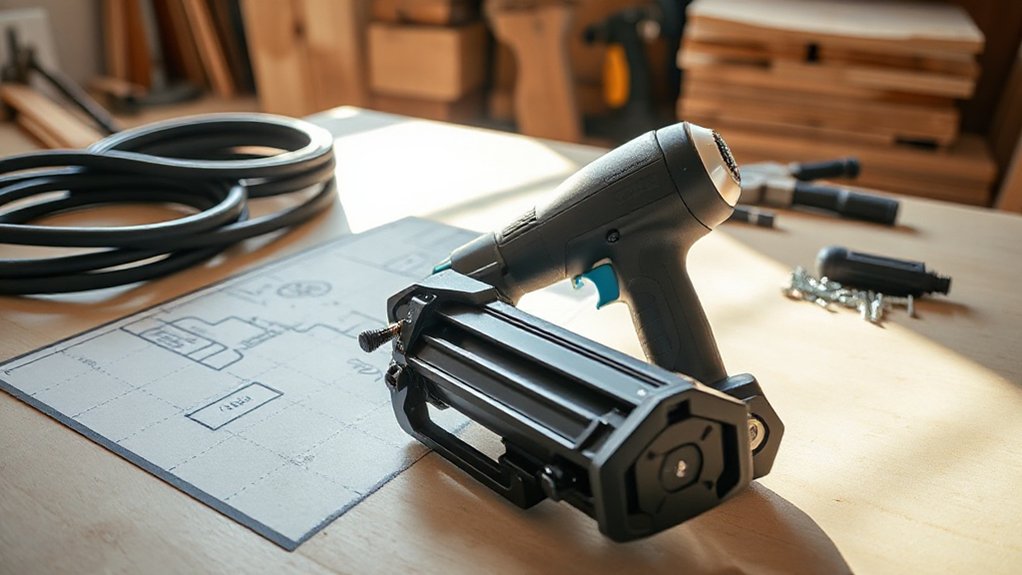
Cordless nail guns that fit home projects blend power, precision, and convenience with 18V or 20V platforms for long runtimes and consistent drive depth. For trim and finish, choose brads or small nails for minimal splitting; for framing or heavier tasks, a framing or finish nailer with deeper drive control works best. 18V tends to offer raw power, while 20V emphasizes lighter weight and cross-brand compatibility. Want more guidance to pick the right setup? Keep going.
What Problems Do Cordless Nail Guns Solve for You?

Cordless nail guns address several common DIY headaches by offering portability, ease of use, and quick setup. You’ll notice power without a cord, enabling you to work in tight spaces and elevated positions. In practice, you gain steady performance across projects, from trim to light framing, with consistent drive depth and reduced fatigue.
Battery compatibility matters, letting you swap packs between tools to keep momentum when you’re mid-project. You’ll plan more effectively since you can move fluidly between rooms without outlets, ladders, or trip hazards slowing you down. Project planning benefits include estimating run-time, selecting appropriate nail types, and scheduling tasks around recharges.
Compared to pneumatic or corded options, you gain flexibility, clearer sightlines, and faster completion, provided you manage battery life and compatible tool ecosystems.
Nail Gun Types at a Glance: Finish, Framing, and Trim
Nail guns come in specialized forms for different tasks, and understanding how finish, framing, and trim models differ helps you pick the right tool for the job. Finish guns excel at precision and are ideal for molding, casing, and decorative trim, delivering small, accurate fasteners with clean counters.
Framing nailers push large fasteners for structural work, offering power, depth control, and rapid productivity for stud walls and subfloors.
Trim guns blend bite and finesse, enabling tight seams with minimal nail visibility.
When evaluating options, consider ergonomics: comfortable handles, balanced weight, and trigger feel affect all-day performance. Also weigh cordless nail gun safety features, like anti-dry-fire, sequential triggering, and tool-less depth adjustment.
In short, match tool type to task, then optimize for control and safety.
When to Choose Finish vs Framing vs Trim
Finish projects benefit from lighter, precision-focused guns, while framing tasks demand greater depth and strength. Consider your load, material, and exposure to determine whether finish or framing gear is more efficient.
Trim work sits between, prioritizing clean joints and minimal stepping while still securing structure where needed. In practice, compare your wood type, fastener size, and hold-down needs to choose the most capable option for each job.
Finish vs Framing Choices
When deciding between finish, framing, and trim, you’ll weigh the visual impact, structural needs, and installation ease each option offers. Finish nails deliver subtle hold for decorative surfaces, but require precise spacing and robust masking to avoid splitting; framing nails tolerate heavier loads and faster drives, yet risk telegraphing through veneer if misapplied.
Trim work demands careful alignment to maintain clean lines, but benefits from lighter fasteners and proactive corner bracing. Prioritize ergonomic design: comfortable trigger reach, balanced weight, and reduced user fatigue during long sessions. Safety precautions matter most in rapid-drive modes and hidden-fastener applications.
Compare nail counts, depth control, and compatibility with your tool’s battery endurance. Choose based on whether you value flawless visibility or structural certainty, then confirm with a quick test on scrap material.
Trim vs Structural Use Cases
Trim nails are ideal for concealed or decorative connections where you want minimal visibility, while framing nails prioritize strength for structural joints and fast installation.
In practice, you’ll choose trim fasteners for cabinetry, molding, and finish work where the goal is clean lines and hidden nails, and you’ll reserve framing nails for studs, plates, and timber framing where load-bearing performance matters.
Compare their drive styles, countersink behavior, and nail diameters: trim nails are thinner and less prone to splitting delicate stock, while framing nails tolerate higher clashes and substrate irregularities.
Always consider material hardness and project scope.
Maintain safety precautions during use, and follow maintenance routines for your tool’s battery, driver, and fastener supply to make certain of consistent, precise results.
18V vs 20V: Which System Fits Your Projects?
Choosing between V-sized batteries and a 20V platform depends on how you’ll use the nail gun. V systems often leverage higher voltage for power and longer runtime, while 20V kits emphasize compatibility and lighter, more portable tools.
You’ll weigh battery compatibility against tool ergonomics to decide what suits your project cadence. V systems typically deliver robust driving force for framing and heavy trim, with fewer recharge interruptions on demanding days.
20V platforms prize interoperability—you can mix brands for basic finishing tasks and reduce overall tool weight. If you prioritize leverage and torque, V may win; if you value legible accessory ecosystems and easier transport, 20V wins.
Consider your typical projects, available batteries, and spare parts on hand, then balance power with weight considerations.
Power and Drive: How Much Pushing Power Do You Really Need?
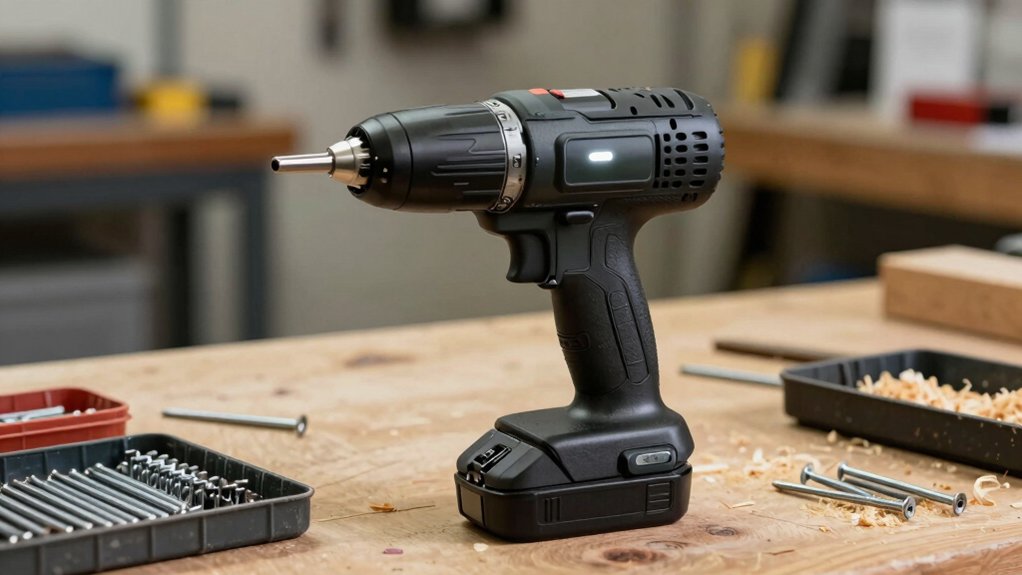
When you evaluate cordless nail guns, you’ll want to compare Battery Torque Fundamentals to see how easily you can drive fasteners without extra effort.
Look at Drive Power Comparisons to gauge whether a model’s pushing power matches your material and project demands.
Then consider Material Surface Interaction to anticipate surface midge marks and penetration.
This balanced view helps you pick a tool that delivers consistent performance across different substrates.
Battery Torque Fundamentals
Battery torque is the driving force behind how effectively a cordless nail gun penetrates material and sets fasteners, and understanding it helps you pick the right tool for the job. You’ll compare motors, gearing, and clutch systems to gauge push strength and consistency.
Torque stability matters more than peak numbers, because steady torque ensures clean, driven fasteners without overdrive. Look for torque adjustment controls that let you tailor pressure to material density and fastener length, reducing jams and nail heads.
Battery maintenance directly affects torque performance, as healthy cells deliver consistent current and cooler operation under load. In practice, higher torque helps in hardwoods, while lighter setups favor softwoods and trim.
Choose a model with predictable response, clear feedback, and robust protection to maximize drive power without sacrificing control.
Drive Power Comparisons
Drive power, simply put, is the amount of push a cordless nail gun can deliver to set fasteners consistently across materials and thicknesses. In drive power comparisons, you’ll notice that higher push force generally improves seating accuracy, reduces jams, and shortens cycle times on denser substrates. However, power shouldn’t come at the expense of control.
Look for models that balance psi and stroke length with a manageable weight. Battery compatibility matters because you’ll want cross-compatibility across tools to minimize swaps. Ergonomic design plays a vital role: comfortable grips, well-placed triggers, and balanced weight reduce fatigue on long sessions.
Compare guns by test-firing on typical boards, then note consistency, depth accuracy, and refill ease. A practical choice is one that delivers reliable drive power without compromising maneuverability.
Material Surface Interaction
Material surface interaction hinges on how the nail gun translates drive power into a secure, flush fastener without damaging the material. You evaluate power delivery by noting how different models handle harder substrates, thin trim, and dense plywood.
Surface compatibility matters: some nails sink cleanly into soft wood but blister hardwood; others prevent head embedment or over-penetration with adjustable depth controls. Drive force must match material adhesion tendencies, avoiding lifting or tearing grain.
A balanced gun reduces recoil while maintaining consistent penetration, ensuring uniform finish without marring edges. Compare unit-to-unit performance: some yield predictable depth with minimal set, others require reconfiguration for dense or knotty stock.
In short, select a cordless nailer whose power curve aligns with your material profile for repeatable, pristine results.
Weight and Ergonomics for All-Day Use
When choosing a cordless nail gun for all-day use, weight and ergonomics matter as much as specs like speed or battery life. You’ll notice models differ in grip feel, balance, and trigger tension, which affect fatigue over hours.
An ergonomic design features a balanced chassis, cushioned handle, and accessible controls, reducing wrist strain during repetitive drives. Weight considerations matter: lighter frames lessen fatigue, but not at the expense of rigidity or durability.
Compare mid-weight tools that maintain steady shot placement with reinforced bodies for professional use. Look for low-profile magazines and slim nozzles that improve line-of-sight and reduce grip twirl.
Battery Life on the Job: Maximizing Runs per Charge
To maximize runs per charge, you’ll want to compare battery efficiency tactics across models and choose features that reduce idle drain and energy spikes.
On-job charge management matters, so evaluate how each nail gun handles rapid recharges, hot-swap options, and charging times alongside overall capacity.
This discussion sets the baseline for practical, side-by-side comparisons of runtimes in typical home-improvement tasks.
Battery Efficiency Tactics
Battery efficiency matters because you’ll get more workable time from each charge without sacrificing performance. You’ll compare packs from major brands, noting energy density, cell chemistry, and runtime claims.
For battery longevity, favor tools with intelligent power management that throttle speed under light loads and recover quickly on startup. Power conservation hinges on selecting the right voltage class for your tasks, avoiding oversized packs that add weight without practical gain.
Efficiency also benefits from firmware that trims motor draw during idle periods and implements rapid cooldown cycles. In practice, assess runtime per charge, recharge speed, and overall tool balance.
A lighter, efficient model often outperforms a heavier, marginally stronger one, especially when you value sustained performance over long sessions.
On-Job Charge Management
On the job, how you manage charge cycles matters as much as the tool you choose. You’ll maximize runs per charge by understanding battery compatibility across models and brands, then matching cells to your work cadence. Favor tools with mixed-charge awareness, so you don’t idle or over-discharge between tasks.
Prioritize ergonomic design to reduce fatigue, which helps you preserve battery life through steadier keystrokes and fewer pauses. Use firmware or tool displays that show remaining capacity and estimated cycles, then plan quick swaps before you hit a lull.
Compare rapid-charge rates against runtime, noting that higher output may heat packs and shorten lifespan if abused. In short, optimize charging strategy, maintain packs properly, and select models engineered for enduring performance.
Depth Adjustment for Precise Results
Depth adjustment is essential for achieving clean, professional results with cordless nail guns. You’ll find depth calibration controls on most models, letting you dial entry depth to suit different materials.
For softwoods, set a shallow depth to prevent dimpling; for hardwoods, go deeper to secure fasteners without splitting. Precision control matters when you’re aiming for consistency across multiple joints, especially in cabinetry or trim work.
Compare tool options: some offer simple single-turn knobs, while others provide micro-adjust sliders with tactile detents. If you crave power without compromising accuracy, choose a gun with repeatable depth settings and clear indicators.
Always test on scrap first, then lock in the setting. Inconsistent depth can undermine structure and finish, so fine-tune thoughtfully.
Jam Clearance and Maintenance You Can Rely On
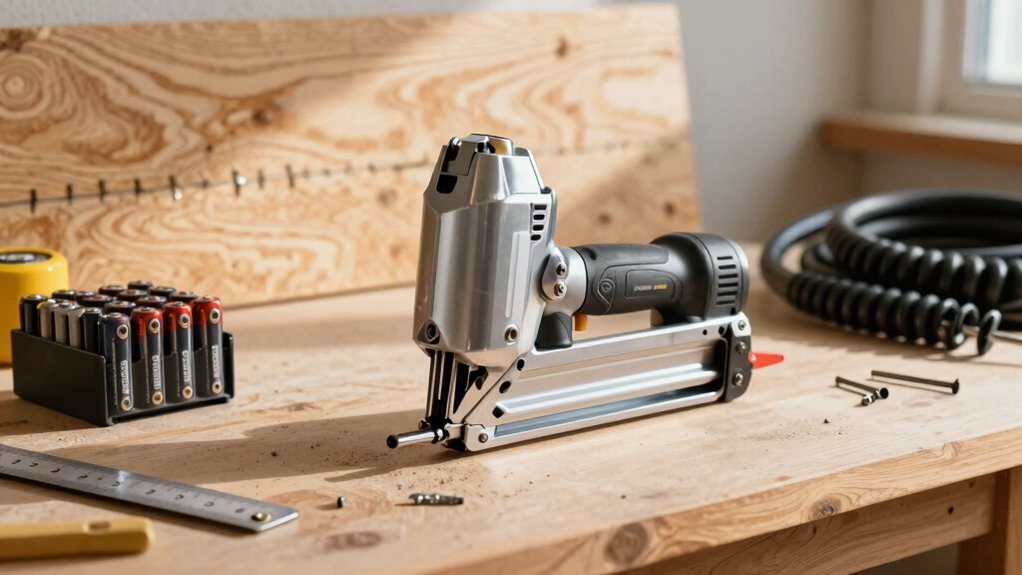
Jam clearing and routine maintenance keep cordless nail guns at peak reliability, preventing jams that slow work and risk misfires. You’ll prioritize consistent cycling, inspect drivers, and clear obstructions with the appropriate brush or tool provided by the manufacturer.
Compare models by jam clearance ease: some enable tool-free access, others require minimal disassembly, affecting downtime. Maintenance tips include keeping the magazine lubricated per spec, checking seals, and replacing worn driver blades before they degrade accuracy.
Clear dust and debris after each session to preserve feeding consistency, and store with batteries detached to avoid self-discharge or corrosion. For precision users, verify timing and depth settings after maintenance to ensure consistent drive depth.
Nail Types by Task: Drywall, Trim, and Molding
Nail types matter for different tasks, and choosing the right one improves grip, finish, and durability for drywall, trim, and molding. For drywall, use thinner nails with small heads to minimize visibility and reduce Jim-in-stud issues; corrosion resistance matters in damp spaces.
Trim and molding benefit from larger shank nails that resist pull-out and edge splitting, paired with finish nails for clean results. Pin nails provide tiny, unobtrusive fasteners ideal for delicate trim, while casing nails deliver strong seats without mushrooming.
Consider project suitability: high-load areas require heavier gauge fasteners; moisture-prone zones demand corrosion resistance. Assess nail type by task, material density, and joinery needs.
Matching nail types to tasks ensures stronger joints, fewer repairs, and a more professional, lasting finish.
Magazine Design for Quick, Reliable Loading
A quick-reload system and reliable magazine performance are essential for minimizing downtime during projects. You’ll want to compare how each nail gun’s magazine design handles staple-like reloading, jam resistance, and ease of clearing misfeeds.
In short, prioritize mechanisms that streamline reloading without sacrificing consistency or safety.
Quick-Reload Mechanisms
One of the key advantages of quick-reload mechanisms is how the magazine design minimizes downtime between nails, enabling you to reload faster without sacrificing reliability. In practice, you’ll encounter inline magazines, top-load bins, and side-feed variants, each with distinct handling characteristics.
Quick reloads hinge on intuitive latch action, smooth follower movement, and a clean cartridge path that resists jams. A robust mechanism reduces misfeeds and streamlines jam clearing, so you stay in control during demanding sessions.
Compare spring strength and material quality, noting how stiffer springs can support higher nail counts yet demand firmer cycling. Overall, choose a design that balances fast action with predictable feed quality, ensuring consistent performance under load, minimal downtime, and clear, decisive operation.
Reliable Magazine Performance
Reliable Magazine Performance hinges on thoughtful design choices that keep feeds smooth and jams rare. You want a system that feeds consistently under load, so compare magazine capacity across models and note how smoothly each feeds from the loading mechanism.
A robust loading mechanism reduces downtime, enabling you to stay on task without frequent resets. Look for spring strength and follower geometry that align with typical nail counts per strip, and verify whether lips or ramps guide nails cleanly into the track.
In practical terms, higher magazine capacity helps you maximize work with fewer reloads, while an intuitive loading mechanism minimizes misfeeds. Consider tool weight and balance, but prioritize reliability: the best cordless guns maintain steady feeding under vibration, preventing misfires and protecting productivity.
Comfort Features: Grip, Balance, and Vibration Control
Comfort features like grip, balance, and vibration control directly influence how precisely and comfortably you can work with a cordless nail gun. You’ll notice that models with thicker, textured grips reduce hand fatigue and improve control during long sessions.
Balance matters: a well‑weighted tool reduces wrist strain and guides steadier nailing, especially in overhead or tight spaces. Vibration control, through dampening systems or sprung housings, minimizes fatigue and improves accuracy over extended runs, a key factor for precision framing or trim work.
Look for ergonomic comfort in the handle shape and material, plus deliberate mass distribution. Compare vibration mitigation tactics across brands, and favor tools that maintain consistent feel at full capacity.
In practice, better ergonomics yield tighter joints and fewer drive misfires.
Safety Features That Protect You and Your Project

When evaluating cordless nail guns, safety features aren’t optional extras—they protect you and your project from common misfires, kickback, and accidental starts. Look for sequential triggers or contact nailing as standard safeguards, which reduce unintended firing. A good model also includes in-line jam release and clear status indicators to avoid delayed responses.
Depth adjustment matters: consistent nail depth minimizes strip jams and surface damage, while anti-dry-fire protection preserves fasteners and tool internals. Rigid motor housings and automatic overload protection reduce heat buildup during extended sessions.
Ergonomic guards, non-slip bases, and cordless models with battery shutoff after idle periods boost hazard awareness on busy sites. Prioritize safety gear compatibility and test reliability across brands to ensure repeatable results under demanding tasks.
Brads vs. Nails: Choosing the Right Fastener Type
Brads and nails serve different purposes in cordless fasteners, and choosing between them hinges on the project demands, material type, and the holding strength you need. You’ll choose brads for delicate trim, where tiny diameters minimize splitting and create a clean finish, while nails deliver higher shear strength for framing and structural joints.
Nail diameter matters: thicker nails resist withdrawal better, but can split softwood; thinner options reduce impact marks yet may loosen over time if loaded heavily. Consider fastener corrosion in exposed or humid environments; coated or stainless options extend life.
For plywood or hardwoods, driving the right size score—smaller diameters for finish work, larger for load-bearing—avoids pull-through. In sum, match fastener type and diameter to load, material, and finish expectations to optimize durability.
Budget vs. Pro-Grade: Where Your Money Goes
Budget decisions in cordless nail guns come down to how you value performance, durability, and long-term costs. A pro-grade tool typically delivers higher sustained power, faster cycling, and better tolerance for demanding workloads, yet it commands a higher upfront price.
For lighter or intermittent use, a mid-range model may offer adequate drive power and reliability at a lower investment. When comparing options, consider battery compatibility across platforms to maximize future flexibility and reduce total ownership costs.
An ergonomic design matters too: a comfortable grip, balanced weight, and intuitive controls cut fatigue on long sessions. Price gaps often reflect motor strength, fastener capacity, and heat management.
In short, prioritize power and endurance, but weigh ongoing battery and service costs.
How to Decide: A Step-by-Step Cordless Nail Gun Buying Guide
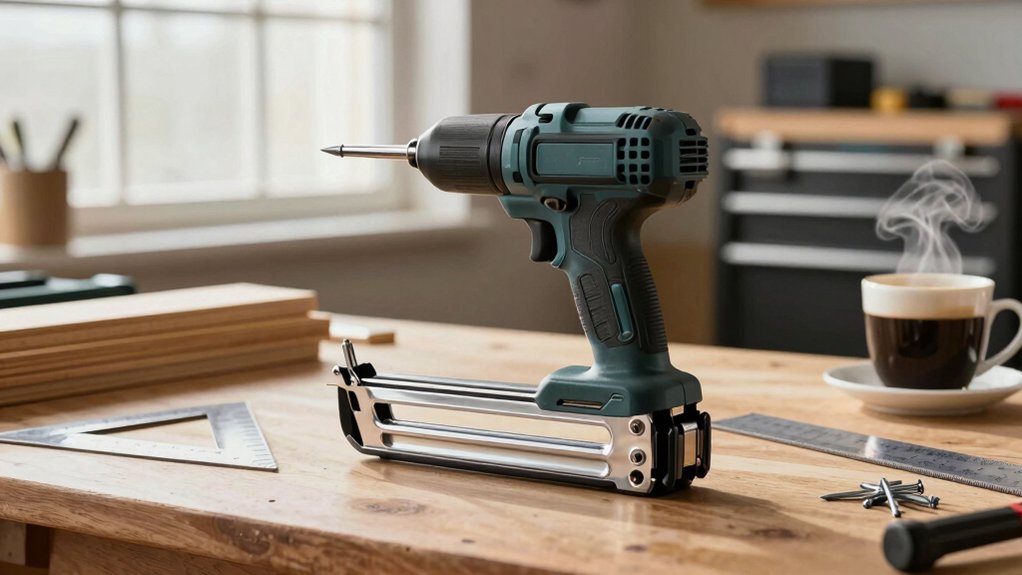
To choose the right cordless nail gun, start with your typical projects and work environment, then map those needs to core specs like nail/fastener type, drive power, battery platform, and magazine capacity.
Next, compare driver types (Brad, Finish, Framing) and adjust for material hardness, base thickness, and repeated cycles.
Assess drive power in psi or impulse consistency, noting how battery voltage and current affect cycles per charge.
Consider battery compatibility across tools to reduce downtime and spare packs.
Evaluate magazine capacity and reload speed for faster runs.
Weigh cordless convenience against weight and balance, especially during long sessions.
Finally, align with your power priorities: compact leverage versus raw forcing power, then verify warranty, service options, and accessory ecosystems.
Frequently Asked Questions
How Long Does a Typical Battery Last on a Single Charge?
A typical battery lasts about 30–60 minutes of continuous fastening, depending on model and usage. You’ll notice longer runtimes on higher-capacity packs; recharge time varies, usually 60–120 minutes, with rapid chargers shaving minutes for urgent projects.
Can Cordless Nail Guns Drive Both Nails and Screws?
Like an atlas balancing weights, no—cordless nail guns can’t drive screws. They’re optimized for nails. Battery efficiency and nail compatibility vary, so compare models to guarantee you pick tools that handle nails confidently, not screws, with power.
Are Pneumatic Nail Guns Faster Than Cordless Models?
Yes, pneumatic nail guns are typically faster in sustained framing, but cordless models close the gap with advanced battery technology; lighter tool weight and high-capacity packs help you maintain speed over longer sessions.
What Maintenance Reduces Jams During Long Projects?
To reduce jams during long projects, perform regular maintenance: clean the nose, verify battery connections, and lubricate moving parts. Battery life varies by model; jam prevention hinges on proper oiling and firing settings, plus consistent drill-down feeding during steady workloads.
Do All Cordless Guns Use the Same Nail Sizes?
No, not all cordless guns use the same nail sizes. Check nail size compatibility for each model, and compare magazines. Prioritize battery life optimization, consistency, and recoil control to power through dense materials efficiently.
Conclusion
You’ll feel the impact of choosing the right cordless nail gun—instant upgrades, zero cords, and speed you can actually hear. Compare finish, framing, and trim like a pro, and the 18V vs 20V tug of war will finally feel solved. With safety checks, proper fasteners, and budget-smart picks, you’ll dodge regrets and overbudget chaos. In short, pick smart, punch fast, and watch your projects fly from “almost done” to “nailed it” in one thunderously efficient swoop.