
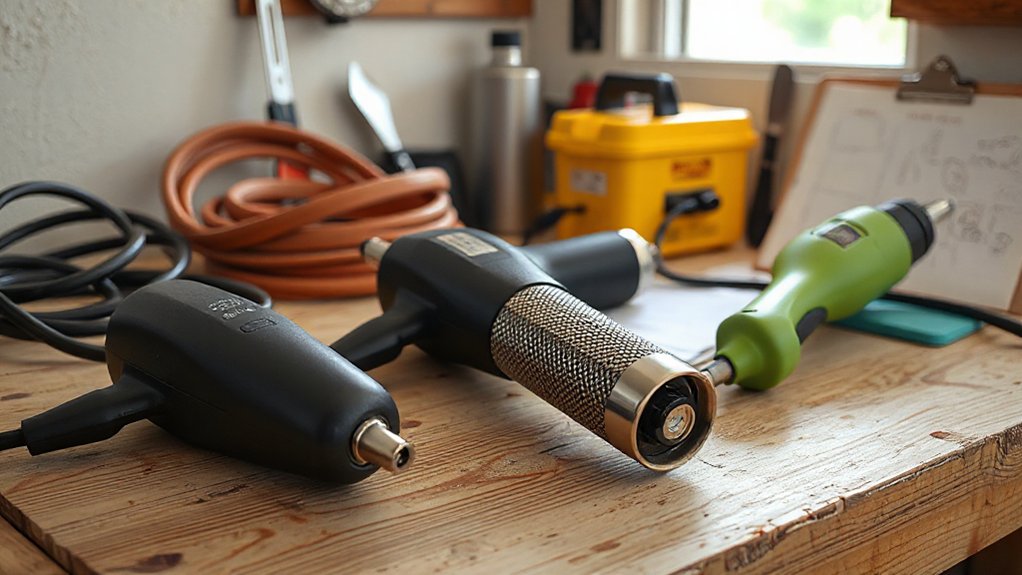
When you compare heat guns for home improvement, look at temperature range, airflow, and control accuracy to match your tasks—from paint stripping to vinyl wrapping. Check adjustable settings, thermal cutoffs, and ergonomic design for steady handling. Note nozzle options and compatibility with accessories, plus safety features like overload protection. Favor models with rapid heat-up and reliable cooldown to prevent substrate damage. Budget for cost-per-use and durability, so you pick a tool that lasts; more specifics follow.
What a Heat Gun Does for Home Projects
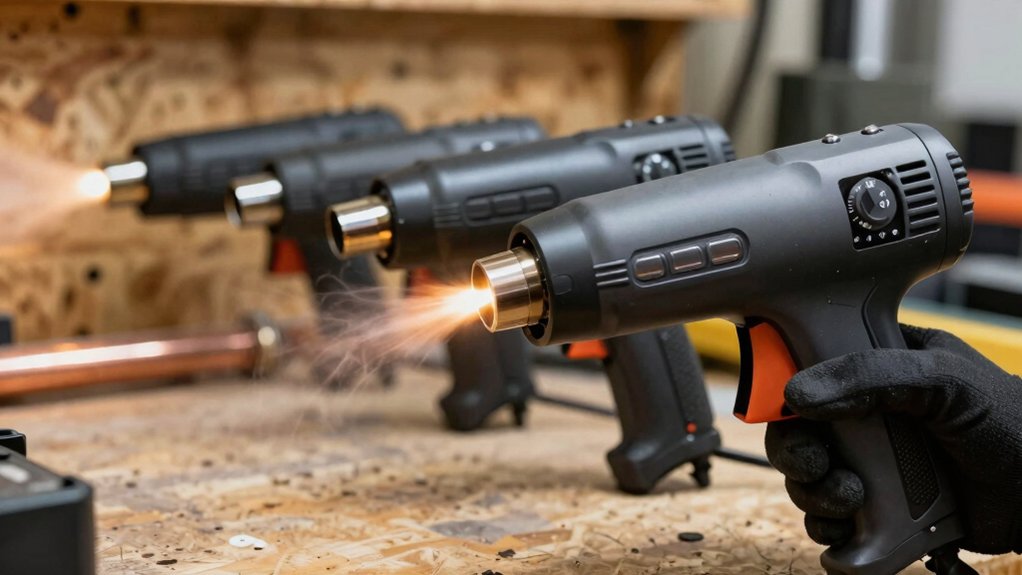
A heat gun concentrates high-temperature air to soften paints, adhesives, plastics, and coatings so you can loosen, remove, or reshape materials efficiently. You understand that controlled heat provides rapid, localized energy, minimizing damage to surrounding substrates.
For home projects, you’ll deploy heat to strip finishes, soften caulk, or bend thermoplastic components with precision. You’ll prefer models offering narrow nozzles and adjustable temperatures, ensuring consistent performance across tasks.
Track thermal profiles to avoid scorching and warping, and maintain steady hands for even results. Prioritize heat gun safety to prevent burns or fumes, and you’ll use protective gear and proper ventilation.
Explore heat gun accessories that extend versatility—reflectors, scraping blades, and compatible shields—so you can tackle diverse materials confidently.
How to Read Heat Gun Temperature and Airflow Specs
When you compare heat guns, start by reading the temperature ranges to see what you’ll actually use for each material.
Next, check the airflow metrics to understand how quickly heat is delivered and how it affects work quality.
This will help you balance heat settings and nozzle choice for precise, efficient results.
Reading Temperature Ranges
Reading temperature ranges and airflow specs on heat guns is essential for selecting the right tool and ensuring safe, effective use. You’ll verify low, mid, and high heat bands, noting incremental steps and the maximum operating temperature to prevent material damage.
Compare thermostatic control vs. manual dial settings, and confirm stability under load to avoid overshoot. You should assess CFM or m3/min figures to match the workpiece and ambient conditions, avoiding underpowered performance or overheating risk.
When precision matters, map the range to your task—paint removal, soldering, or thermal insulation work—then verify duty cycle and tip compatibility. Remember compatibility with heat gun accessories and safety gear.
Mastering ranges optimizes control, minimizes waste, and preserves substrate integrity.
Understanding Airflow Metrics
Airflow metrics matter just as much as temperature: they determine how quickly heat moves to the workpiece and how the tool handles load. When you read specs, compare CFM or CMM values alongside nozzle size and flow control. Higher airflow can boost heat transfer across surfaces, but efficiency matters: you want enough volume without wasting energy or overheating nearby components.
Look for a balance between airflow rate and outlet velocity, which informs how evenly heat is delivered. Consider thermal insulation within the nozzle and body, which reduces heat loss and protects you from stray heat. Airflow efficiency matters for sustained sessions; it preserves tool life and maintains consistent performance while you push toward precise, repeatable results.
Which Heat Gun Class Fits Your Budget and Project
Consider how your project requirements align with budget brackets to choose the appropriate heat gun class. If your needs are simple, DIY, or short-duration tasks, a lower-cost model may suffice, but verify duty cycles and temperature consistency.
For demanding jobs or longer runs, match higher power, features, and reliability to the project scope to prevent overinvestment or shortfalls.
Budget Bracket Fits
Deciding which heat gun class fits your budget and project hinges on power needs, temperature range, and duty cycle.
In this budget bracket fits examination, you match capability to cost by evaluating core performance before purchasing. Budget options span lightweight, consumer-grade models through midrange units with higher airflow and longer duty cycles.
You’ll balance wattage, nozzle versatility, and thermal stability against price, noting that cheaper units can suffer from shorter runtimes and slower heat rise.
Consider included features such as adjustable temperature, ergonomic grip, and thermal protection, but prioritize reliable components and consistent output.
Cost considerations should include replacement parts, warranty length, and energy efficiency.
Choose a model that delivers sufficient heat delivery without overspending on unneeded extras.
Project Needs Alignment
To align your heat gun choice with project needs, start by mapping required performance to job specs: target temperature range, steady-state duty cycle, and airflow volume for the material and workpiece size.
With those anchors, classify your project scope to select the appropriate class and features. For precise work, match higher constant heating capability to extended sessions and larger surfaces, while compact projects benefit from lighter, lower-output models.
Assess material sensitivity, including adhesives, plastics, and paint, to determine acceptable overshoot and stabilization time. Prioritize controllable temperature, reliable airflow, and quick heat-up for efficiency.
Align power budget with duty requirements and maintenance feasibility, ensuring your project needs are met without over-specing, preserving safety margins, and optimizing workflow. project needs, project scope.
Key Features That Matter: Temperature Control, Airflow, Nozzles, Safety
Temperature control, airflow, nozzle options, and safety features are the core factors that determine a heat gun’s performance and suitability for a given task. You’ll evaluate temperature ranges, stabilization, and rapid cooldown to maintain precision under load.
Airflow matters: choose models offering adjustable, high-velocity blasts for fast material deformation or lower flow for delicate work without overheating substrates.
Nozzles expand capability, directing heat where you need it and enabling controlled shaping, shrinking, or stripping.
Safety features must meet demanding conditions: thermal cutoffs, overload protection, and ergonomic, insulated grips for extended sessions.
Prioritize reliable temperature feedback, repeatable settings, and clear readouts to minimize errors.
Heat gun safety and airflow customization should be non-negotiable prerequisites, so you can push performance without compromising integrity or personnel.
Heat Guns for Paint Removal: Practical Picks and Tips
When removing paint, select heat guns with precise temperature control, steady airflow, and reliable safety features to prevent substrate damage and blistering.
For practical paint removal, prioritize models offering adjustable dial ranges around 200–650°C and fast cool-down.
Choose heated-air devices with ergonomic grips, low-weight bodies, and integrated overheat protection to sustain long sessions.
In practice, implement paint stripping techniques that minimize heat exposure time per spot and use pause-and-check cycles to avoid scorching edges.
Favor tools with narrow nozzles for focused heat, while keeping a safe distance to maintain controlled the heat plume.
Prioritize heat gun safety through proper PPE and safe work zones.
Efficiently schedule heat application, and document tested temperatures for repeatable results.
Heat Guns for Vinyl Wrapping and Plastic Bending
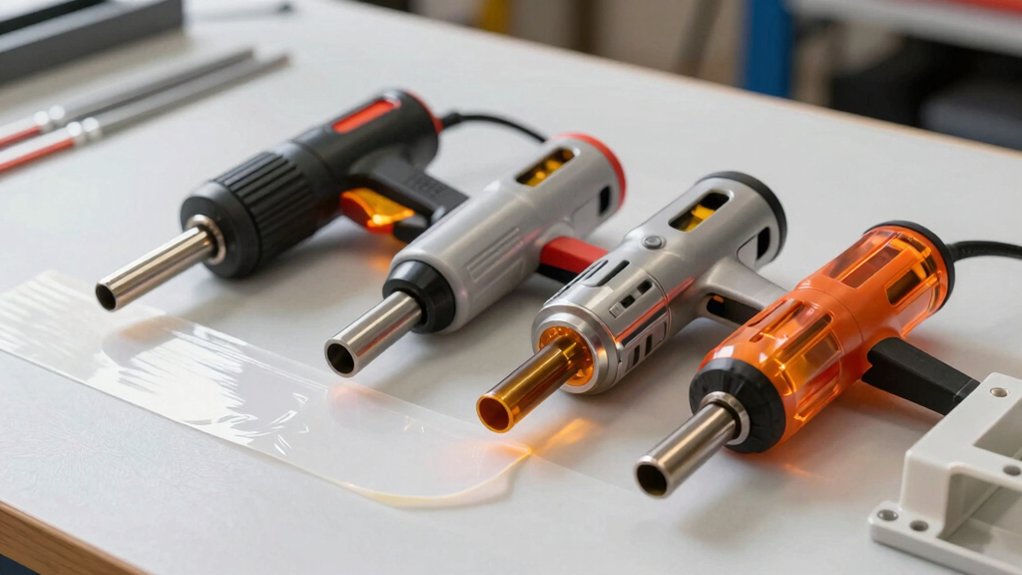
You’ll optimize vinyl wrapping with specific heat settings tailored to film type, ambient conditions, and adhesive behavior.
For plastic bending, apply controlled heat using higher, stable settings and gradual shaping to avoid scorching or work-hardening.
This discussion covers Vinyl Wrapping Heat Settings and Plastic Bending Techniques to establish reliable parameters and workflow.
Vinyl Wrapping Heat Settings
Vinyl wrapping requires careful heat control to soften the film for bending and conforming without causing scorching or adhesive failure. You select settings by film type and ambient conditions, not by guesswork.
Start at low heat to test tack and gradually increase to the window where the film curls without shrinking or air pockets. Maintain a steady, sweeping motion to prevent heat concentration; linger only where you need a bend, then resume motion.
For PVC or calendered vinyl, use moderate heat and shorter dwell times to avoid distortion. For cast vinyl, tolerate higher temperatures but watch adhesive performance.
Keep Heat gun accessories organized, and ensure quick changes without disruption. After use, practice Heat gun storage for longevity and ready accessibility.
Plastic Bending Techniques
Plastic bending with a heat gun combines controlled heat, deliberate shaping, and steady motion to form sharp angles and precise radii in vinyl or plastics. You apply targeted heat to pliable areas, then direct material with firm hands or bending tools to achieve exact profiles.
Maintain a consistent distance to prevent scorching and ensure uniform deformation. For tight radii, work incrementally, reheating as needed while monitoring temperature cues to avoid burn-through.
Choose a gun with stable output and rapid cooldown for repeatable results. Battery powered tools offer mobility, but ensure sufficient runtime for longer bends.
Corded versus cordless matters: corded delivers steady power for precision jobs; cordless enhances accessibility in tight compartments.
Always test fit, document heat cycles, and prioritize safe venting and PPE.
Precision Work With Low-Temperature, Low-Airflow Options
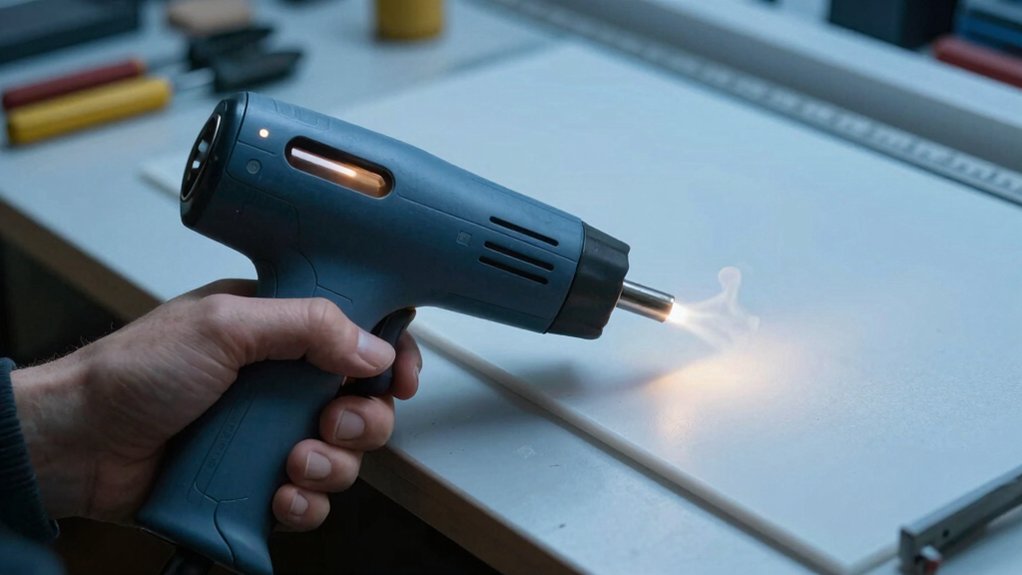
For precision work, opt for heat guns that deliver low temperature settings and restricted airspeeds, enabling fine control over heat-sensitive materials without overshooting. You’ll appreciate calibrated temperature accuracy that stays within tight margins, reducing scorching risk while maintaining material integrity.
With airflow control tuned to fractional speeds, you can feather heat into delicate joints, decals, and laminates without drift. Aim for models offering micro-adjustments rather than broad swaths, so you can sequence heat in brief pulses and verify surface response between passes.
In practice, select tools with stable low-end performance, rapid cool-down, and consistent output as workload demands shift. This approach minimizes distortion, preserves adhesions, and ensures repeatable results across small, detail-driven tasks.
Safety Essentials You Should Never Skip
When you’re using heat guns, safety isn’t optional—it’s the baseline for every operation. You must establish a controlled working environment before any heating begins, ensuring floors are clear, air pathways unobstructed, and observers are at a safe distance.
Wear appropriate Personal protective gear—ANSI-rated gloves, heat-resistant sleeves, safety glasses, and a respirator if fumes arise.
Inspect cords, nozzles, and insulation for damages, and set thermal cutoffs to prevent overheating.
Use a stable stand or purpose-built support to keep the device away from flammables.
Maintain a consistent, directed airflow to minimize hot spots and delays.
Keep a functioning fire extinguisher nearby, and power down after use, allowing complete cool‑down.
Document safety checks, and never bypass protective controls.
Quick-Start Buying Guide: Match Use Case to Model
A heat gun’s best value comes from matching its model to your specific task, so start by clarifying your use case and required features before you shop. You’ll translate project needs into performance specs: heat range, airflow, duty cycle, and nozzle options.
For stripping, you’ll prioritize steady heat delivery and control; for bending or shrinking, you’ll require precise temperature presets and rapid cool-down.
Evaluate safety features first, including overload protection and thermal cutoffs, then assess ergonomics and weight for extended sessions.
Compare cost-per-use across brands rather than upfront price alone.
Plan heat gun storage and handling routines to protect components when idle.
Remember heat gun safety and storage practices, reference manuals, and use cases to ensure dependable, efficient results.
Maintenance Tips to Extend Heat Gun Longevity
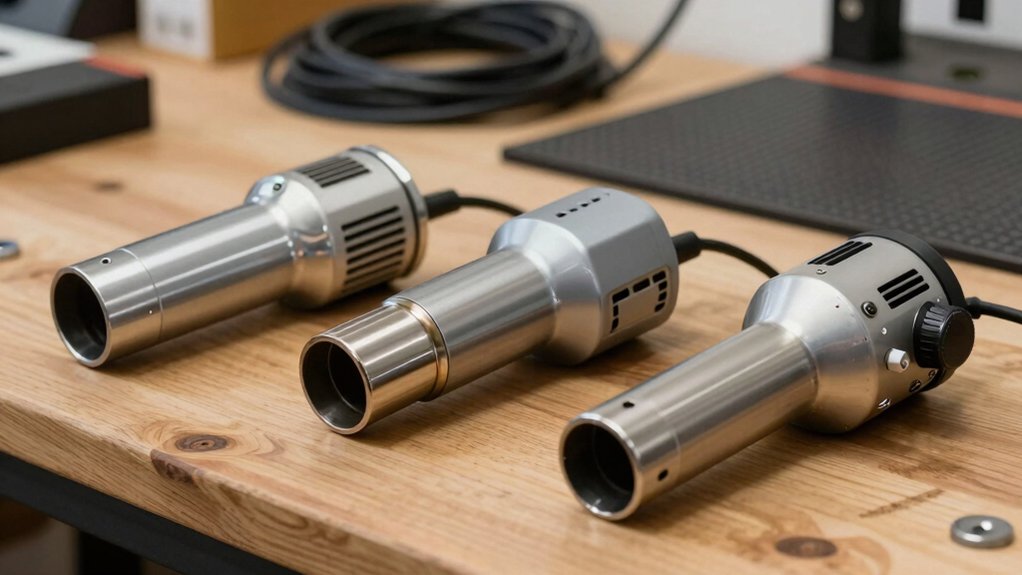
Regular maintenance prevents performance decline and extends a heat gun’s life by addressing wear before failures occur. You should routinely inspect the nozzle, debris, and cord integrity, replacing damaged components before they compromise safety or efficiency.
Clean the air intake and exhaust to preserve airflow and prevent overheating; use compressed air if available, avoiding liquid cleaners that can enter the motor.
Calibrate temperature and airflow settings after extended use to ensure consistent output.
Schedule periodic lubricant checks on moving parts per the manufacturer’s guidance, and replace worn brushes or bearings promptly to maintain torque and response.
Store tools in a dry environment, away from dust and moisture.
Heat gun storage and heat gun accessories should be compatible with your model, making sure secure attachment and quick readiness for demanding tasks.
Typical Setup: How to Use a Heat Gun Effectively
To set up a heat gun for effective use, start by selecting the correct nozzle and mounting the tool securely on a stable work surface. Position the heat gun at the recommended distance from the target and orient the nozzle away from your body.
Engage a slow initial sweep to warm the area gradually, avoiding concentrated heat. Maintain steady motion to prevent scorching or uneven heating. Monitor temperature closely; perform temperature calibration checks if your model supports it, and verify readings with a reliable thermometer when precision matters.
Prioritize safety: wear heat-resistant gloves, eye protection, and keep flammable materials clear. After operation, allow the tool to cool fully before storage.
Adhere to Heat gun safety guidelines to minimize risks and guarantee consistent results.
Common Mistakes to Avoid With Heat Guns
Common mistakes with heat guns often stem from rushing or neglecting proper setup. You’ll waste time, damage materials, and risk injury if you skip a deliberate preflight. Always verify heat settings align with your target substrate, and test on a sacrificial sample first.
Neglecting safety precautions invites burns or toxic fumes; wear PPE and ensure proper ventilation.
Inadequate distance control leads to scorching or delamination, so maintain consistent, appropriate spacing and move with deliberate speed.
Failures in project planning—omitting a cooling interval, or sequencing steps poorly—cause warping and surface defects.
Don’t override manufacturer guidance, and document settings for repeatability.
Finally, neglecting tool maintenance, like clogged vents, reduces performance and increases hazard.
Plan, verify, and monitor every pass to sustain control and results.
Side-by-Side Comparison: Top Models at a Glance
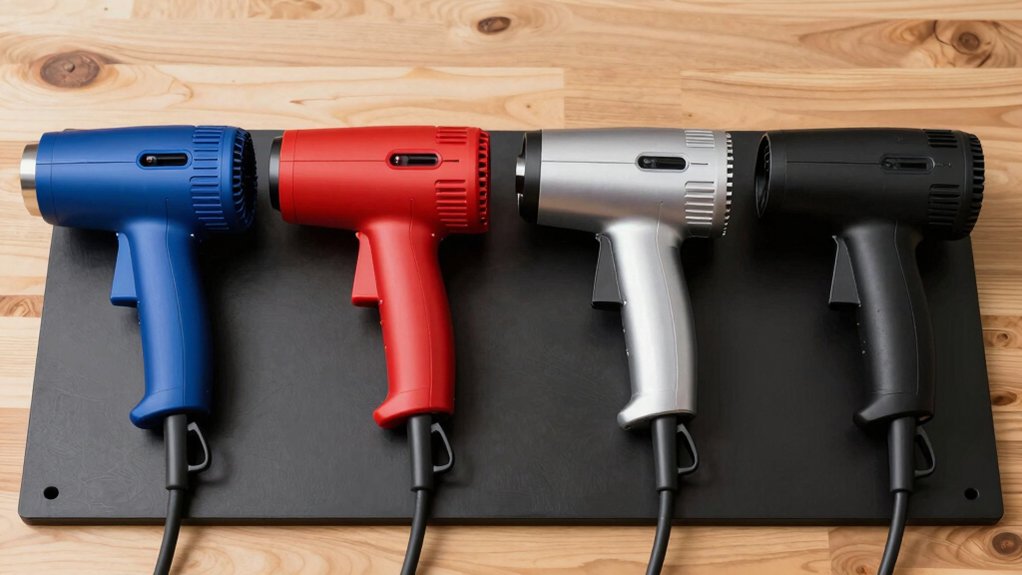
Here’s a concise side-by-side snapshot of the top heat gun models, focusing on core specs, performance, and practical tradeoffs you’ll encounter in typical projects. You’ll compare power ranges (1500–2000 W), temperature spikes (up to 1200°F), and airflow control (adjustable cfm).
For rapid surface heating, pick higher wattage with pulse mode; for fine detailing, prioritize steady heat and ergonomic grip. Weight matters for extended use, as does temperature stability under continuous operation.
Feature sets vary: integrated safety shutoff, digital readouts, and interchangeable nozzles. Consider heat gun safety considerations beside efficiency, and plan around heat gun accessories like scrapers and shield attachments to maximize versatility.
Choose models with robust longevity, clear warranty, and predictable performance across materials.
Frequently Asked Questions
How Hot Is Too Hot for Delicate Plastics?
You should stop well before plastic deformation starts; stay under about 100–120°C for most delicate plastics, respecting heat resistance limits, and monitor closely as deformations can occur even with brief exposure when heat is concentrated.
Can Heat Guns Burn Paint Without Removing It?
You ask if a heat gun can burn paint without removing it: yes, if you overheat, you scorch surface and peel. Think of it like caution: paint removal requires steady control; heat gun safety governs every stroke, precise, deliberate.
Which Nozzle Prevents Scorching Wood Finishes?
The narrow, flat nozzle avoids scorching wood finishes; choose a medium heat setting and steady, sweeping motion. Proper nozzle selection and airflow control prevent hot spots, preserving wood finish while you work on detailed shaping and stripping tasks.
Are Cordless Heat Guns as Effective as Corded?
Cordless heat guns aren’t as powerful as corded models for heavy use, but you gain cordless convenience. In power comparison, you’ll notice shorter runtimes and lower steady heat; choose based on task duration and battery capacity.
What’s the Noise Level of Typical Heat Guns?
You’ll notice noise levels typically range from 80 to 105 dB at peak; sound comparison shows higher-output models are louder. You’ll want hearing protection if you’re using long sessions, especially with hot air settings.
Conclusion
A heat gun is a versatile tool, but match the model to your task and budget. Precision matters: higher temp and adjustable airflow improve paint removal efficiency, while steady ergonomics reduce fatigue. An interesting stat: using the right nozzle can cut thinning times by up to 40%, compared with generic use. Always start with the lowest effective temperature, inspect for damaged cords, and wear eye protection. With proper selection and technique, you’ll achieve safer, cleaner, faster results.