

Urban rental demand hinges on proximity, transit access, dense services, and amenities, while rural demand centers on space, price, and steadier bargains. In cities, you’ll see higher rents, smaller units, and faster turnover driven by diverse demographics and job access. Rural markets offer larger homes, lower costs, longer tenancies, and value-focused tenants, with demand tied to remote work and school quality. Tracking permit velocity, inventory, and rent trends helps you react quickly as markets shift; more details ahead.
Urban Vs Rural Demand in 2024: Key Differences and Implications
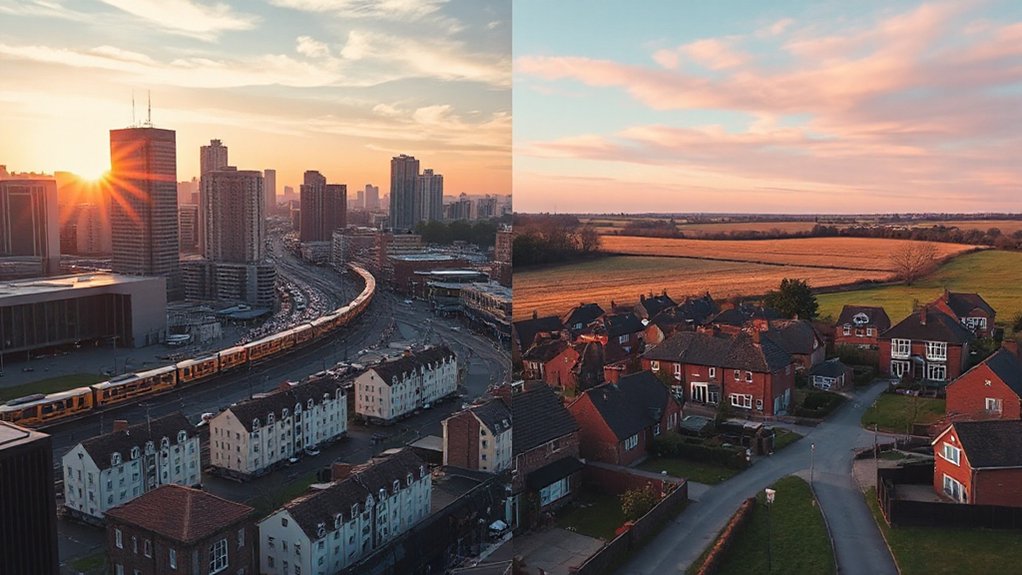
Urban demand in 2024 shows sharper splits from rural demand, driven by shifting employer locations, housing affordability constraints, and migration patterns. You can see urban markets pull stronger capital flows, with rental yields adapting to density and amenity clusters.
Historical migration traces movement cycles, shaping suburb-to-city churn and backflows during downturns, while cultural influences guide landlord expectations and tenant preferences. In cities, demand concentrates around transport access, mixed-use districts, and service ecosystems, creating tighter vacancy gaps and selective leasing.
Rural areas respond with value-oriented pricing, slower turnover, and resilience in utilities, yet face aging housing stock and slower investment. The net implication: you balance risk and return by aligning asset strategies with evolving migration routes, community signals, and the pace of urbanization.
What Drives Tenants to Choose Cities: Accessibility, Jobs, and Community
People are drawn to cities by a mix of accessibility, jobs, and community signals that complement what urban demand patterns showed in 2024. You’ll find that access to transit, dense services, and digital infrastructure shorten commute frictions and widen opportunity.
Jobs remain the core magnet, with concentrations in sectors that reward collaboration and progression, reinforcing higher willingness to pay for central locations.
Community signals—cultural amenities, networks, and neighborhood identity—convert mere proximity into belonging, sustaining retention beyond initial convenience.
Historical trends show cycles of population inflow tied to industry shifts, while demographic shifts influence housing gaps and amenity demand.
In short, cities attract tenants who value speed, scale, and shared belonging, shaping pricing, segmentation, and retention strategies for landlords and developers.
What Attracts Renters to Rural Areas: Space, Price, and Pace
You weigh space and privacy as you evaluate rural options, where larger lots and fewer neighbors can translate to real livability gains.
The price advantage matters too, with lower rents and purchasing power helping stretch your budget without sacrificing space.
As pace slows, you trade crowded amenities for predictable costs and a steadier rental market, enabling clearer long‑term planning.
Space and Privacy
Rural renters prize space, privacy, and a slower pace, and data show these traits translate into meaningful value separate from city living. You’ll notice larger lot sizes and fewer shared walls, which translates into lower perceived intrusion and better acoustics.
Privacy concerns drop as you gain yard-buffered boundaries and fewer quick turnover of neighbors. In practice, households report lower stress from neighbors, letting you customize outdoor routines and work-from-home setups with less interruption.
Noise pollution, a persistent city complaint, often declines by design in rural layouts, boosting concentration and sleep quality. Market signals confirm demand aligns with quieter environments and predictable rental terms, making space and privacy a durable differentiator in rural occupancy metrics.
Price Advantage For Renters
The price advantage in rural areas is real and measurable: rents typically lower than urban equivalents, even after accounting for amenities and lot size. You’ll notice that price sensitivity drives renter segments toward towns where space comes standard and monthly costs stay predictable.
Data show rent affordability improves as local competition tightens and supply expands, yet the gap versus cities remains meaningful across property classes.
Tenant preferences lean toward homes with larger footprints, outdoor access, and lower carrying costs, making rural options appealing without sacrificing essential amenities.
For renters, price isn’t just a number—it shapes budgeting, lifestyle, and commute choices.
In practice, communities that package pricing with clear value signals attract steady demand, reinforcing a virtuous cycle of affordability, occupancy, and belonging.
Cost, Space, and Quality of Life: What Renters Trade Off
Cost, space, and quality of life are the three levers renters pull most often when weighing urban and rural housing options. You’ll notice trade-offs in price per square foot, with urban units often pricier but smaller, and rural homes offering space at a lower cost.
Yet quality of life hinges on access to amenities, safety, and community feel, which vary by locale. Cultural differences shape neighborhood norms, timing, and social cohesion, influencing daily routines and comfort.
Transportation infrastructure matters too: dense areas deliver convenience but can raise commute stress, while rural routes may reduce congestion yet increase travel time.
You’ll benefit from data on vacancy rates, maintenance responsiveness, and long-term value—helping you choose a place where belonging isn’t optional, it’s built in.
Who Is Shaping Demand by Locale: Demographics to Watch
Demographic shifts are reshaping demand by locale, with urban and rural buyers and renters reacting to different pressures and incentives. You’ll see historical migration patterns tilting demand toward regions offering affordability, schools, and job proximity, while cultural influences steer neighborhood preferences and housing types.
In urban areas, diverse age cohorts and immigrant communities sustain demand for smaller units, walkable layouts, and amenity-rich cores.
Rural markets attract growing numbers of remote workers, multi-generational households, and value-seeking buyers prioritizing space and longer-term security.
Data show shifting age bands, rising renter mobility, and evolving household compositions, all shaping price signals and inventory choices.
You benefit from recognizing these micro-trends, aligning offerings with locale-specific expectations and fostering belonging through targeted, transparent communications.
How Work, Tech, and Transit Fuel Urban Demand
As work, technology, and transit reshape urban life, effective demand hinges on proximity to jobs, robust broadband, and reliable mobility options. You’ll see urban renters reward density: short commutes, flexible work hubs, and constant connectivity drive higher bid rents near transit corridors and tech clusters.
Data show tech-enabled firms concentrating in central districts, elevating demand for rental units with modern infrastructure, smart amenities, and flexible leases.
Cultural differences influence housing needs, from shared spaces to privacy norms, shaping product-market fit within neighborhoods.
Community engagement programs—local events, tenant councils, and participatory planning—translate value into loyalty and steadier occupancy.
To compete, sellers should emphasize accessibility, reliable networks, and a sense of belonging that strengthens neighborhood identity amid rapid change.
Rural Housing Supply and Land Costs: Market Pressures and Opportunities
You’ll see land cost pressures reshape rural supply dynamics, with parcel prices and permitting timelines guiding developers’ choices.
Market signals point to opportunities where flexible zoning, infrastructure upgrades, and lower density options open new supply amid tighter inputs.
Tracking these data-driven trends helps you assess where the gaps are and what mix of housing types could meet demand most efficiently.
Land Cost Pressures
Rural housing supply is being constrained by rising land costs, which squeeze development feasibility and push new units toward higher-priced plots. You see land scarcity shaping project economics: larger buffers, costly entitlements, and longer timelines diminish returns and deter speculative development.
As markets weigh feasibility, you’ll notice rural builders prioritizing compact, modular, or infill options where land remains affordable. Zoning policies, including minimum lot sizes and agricultural protections, amplify price signals and limit density, reinforcing affordability gaps.
Yet opportunities exist: targeted land banking, fee waivers for affordable units, and streamlined permitting can access parcels without eroding village character. When you track land-cost trends, you align investment with community needs, balancing growth with belonging and long-term stability for tenants and neighbors alike.
Rural Supply Dynamics
When land costs rise, you lean on efficiency—density, streamlined approvals, and adaptive reuse—to protect affordability while meeting need.
Agricultural shifts affect supply curves: as farms consolidate or repurpose, available parcels may shift, changing both cost baselines and development risk.
Rural infrastructure, from roads to broadband, underpins viability, expanding where housing can pencil out.
You notice inventories respond to demand spikes in harvest seasons or school-year cycles, and you adjust by coordinating with local builders, lenders, and officials.
The result is a clearer pathway to sustainable, inclusive rural housing that aligns with community identities.
Market Opportunity Signals
Market signals illuminate where rural housing supply can grow despite rising land costs. You’ll see that land prices aren’t a wall so much as a threshold; strategic parcels near towns and transit facilitate capacity for gentle density, multi-use housing, and phased development.
Historical migration patterns shift demand toward affordable, open environments, signaling opportunities for builders who align product with local amenities and an evolving workforce. Cultural influences matter: communities often favor designs that respect landscape, heritage, and scale, reducing friction and accelerating permitting.
Data trails—permit velocity, lot inventory, and interim zoning—reveal where supply can expand without sacrificing quality of life. If you listen to these signals, you’ll identify pockets with rising rent potential and durable tenant attraction.
Lifestyle Segments: Urban vs Rural Renters and Preferences

Urban and rural renters differ considerably in lifestyle needs and preferences, with location shaping priorities like commuting time, space per dollar, and access to amenities. You’ll notice urban renters prioritize walkability, flexible spaces, and mixed-use environments, while rural renters emphasize larger footprints, outdoor access, and lower per-room costs.
Historical migration patterns show shifts toward city centers during growth cycles, then rebounds to suburbs or countryside in volatility, influencing demand spikes for affordable connectivity and sturdy infrastructure.
Cultural community trends matter too: urban renters seek diverse networks and transient social scenes, whereas rural renters lean into tight-knit neighborhoods and shared traditions.
Data suggests retention improves when property managers enable local collaboration, vetted by neighborhood associations, to foster belonging without sacrificing efficiency or market adaptability.
How to Compare Urban and Rural Demand: A Practical Evaluation Framework
To compare urban and rural demand, start with clear benchmarks: Urban Demand Metrics capture price trends, occupancy rates, and turnover.
Rural Demand Indicators track housing supply, vacancy gaps, and affordability.
Use comparable timeframes and normalization to surface real differences, not noise.
This framework emphasizes actionable signals you can monitor to adjust pricing, marketing, and inventory strategy.
Urban Demand Metrics
When evaluating urban demand, start by aligning metrics to consumer behavior, price sensitivity, and activity patterns unique to city centers versus nearby towns. You’ll track occupancy rates, turnover velocity, and rent-per-square-foot shifts across submarkets to reveal where demand sticks.
Price elasticity informs you how tenants respond to modest concessions or tiered pricing, while time-on-market flags friction in crowded cores versus emerging zones.
You measure commuter influence, nightlife density, and amenity access to gauge willingness to pay for proximity.
Urban infrastructure impacts can sway demand more than raw supply, so monitor transit access, walkability, and parcel delivery reliability.
Pair these with Rural amenities to compare value perception, ensuring your strategy balances density with livability and belonging.
Rural Demand Indicators
Look for correlations with rural infrastructure, like road quality, bridge reliability, broadband reach, and utility reliability, which amplify tenant stability. Agricultural development matters because on-farm worker housing or nearby agro-services influence occupancy retention and price tolerance.
Track demographics shifts, school quality, healthcare access, and seasonal employment to gauge cyclical demand. Use these signals to forecast cap rate pressure and vacancy risk.
This framework supports a sense of belonging by highlighting markets where residents align with local growth, values, and daily routines.
Practical Strategies for Investors and Landlords in Both Markets
Investors and landlords should tailor strategies to each market’s signals, then apply a unified framework that emphasizes cash flow, risk mitigation, and scalability.
In practice, you’ll monitor Historical trends to align rent tiers, turnover expectations, and capex cycles with local demand shifts.
For urban plays, prioritize asset class mix, lease structures, and amenity offsets that attract stable tenants seeking convenience.
In rural markets, emphasize affordability, longer-tenancy incentives, and maintenance predictability to preserve occupancy.
Across both, review zoning regulations to confirm development limits and occupancy rules, ensuring compliance while planning expansions.
Use data dashboards to track occupancy, days-on-market, and rent-both.
Maintain flexibility for pricing bands and timing, so you capture seasonal waves without sacrificing margin or long-term liquidity.
Frequently Asked Questions
How Do Seasonal Trends Differ Between Urban and Rural Rental Markets?
Seasonal trends differ: you’ll see urban demand peak in summer as movers cluster, while rural markets rise in spring and fall; seasonal migration happens, weather impact nudges vacancy, but data shows steadier rural occupancy year-round.
What Role Does School Quality Play in Rural Rent Decisions?
School rankings shape rural rents modestly; you’ll pay more where education access is strong, yet value can surprise you. Ironically, data shows few districts drive big premiums, so you belong more by community than price.
How Do Rural Commute Options Affect Tenant Demand?
Rural commute options shape tenant demand by boosting appeal where Public transportation is available and Commuter patterns are favorable; you’ll see steadier occupancy when accessibility aligns with work centers, signaling belonging in market-oriented, data-driven decisions.
Do Rural Areas Favor Long-Term Leases Over Short-Term Stays?
You’ll notice rural leases skew longer, with about 60–70% lasting a year-plus, suggesting a preference for stability. Agricultural leases and Property maintenance commitment boost retention, reinforcing a market feel of belonging for you in steady, community-focused rentals.
How Does Housing Density Influence Rent Pricing in Cities Vs Countryside?
Housing density lowers rents in cities and raises them in rural areas, but you’ll see tighter supply push rents up where density is high. Housing affordability worsens for some renters, shaping tenant preferences toward value, location, and community.
Conclusion
In cities, demand clusters around jobs, transit, and amenities, driving higher rents and faster turnover. In rural areas, space and price win, with slower but steadier demand and different risk profiles. Your evaluation should weigh employment access, housing stock, and land costs alongside quality-of-life trade-offs. Use a data-driven lens to map occupancy, vacancy, and price trends by locale. Think of demand as a spectrum—urban energy fueling growth, rural steadiness anchoring long-term value, like two sides of one market.