
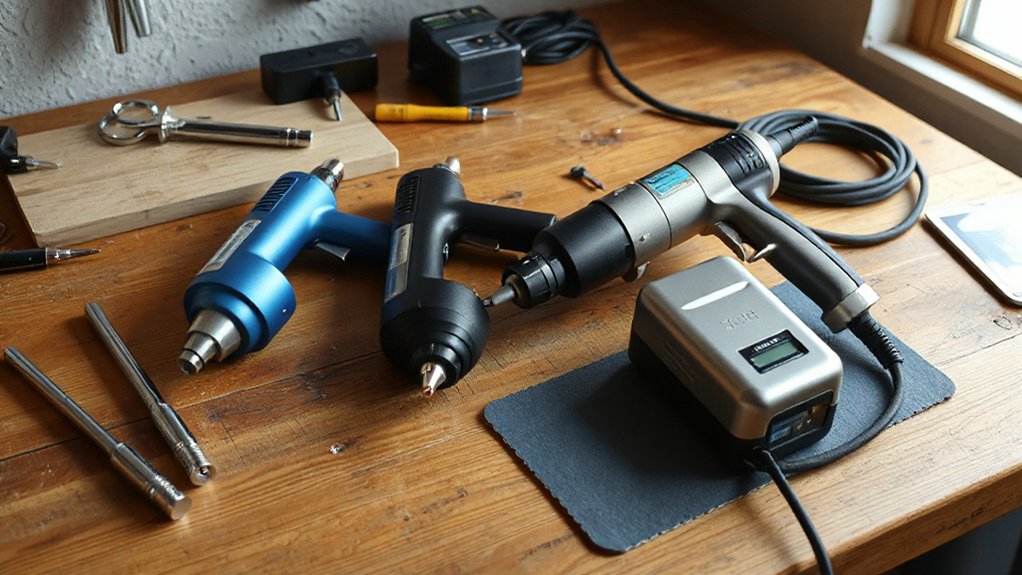
Heat guns differ by heat source, nozzle options, and safety features, so pick based on your task. Hot air is ideal for broad paint stripping and plastic work, while infrared excels in surface-drying and precise curing. Match temperatures—low for plastics, mid for shrink, high for bending—and choose nozzles that focus heat or diffuse it for control. Consider weight, duty cycle, and cords for extended use. If you keep exploring, you’ll uncover how to optimize performance for your projects.
What a Heat Gun Can Do for DIY Home Projects
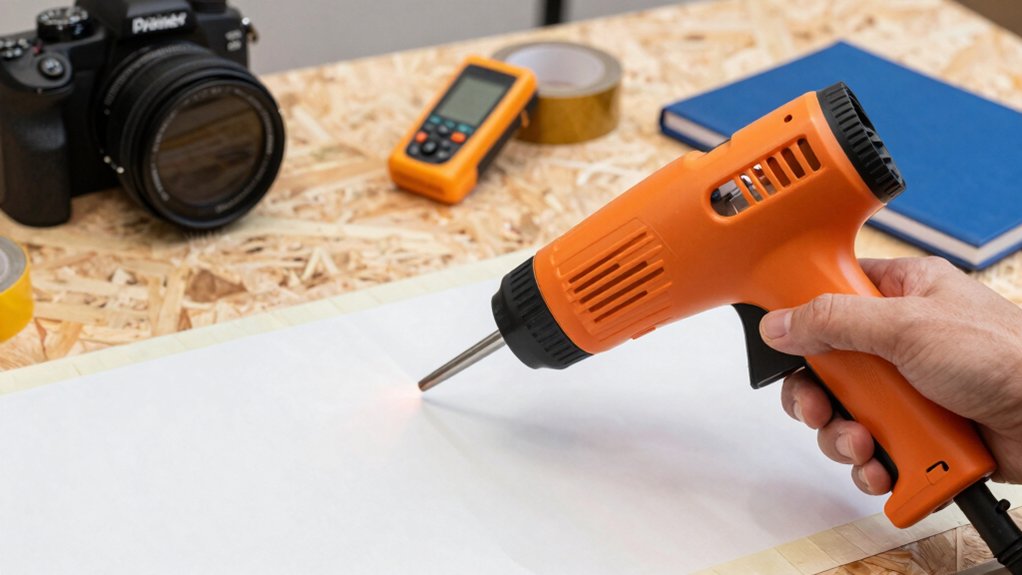
A heat gun is a versatile tool for DIY home projects because it concentrates hot air to modify materials quickly and controllably. You guide heat with precision, enabling strip-and-peel tasks, paint removal, and plastic bending without combustion.
You’ll dimension torque-like control, adjust temperature and airflow, and predict outcomes across plastics, coatings, and adhesives. With proper technique, you warp corners, soften adhesives, and renew surfaces, all while preventing scorching.
Heat gun accessories expand capability: nozzle attachments focus or diffuse heat, multilayer membranes reveal edges, and scrapers accelerate finishing. Store units safely to preserve performance, avoiding moisture and corrosion.
When you manage power responsibly, you unbolt repeatable results and safer workflows. For durability, plan heat cycles, inspect connections, and maintain the tool. Efficient heat gun storage keeps performance reliable.
Hot-Air Vs Infrared: Which Fits Your Task
Hot air and infrared heat each have distinct behavior and fits for home-improvement tasks. You’ll choose based on heat transfer dynamics, surface contact, and control precision.
Hot air delivers rapid, convection-driven heating, ideal for shaping plastics, stripping paint, and loosening adhesives when you need broad surface coverage with adjustable nozzle focus.
Infrared delivers surface-accurate, radiant heating, suited for drying coatings, curing polymers, and targeted warm-ups where you want minimal substrate cooling and deeper energy penetration is unnecessary.
For industrial applications, infrared reduces frame distortion and speeds throughput by concentrating energy exactly where it’s needed.
In commercial vs residential contexts, hot air favors versatility and ruggedness, while infrared emphasizes efficiency and precision.
Your selection hinges on task geometry, material tolerance, and required process speed.
Temperature Ranges That DIYers Actually Need
Understanding your temperature range needs helps you match a heat gun to the task without overkill. We’ll compare how many degrees you actually require for common tasks, consider your tolerance for heat, and identify practical limits to avoid damage.
This sets the baseline for selecting models that balance performance, control, and safety.
Temperature Range Needs
When selecting a heat gun for DIY projects, you’ll want a practical temperature range that matches common tasks and materials. A broad range enables precise control, ensuring you don’t scorch finishes or delaminate substrates.
Start with low settings for delicate plastics and paint stripping, then ramp to mid for vinyl wraps or heat-shrink tubing. High temperatures accelerate bending, thermoforming, and composite prep, but hinge on material tolerance.
Critical metrics are thermal conductivity and material compatibility, which determine heat transfer rates and chemical stability under heat. Seek guns with stable, controllable increments and rapid cool-down to minimize downtime.
Consider duty cycle and nozzle options to tailor energy delivery. By matching range to task-specific needs, you preserve integrity while maximizing throughput and repeatability.
Diyer Heat Tolerance
For DIY projects, most hobbyists don’t need extreme heat capability; they need a practical, predictable range that covers common tasks without risking damage. You’ll prioritize a mid-to-low hot air spectrum that reliably reaches 120–650°F (50–dispersion varies by model) for shrinking sleeves, loosening adhesives, and plastic bending.
Target steady flow at 350–500°F for delicate plastics and trim work, then push toward 600–650°F only briefly for robust tasks like paint stripping. Durability in operation matters; look for stable temperature control, quick cool-down, and intuitive settings. Maintain instant shutoff, a heat shield, and easy replacement nozzles.
Heat gun safety guides your technique; practice controlled passes. Use diy project tips to optimize runtime, avoid overheating joints, and preserve finishes.
Practical Heat Limits
You don’t need extreme heat to cover most DIY tasks; a practical range is enough to handle common materials without risking damage. For heat guns, stay within 250–450°F (120–230°C) for most plastics, paints, and adhesives. Lower settings minimize scorching, while higher ones accelerate results on aluminum, stain removal, or thick plastics, but you must monitor surface response to avoid scorching or deformation.
Know your material’s heat limits: heat resistant materials tolerate brief higher bursts, yet sustained exposure compounds risk. Consider thermal expansion: uneven heating causes warping, especially on laminated panels or metals with coatings. Use a gauge, timer, and sample testing to validate outcomes.
Efficient workflows rely on consistent distance control, even passes, and cooldown intervals to preserve material integrity and tool longevity.
Essential Nozzles for Common Tasks
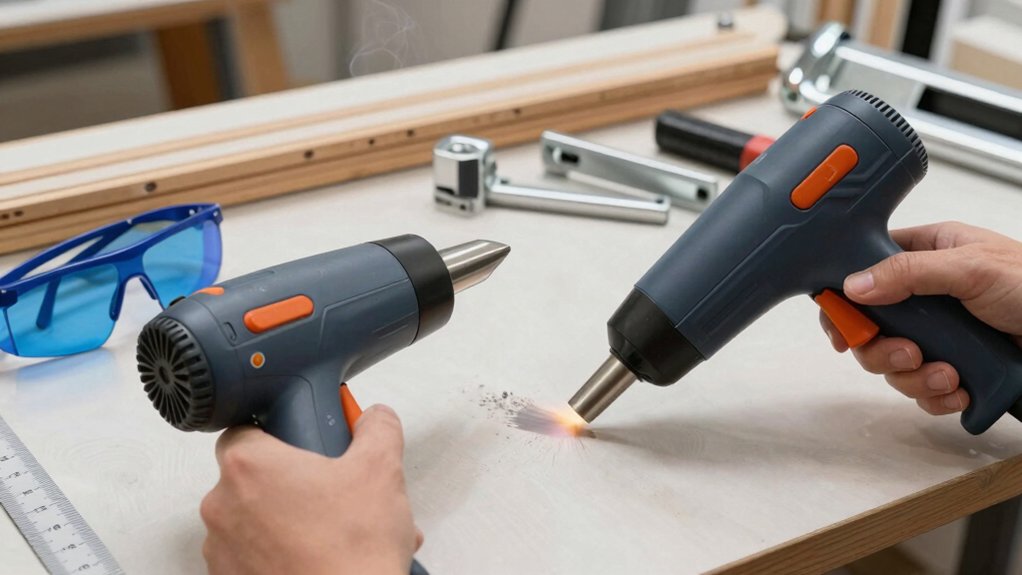
Heat guns come with a handful of nozzle options, each tailored to a specific task and material. You’ll choose nozzle types based on heat distribution, edge control, and target area.
For stripping paint, use a broad, flat nozzle to maximize surface area without scorching adjacent material.
Narrow conical nozzles focus heat for bendable plastics or glue softening, improving precision and reducing waste.
A wide-angle conical delivers gentler, even heating for vinyl and delicate laminates, preserving integrity.
For shrinking tubing or heat-shrink film, a precision ring handles small diameters with controlled heat.
Your project compatibility determines success; mismatched nozzles waste energy and time.
Always verify fit, maintain even distance, and monitor temperature to prevent deformation.
This approach yields faster, cleaner results with repeatable accuracy.
Safety Features That Protect Your Project and You
You’ll want heat guns with clear safety gear guidelines and easy access to protective wear to minimize personal and material risk.
Temperature control mechanisms should provide precise, repeatable settings to stop overheating and protect your workpiece.
We’ll assess these features across models to quantify how effectively they guard both you and your project.
Safety Gear Essentials
When selecting a heat gun for home projects, prioritize safety gear that directly mitigates common hazards such as burns, eye injury, and inhalation of fumes. You demand durable, verifiable protection, so choose PPE with proven rated performance.
Protective gloves shield hands from radiant heat and brief contact without sacrificing dexterity during material prep and grip adjustments.
Eye protection—impact-rated safety glasses or goggles with side shields—prevents debris and radiant glare from compromise.
Respiratory awareness matters; use a properly fitted mask or respirator when working with coatings or solvents that emit fumes, and ensure ventilation is adequate.
Inspect gear for integrity after each session, replace damaged items promptly, and maintain a ready safety kit nearby for rapid response in fast-paced tasks.
Temperature Control Mechanisms
Temperature regulation mechanisms in heat guns are safety-critical because they directly limit exposure to materials’ heat and reduce the risk of scorching delicate substrates. You evaluate adjustable thermostats, preset heat ranges, and smart feedback loops to prevent overheating.
Precision matters: a narrow band minimizes thermal shock to finishes, while rapid cooling prevents warp. Duty-cycle awareness ensures sustained performance without exceeding component margins. Look for overheat cutoffs, soft-start ramps, and stable temperature hold under load.
Ergonomics matter too—easy-access controls and clear readouts speed correct use in demanding tasks. Consider Heat gun safety implications for continuous work and Heat gun storage practices that prevent accidental activation or jump starts.
Informed choice translates to reliable results, reduced waste, and safer, more efficient project execution.
How Weight, Power, and Ergonomics Affect Comfort
Weight, power, and ergonomics jointly shape comfort in use. You prioritize performance, so you assess how mass and grip interact with balance, vibration, and control precision during extended sessions.
Power-to-weight ratio directly influences rapid heating cycles and cooldown behavior; higher ratios boost productivity but can worsen fatigue if weight distribution shifts load to the wrist.
Ergonomic design guides grip contour, trigger position, and handle texture to minimize strain exposure and maximize stable posture.
You should compare weight distribution across models, noting how front- or rear-biased heft alters maneuverability and fatigue onset.
Evaluate vibration damping, circumference, and support surfaces to sustain accuracy.
In objective tests, measure grip endurance, temperature exposure, and control latency to validate comfort without compromising safety or performance.
Value by Use Case: Budget Bands for Homeowners
For homeowners on a budget, value hinges on how well a heat gun’s price-to-performance ratio matches common tasks like stripping paint, thawing frozen fittings, or loosening adhesives.
You assess budget bands by expected duty cycles, durability, and the instrument’s thermal response under real-use loads. In the low-cost tier, focus on robust trigger control, steady heat delivery, and predictable cycle behavior, since erratic output erodes perceived value.
Midrange models should demonstrate reliable thermal conductivity with consistent reach across panels and joints, plus better moisture resistance in typical shop environments.
High-end options justify premium via faster task completion, reduced restart times, and longer service life.
Balance these factors against upfront cost to optimize overall efficiency, avoiding overinvestments for simple chores.
How to Compare Heat Guns: A Practical Spec Checklist
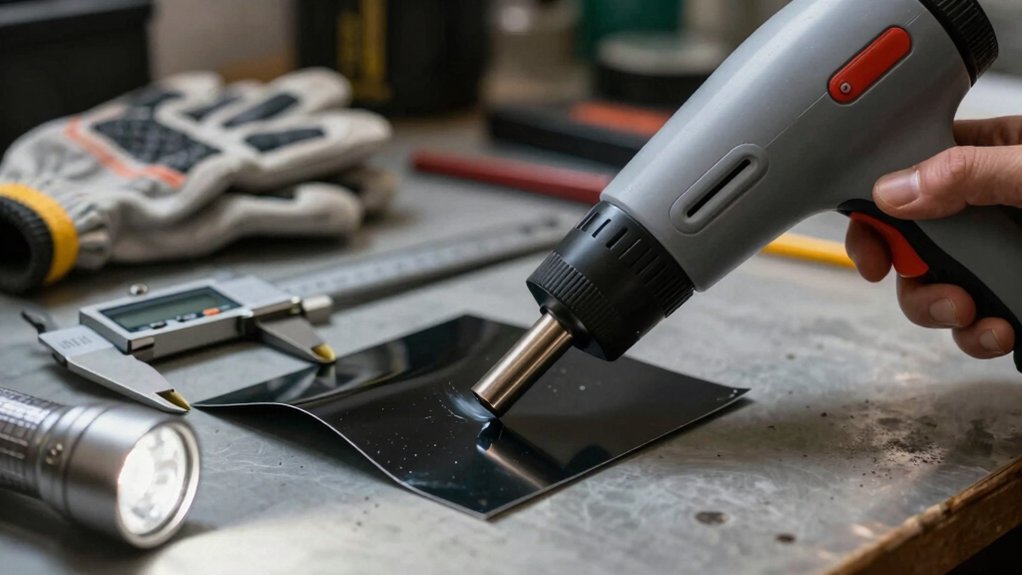
To compare heat guns effectively, start with a practical spec checklist that targets real-use tasks. You’ll assess peak power, duty cycle, nozzle variants, and temperature range, then map them to task duration and material.
Prioritize stability, linear heat response, and ergonomic grip to minimize fatigue. Focus on thermal cutoff features, temperature control accuracy, and fan speed variability for precise deglazing, stripping, or bending jobs.
Consider weight distribution and cord length for extended sessions. Validate build quality with motor torque and bearing resistance data, and verify compatibility with common accessories.
Keep heat gun safety top of mind and evaluate user controls for fail-safes. Acknowledge heat gun noise levels in critical environments, and choose models with adjustable noise-reduction options where available.
End with a concise, objective scorecard.
Quick Reviews: Top Heat Guns for DIY Homeowners
If you’re tackling DIY tasks like paint removal, plastic de-burring, or heat-assisted bending, these top heat guns balance performance and value for homeowners. In quick reviews, you’ll notice models with rapid heat-up, stable temperatures, and anti-tilt stands that enhance control.
Emphasize a broad wattage range for versatility, plus precision nozzles that reduce overshoot. Empirical performance indicators—cycling duty, temperature stability, and nozzle exchange cadence—drive reliable outcomes.
Prioritize ergonomics for user comfort during extended sessions, and favor designs with low vibration and balanced weight. For safety, favor e-stop features, clear thermal indicators, and accessible cool-down modes, ensuring heat gun safety without sacrificing speed.
Accessories and Maintenance: Budgeting Tips and Care
Budgeting for accessories and upkeep starts with itemizing must-haves versus optional add-ons based on your typical tasks, then projecting annual costs across tool-specific consumables, replacement parts, and storage gear.
You’ll want to map accessories compatibility upfront to avoid upgrades mid-projects and to preserve performance margins. Prioritize durable nozzles, heat shields, and filter elements with empirical reliability data, pairing them to your most-used application profiles.
Establish maintenance routines that minimize downtime: clean vents after each session, inspect cords and nozzles for wear, and test thermal cutoffs quarterly. Track consumable lifecycles and set replacement thresholds to sustain peak output.
Budget for protective storage and transport, ensuring components remain organized and protected. This disciplined approach delivers consistent power, predictable costs, and faster, higher-quality results.
Frequently Asked Questions
How Long Do Heat Guns Typically Last With Heavy Use?
Heat gun durability varies, but with heavy use you’ll generally get 600–1200 hours, depending on temperature settings and duty cycle. Lifespan factors include airflow, motor quality, and heat sink design; regular maintenance boosts lifespan, reducing overheating and failures.
Can Heat Guns Cause Warping in Thin Plastics?
Do heat guns cause warping? Yes, under rapid heating you can induce plastic deformation and heat distortion in thin plastics. You’ll minimize risk by gradual heating, controlled temperature, and short bursts to avoid irreversible shape changes.
Do Brushless Motors Matter on DIY Heat Guns?
Yes, brushless motors matter: they boost durability and motor lifespan, with cooler operation and fewer wear parts. You’ll get steadier performance; follow maintenance tips, monitor temperature, and choose brushless models for lasting, powerful DIY heat guns.
Are Cordless Heat Guns Practical for Home Projects?
Yes, cordless heat guns are practical for many home tasks. You gain cordless convenience and portability benefits, trading constant power for shorter run times and battery management, so choose high-CIP cells and rapid-charge packs for rigorous, time-sensitive projects.
What Maintenance Extends a Heat Gun’s Lifespan?
Regular maintenance extends a heat gun’s life: perform Regular cleaning to remove resin and debris, guarantee Proper storage in a cool, dry place, and inspect cord and nozzle before each use for peak, durable performance.
Conclusion
You’ve seen how heat guns vary by task, temperature range, and nozzle type, and you’ve weighed safety features against budget. Pick the model that matches your project’s demands, not the flashiest one on the shelf. In practice, verify real-world performance with temps, airflow, and heat-up times, then assess durability and maintenance costs. Do the math, test a sample task, and you’ll avoid overkill or underperforming tools—go from plan to project, no fluff, with chops to spare. You’ll nail it.