
Concrete Dye vs Concrete Stain: Which Should You Choose?

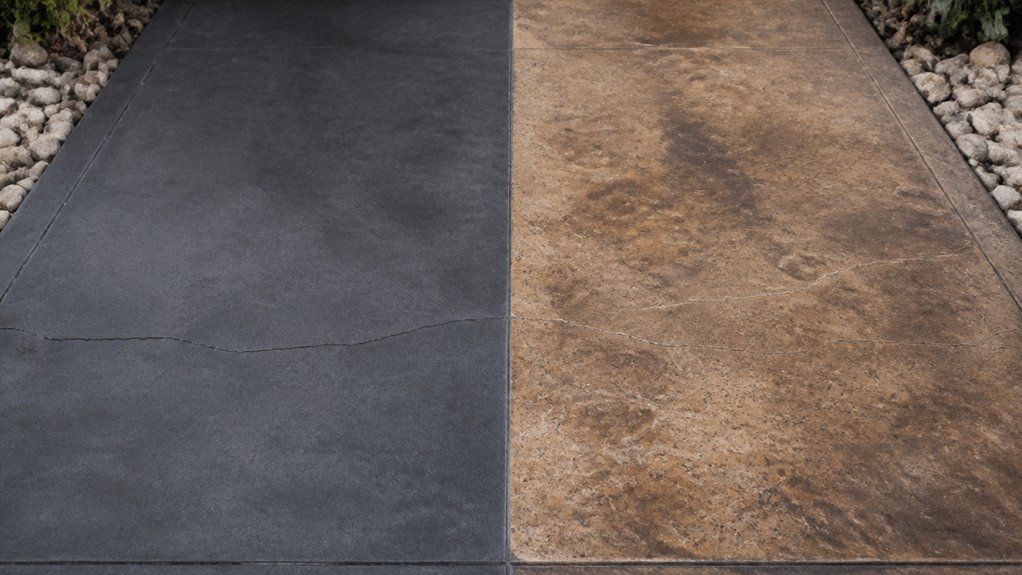
While both products colour concrete, you’ll get very different results depending on whether you choose a dye or a stain. You’ll use dyes when you want crisp, design-led colour blocking and high Color consistency across polished slabs, especially indoors under controlled lighting. Dyes penetrate via solvents or water carriers, so you must manage UV exposure and specify a compatible sealer to prevent fade in sunlit UK extensions and shopfronts.
You’ll choose stains when you want variegation and a more mineral, architectural finish. Acid or water-based stains react with the cement paste, so you’ll accept natural mottling and batch variability. For Environmental impact, you’ll typically prefer low-VOC, water-based systems, plus responsible wash-water handling and minimal solvent use during application.
Concrete Dye vs Stain: Quick Decision Chart (By Project)
Because your brief, lighting conditions, and sealer strategy drive the finish far more than the label on the tin, use the quick chart below to match common UK project types to the right colour system—choose dye when you need tight, repeatable colour on polished interiors, and choose stain when you want a mineral, mottled character that reads as integral to the slab.
Quick chart (UK projects):
- Polished retail, galleries, showrooms: Dye for high Color saturation and crisp zoning.
- Warehouse conversions, heritage refurb: Stain to complement existing variation and patina.
- Domestic kitchens, extensions: Dye when you want uniformity under warm LEDs; stain for softer movement.
- External patios, driveways: Stain for UV-tolerant character; avoid dye unless fully protected.
- Fast-track fit-outs: Dye suits streamlined Application techniques and predictable sign-off.
How Concrete Dye and Stain Color Concrete
When you specify colour for a UK concrete floor, you need to know whether the product penetrates the capillaries (dye) or bonds and reacts at the surface (stain). You’ll also see a key chemical split: stains develop colour through a reaction with the cement matrix, while dyes rely on pigment carried into the slab with minimal chemistry. That difference drives the outcome—dyes can read more uniform and design-clean, while stains tend to deliver greater tonal depth with natural variation.
Penetration Versus Bonding
Although both products aim to transform plain grey slabs into design features, concrete dyes and concrete stains colour concrete in fundamentally different ways: dyes penetrate into the pore structure, whereas stains bond through a chemical or film-forming reaction at or near the surface. With dye, you’re relying on capillary draw, so preparation focuses on opening the concrete and controlling moisture to drive even uptake across bays and edges. The resulting colour sits within the matrix, helping you achieve crisp, contemporary tones with minimal surface build. With stain, you’re managing surface adhesion; the colour layer forms at the top, so profiling and contaminant removal become critical to avoid patchiness or delamination. In service, chemical stability and UV exposure influence how reliably each finish holds its intended shade.
Chemical Reaction Differences
Penetration and adhesion set the stage, but the real difference sits in the chemistry that creates the colour. With a concrete dye, you’re typically introducing finely milled pigments carried by solvents or water; the Chemical composition is largely colourant plus carrier, and there’s minimal Reaction process with the cement matrix. Instead, the carrier flashes off and leaves pigment lodged in the capillaries.
With a concrete stain, especially acid stain common on UK polished floors, you trigger a Reaction process: acidic salts react with free lime in the slab, forming insoluble coloured compounds. That chemical shift becomes part of the surface, not just a deposit. If you choose water-based reactive stains, you still rely on binder chemistry and cement interaction rather than simple pigment placement.
Color Depth And Uniformity
Because the colour in a dye sits as concentrated pigment within the surface pores rather than forming new compounds, you’ll usually get deeper, cleaner, more uniform tones across a UK slab—especially on mechanically polished concrete where the pore structure is consistent. You can tune saturation with additional passes, then lock it in with a compatible guard and sealer for reliable Color consistency under showroom lighting and north-facing daylight.A stain, by contrast, relies on reactive chemistry and substrate variability. Changes in cement content, moisture, finishing marks, laitance, and aggregate exposure drive aesthetic variation, so you’ll see marbling, mottling, and edge-to-centre shifts—often desirable in industrial or heritage schemes. If you need tight colour matching across bays, choose dye and control prep. If you want character, stain rewards it.
Dye vs Stain: Color Range and Final Look
When you’re choosing between concrete dye and concrete stain, the biggest visual differentiator is the colour range and the way the finish reads under UK lighting. Dyes give you higher Color saturation and cleaner, more contemporary hues—charcoals, inky blacks, teals, even near-white tints—because they’re formulated for finer penetration and tighter control. You’ll see sharper tonal consistency across large bays, which suits minimal interiors and polished concrete in London flats.
Stains lean earthier and more variegated: ambers, umbers, terracottas, and weathered greys that reference brick, limestone, and heritage finishes. They react with the slab or sit within its capillaries, so you’ll get organic movement and Texture enhancement that highlights trowel marks, aggregate exposure, and repaired patches under raking winter light.
Dye vs Stain: Durability Under Foot and Tire Traffic
When you’re specifying a coloured concrete floor for heavy footfall or vehicle loading, you need to compare abrasion resistance between dye and stain, not just the visual finish. You’ll also want to factor in UV stability and wear longevity, especially in glazed areas and external thresholds common in UK schemes. Finally, check how each system behaves under tyre pickup and scuffing so the design stays crisp in garages, retail, and circulation routes.
Abrasion Resistance Compared
Although both products can transform a slab aesthetically, abrasion resistance is where their performance diverges under real UK footfall and tyre traffic. A dye sits closer to the surface, so if you’ve got high Surface porosity, it can lodge deeper in open capillaries yet still relies on your sealer or densifier to take the abrasion. Under frequent trolley wheels, trainers, and car tyres, you’ll see scuffing first at thresholds and turning circles if protection is thin. A reactive stain penetrates and bonds within the paste, so the colour change isn’t a film to abrade; you generally keep better Color consistency where traffic polishes the floor. For retail, cafés, and driveways, specify a hardener plus an abrasion-rated sealer regardless, then plan maintenance for recoat intervals.
UV And Wear Longevity
Two forces—UV exposure and mechanical wear—decide how long your colour looks intentional on a UK slab. Dyes sit in the pore structure, so they can look sharper at first, but many formulations offer lower UV stability; in bright south-facing patios or glazed atriums, you may see faster fade unless you specify UV-rated product and a protective topcoat.
Stains react or lodge deeper, so they usually hold tone better outdoors and read more “mineral” in design schemes. Under footfall and occasional tyre traffic, your longevity depends less on colourant and more on Wear resistance from the sealer system: solids content, film build, and maintenance cycles. If you want boutique hues, plan periodic reseals; if you want long-term neutrality, choose stain with a robust sealer and matte finish.
Tire Pickup And Scuffing
Since hot tyres and gritty shoes act like moving abrasives, you’ll notice scuffing and tyre pickup first in garages, driveways, and high-traffic retail thresholds. Concrete dyes sit closer to the surface, so if you burnish lightly or skip a robust sealer, Tire pickup can leave grey tracking and soften colour clarity. You’ll improve results by using a high-solids polyurethane or polyaspartic topcoat, specified to UK slip ratings where needed. Acid or water-based stains penetrate more, so they disguise marks better, but they still rely on the same topcoat for true Scuffing resistance. For design-led schemes, keep your sheen realistic: matte hides micro-scratches; gloss shows every tyre turn. Add entrance mats and grit control to reduce abrasion. Use periodic scrub-and-recoat maintenance cycles.
Concrete Dye vs Stain: UV Fading Outdoors
When you’re specifying colour for an exterior slab, UV exposure quickly becomes the deciding factor between concrete dye and stain. Dyes sit near the surface, so in full sun they’ll typically shift faster, especially on south-facing patios and pool surrounds. Stains chemically react or penetrate deeper, so you’ll usually get better long-term hue stability on driveways, terraces, and public domain paving. For a design-led Colorfastness comparison, ask for UV test data, then favour stains for saturated tones and tight architectural palettes, and reserve dyes for shaded courtyards or sheltered colonnades. You’ll still need a UV-stable sealer to lock in the finish and reduce bleaching. Consider Environmental impact too: lower-VOC, water-based systems suit UK spec and Part L-conscious projects.
Concrete Dye vs Stain: Moisture, Spills, and Peeling Risk
UV stability sets the colour story outdoors, but moisture is what usually decides whether that finish survives day‑to‑day use. In UK basements, garages, and ground‑bearing slabs, rising damp and condensation push moisture absorption through the pore network. A dye sits in fine capillaries and can re-emulsify or migrate if water vapour drives it, leaving patchiness around door thresholds. A reactive stain chemically bonds within the cement paste, so it tolerates intermittent wetting better and rarely “lifts”, though salts can still mark the surface.
For kitchens and hospitality floors, you’ll judge by spill resistance. Dyes can deliver crisp, contemporary tones, yet oil, wine, and cleaning chemicals can tint the matrix if you don’t lock it down. Stains mask minor spots but won’t prevent etch marks.
Prep and Application: Grinding, Etching, and Cleanup
Although colour choice gets most of the attention, your finish will only look as clean as the substrate prep you’ve done. Start by removing laitance, paint, and curing compounds; in the UK you’ll usually get best results from mechanical grinding with a diamond cup, not just acid. Grind to open the pores evenly, then vacuum with an M‑class unit and wipe with clean water.
If you must etch, use a controlled citric or phosphoric wash, neutralise thoroughly, and rinse until runoff stays clear; any residue will telegraph through dyes and stains. Keep Application techniques consistent: apply in thin, overlapping passes, maintain a wet edge, and test dwell times. For Color blending, mist in layers and cross-hatch, then clean up overspray immediately to avoid tide marks.
Sealers for Dye vs Stain: What to Use and Why
Once you’ve ground, cleaned, and applied colour without lap marks, the sealer becomes the layer that locks the look in and sets the floor’s sheen, slip resistance, and maintenance regime. With dyes, choose a film-forming acrylic or polyurethane: it prevents UV fade, preserves crisp Color blending, and gives predictable gloss levels for retail or kitchens. For stains, especially reactive acid stains, use a breathable, water-based acrylic first so residual salts can off-gas; then add a tougher PU topcoat if you need abrasion resistance. In UK interiors, check VOC limits, damp risk, and underfloor heating compatibility. Specify a matte or satin with anti-slip aggregate for entrance zones. You’ll gain aesthetic versatility, but only if you match sealer chemistry to the colouring method and traffic.
Frequently Asked Questions
What’s the Average Cost Difference Between Concrete Dye and Stain per Square Foot?
You’ll typically pay about £1–£3 per sq ft more for dye than stain in the UK. Factor colourfastness comparison and environmental impact analysis: dyes deliver sharper hues; stains often emit fewer VOCs.
Can I Apply Dye or Stain Over Existing Paint, Epoxy, or Old Sealer?
You can’t reliably apply over existing paint, epoxy, or old sealer; you’ll need to strip or mechanically abrade first. Like painting a Mini over rust, poor prep kills Colour retention. Follow precise Application techniques, test patches.
How Do I Fix Blotchy or Uneven Color After Dyeing or Staining Concrete?
Fix blotchy colour by abrading lightly, cleaning with a pH-neutral degreaser, then applying a controlled second coat for colour correction. You’ll improve uniformity with consistent spray patterns, and finish using sealing techniques: compatible, low-sheen sealer.
Are Concrete Dyes or Stains Safe for Indoor Air Quality and Pets?
Yes, you can keep Indoor air safety high and choose Pet friendly options if you specify low‑VOC, water‑based products, ventilate well, and allow full cure. In the UK, check SDS, CLP labels.
How Long Should I Wait Before Placing Furniture or Rugs on Colored Concrete?
Wait 24–48 hours before Furniture placement, and 72 hours to 7 days before rug installation, depending on sealant cure. You’ll protect finish, prevent plasticiser marks, and maintain a crisp, design-led sheen.
Conclusion
If you want bold, design-led colour indoors, you’ll likely choose concrete dye: it penetrates finely, reads crisp, and pairs well with a hard-wearing sealer. If you need variegated, mineral character or you’re working on older slabs, stain often suits better, but you’ll manage UV and moisture more carefully outside. Either way, you’ll prep properly—grind, clean, neutralise—then seal for traffic, spills, and fade resistance. Think of it as specifying finishes by fax: precise, deliberate.