
Choose a Wall Scroll Hanging Method (Wall + Weight)
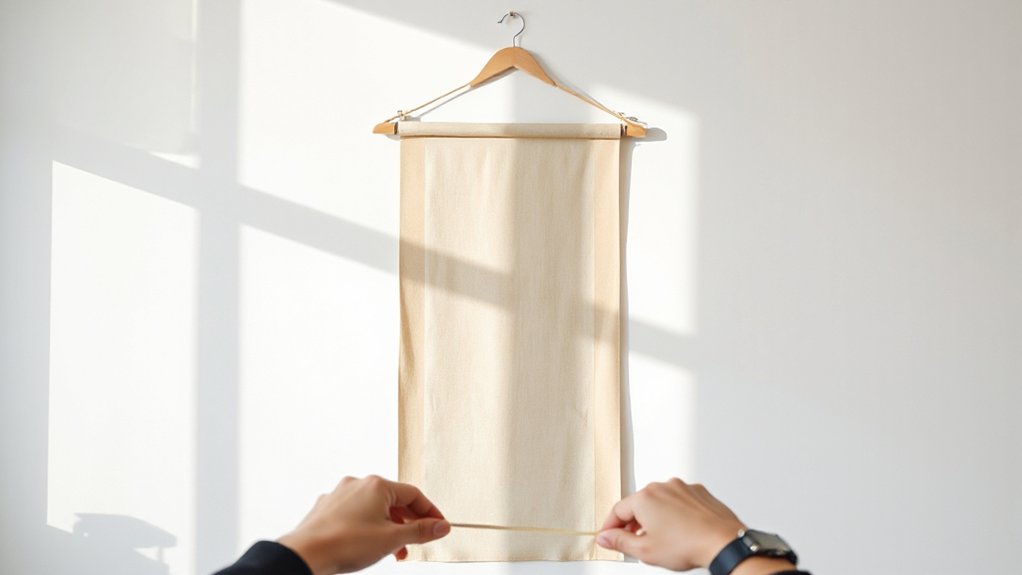
Before you put a hole in the wall, decide how you’ll support the scroll’s weight and what surface you’re mounting to. Weigh the scroll, then choose hardware rated above that load. For light paper scrolls, use Traditional mounting with a top rod and cord, then hang the cord on a single hook or picture hanger centered over the rod. For heavier fabric or brocade, add a bottom rod for tension and use two hooks spaced to match the rod ends so the fabric won’t bow. If you want maximum protection, use Decorative framing: mount the scroll to a backing, glaze it, and hang the frame with D-rings and wire or two hangers. Keep the hanging point level and tested.
Identify Your Wall Type (Drywall, Plaster, Brick)
Now that you’ve picked hardware that can handle your scroll’s weight, match that hardware to the wall you’re hanging on, because drywall, plaster, and brick each hold fasteners differently. Find your wall type by checking Surface texture and probing gently at an existing hole or outlet cutout.
Drywall feels slightly soft, often with paper facing; screws can strip, so use Wall anchors sized to your fastener and stay clear of stud-less corners. Plaster feels harder and more brittle over lath; pre-drill a small pilot hole, drill slowly, and avoid hammering to prevent cracks. Brick or masonry shows gritty pores and mortar joints; drill with a masonry bit, use a sleeve or expansion anchor, and avoid weak mortar whenever possible.
Check the Scroll Hardware (Rod, Dowel, Loops)
Before you hang the scroll, inspect the rod or dowel for cracks, warping, or loose end caps. Check the hanging loops for fraying, stretched stitching, or uneven placement that could tilt the scroll. Then tug the assembly gently to verify the hardware feels stable and can support the scroll’s weight without slipping.
Inspect Rod And Dowel
Once you’ve unrolled the scroll, examine the top rod and bottom dowel to confirm they’re straight, firmly attached, and free of cracks or splinters. Roll the fabric edge between your fingers and check for loosened stitching where the rod sleeves meet the scroll; if you feel gaps, plan to reinforce before hanging. Sight down each piece like a cue stick to spot bowing that could make the scroll hang unevenly.
Wipe both rod and dowel with a dry, lint-free cloth to remove grit that can abrade the fabric. Confirm the rod’s diameter matches your traditional mounting plan and any decorative brackets you’ll use. If the dowel feels too light or shifts inside its pocket, add a thin felt shim so it stays centered and keeps tension even.
Check Hanging Loops
After you’ve confirmed the rod and dowel sit straight and secure, inspect the hanging loops that support the scroll’s full weight. Check that each loop is evenly stitched, not frayed, and firmly attached to the top edge or rod sleeve. If the loops are corded, look for crushed fibers, splits, or thinning where they bend over the hook. Verify both loops match in length so the scroll won’t tilt.
If the scroll includes decorative tassels near the top, make sure they don’t conceal damaged stitching or catch on the mounting hardware. Slide a finger under each loop to feel for stiffness from old glue or moisture. Replace weak loops or add a reinforcing stitch before you hang the scroll.
Verify Hardware Stability
Even if the rod, dowel, and loops look fine at a glance, test their stability with a quick, controlled stress check. Hold the scroll near each end and apply light downward pressure; you shouldn’t feel flexing, creaking, or shifting knots. Spin the rod or dowel in place to confirm it’s seated evenly and won’t roll out of its sleeve. Tug each loop straight out, then diagonally, and inspect stitching for frays, stretched holes, or loose thread. If the hardware uses end caps, verify they’re snug and not cracked. Confirm hardware durability by checking for corrosion, splinters, or bent metal. Finally, match your hook or hanger size to the rod and ensure wall compatibility with your mounting method.
Mark Wall Scroll Height and Center Point
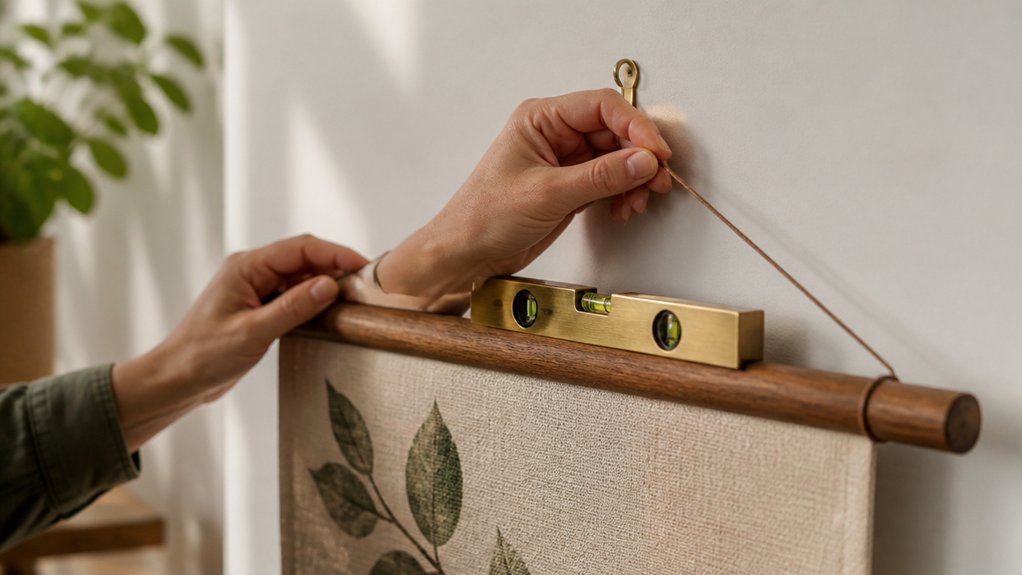
Before you put any hardware in the wall, decide exactly where the scroll should sit and mark it. Hold the scroll up (or tape it temporarily) and step back 6–8 feet to judge balance with nearby furniture and decorative accents. Aim for the visual center at about 57–60 inches from the floor, then adjust for wall scroll styles: taller scrolls often look best slightly higher, while shorter pieces sit closer to eye level. Measure the scroll’s full length, including dowels and hanging loop. Find the midpoint of the top dowel, then transfer that center point to the wall with a pencil. Use a level to draw a short, light reference line. If you’re aligning with other art, measure from known edges, not just eyeballing.
Hang a Wall Scroll With Nails or Hooks
Once you’ve marked the center point and height, choose a fastener that matches your wall type and the scroll’s weight, then install it directly on that mark. For drywall, drive a small nail for light scrolls, or a picture hook with an anchor for heavier pieces. For plaster, pre-drill a pilot hole to prevent cracking; for masonry, use a masonry bit and plug. Seat the hook so it angles upward, then test it with a firm downward tug. Hang the scroll’s cord or top rod loop, and confirm it’s level. If the scroll has Historical context or cultural significance, avoid piercing fabric or mounting through the rod; use the existing hanger to prevent damage and preserve authenticity. Recheck after 24 hours.
Hang a Wall Scroll Without Nails (Command Strips)
If you can’t (or don’t want to) put holes in the wall, use Command Strips to hang your scroll with a clean, removable mount. Choose strips rated above the scroll’s weight, and use two or four points so fabric doesn’t sag. Wipe the wall with isopropyl alcohol, let it dry, then press each strip firmly for 30 seconds. Wait one hour before hanging to let adhesive bond. Align the top edge with a level, then attach the scroll’s hanging edge to the strips, keeping tension even left to right. For delicate textiles with Historical background and Cultural significance, add a thin, acid-free barrier (archival paper) between adhesive tabs and fabric to prevent residue. To remove, pull tabs straight down slowly.
Hang a Wall Scroll With a Rod or Dowel
Although a rod or dowel takes a bit more setup than adhesive strips, it gives your wall scroll crisp alignment and even support across the top edge. Choose a smooth dowel slightly longer than the scroll’s top sleeve, then sand any rough spots to prevent snagging. Slide the dowel through the sleeve and center the artwork.
Mark level hanging points on the wall, measuring equal distances from the scroll’s center. Install two small hooks, nails, or wall anchors rated for the combined weight. Tie cord or thin wire to each dowel end, keeping both loops identical so the scroll hangs square. Lift it onto the hooks, then adjust the knots until the bottom edge sits parallel. This method preserves Traditional aesthetics and respects Cultural significance.
Hang Fabric Wall Scrolls Without Stretching
To keep a fabric wall scroll flat without pulling it out of shape, support its weight evenly and avoid point tension at the corners. Use a full-width sleeve with a rigid rod so the load spreads across the top edge. If there’s no sleeve, sew one with a light lining fabric; don’t pierce the artwork area with pins or tacks. Choose hardware that matches weight and weave: for Material compatibility, use smooth, rust-free rings or hooks and a rod with a sealed finish. Keep the scroll slightly off the wall to prevent abrasion and aid Fabric preservation. If you must use clips, select wide, padded clamps and place them over reinforced hems only. Check alignment, then stop adjusting once it hangs straight.
Stop Slipping, Curling, and Wall Scroll Sagging
If your scroll keeps sliding down, start by locking the top bar in place with properly sized hooks or end caps and a level mount. If the edges curl, you can flatten them by adding light, even tension at the bottom and using straighteners or discreet weights along the hem. If the center sags, you’ll fix it by supporting the midspan with an extra hanger point or a stiffer backing so the fabric hangs flat.
Prevent Top Bar Slippage
Even when you hang the scroll level, the top bar can drift and make the fabric curl or sag over time. Start with top bar stabilization: use two wall anchors or hooks spaced to match the bar’s end loops, not a single center hook. If you’re using nails, switch to screw-in cup hooks so the bar can’t walk sideways.
Next, add a light tension adjustment. Tie short, non-stretch cords from each bar end to its hook so both sides share load equally. Keep cord lengths identical; measure, don’t eyeball. If the bar sits in brackets, add thin rubber pads or museum putty inside the cradle to increase friction. Finally, recheck after 24 hours and retighten knots before the fabric settles.
Flatten Curling Scroll Edges
Why do wall scroll edges curl after you’ve hung everything straight? Fabric memory, humidity, and tight rolling pull the selvage inward, especially on lightweight polyester. Start curl correction by taking the scroll down and laying it face-down on a clean towel. Mist the back lightly with distilled water; don’t soak. Cover with another towel and press with a warm (not hot) iron for 5–10 seconds per section, moving continuously. Let it cool under two flat books for 30 minutes for reliable scroll flattening. If you can’t iron, use low-heat steam from 8–10 inches away, then weight it flat. Rehang only after it’s fully dry to prevent the curl from returning. Repeat once if needed.
Eliminate Mid-Scroll Sagging
Flattened edges make the scroll look sharper, but you’ll still notice a belly in the middle when the fabric slowly slips down the rod or the rod bows under its own weight. To stop Mid scroll sagging, first confirm the top sleeve is evenly seated and centered on the rod, not bunched. Add friction by wrapping a thin strip of felt or gaffer tape around the rod where it contacts the sleeve. If your hanger has end caps or cords, do a tension adjustment: tighten both sides equally until the top edge stays level and the fabric hangs straight. For long scrolls, upgrade to a stiffer rod (hardwood or aluminum) or add a discreet center support hook behind the rod. Recheck after 24 hours and retighten if needed.
Troubleshoot Common Wall Scroll Hanging Issues
If your wall scroll doesn’t sit straight or stay put after you hang it, a few targeted checks will usually fix the problem fast. First, confirm the top rod is level and the cord is centered; even a 5 mm offset can skew the bottom. Respect the wall scroll design and cultural significance by avoiding adhesive on silk or paper mounts.
If the scroll slips, swap smooth hooks for textured nails or a wider picture hook, and knot the cord to shorten slack. If corners curl, add small, removable weights to the bottom rod ends, or re-roll the scroll loosely overnight to relax the fibers. If it bows away from the wall, move the hanger point up 1–2 cm so gravity pulls it flat.
Frequently Asked Questions
What’s the Best Way to Store a Wall Scroll Without Creasing It?
Use Rolling storage: roll it around an acid-free tube, image outward, with even tension. Add Protective wrapping like acid-free tissue and a breathable sleeve. Store horizontally, elevated, in a cool, dry place.
How Do I Safely Clean a Dusty or Stained Wall Scroll?
Sure, attack it with a vacuum—if you like damage. You’ll do Dust removal by soft-brushing or microfiber, low suction through mesh. For stain treatment, blot, test mild detergent, dab outward, air-dry flat.
Will Sunlight or Humidity Damage My Wall Scroll Over Time?
Yes—Sunlight damage and Humidity effects can degrade your wall scroll over time. You’ll fade dyes and weaken fibers in direct sun; you’ll risk mold and warping in damp air. Keep it shaded, ventilated.
How Can I Frame or Mount a Wall Scroll Behind Glass?
You can frame it behind UV glass by using acid-free mats, hinging with archival corners, and leaving airflow. Explore framing techniques like spacers, plus mounting options including float mounts or sew-on supports. Avoid adhesives.
What’s the Best Method to Transport a Wall Scroll for Moving?
Why risk creases? Roll it around an acid-free tube, face outward, wrap with tissue, bag, and place in a rigid box. Pack Wall scroll hooks separately, label Hanging techniques notes, and keep it dry, flat, upright.
Conclusion
Now you’ve picked a hanging method, matched it to your wall type, and checked your scroll’s rod, dowel, or loops. You’ve marked the center and height, then mounted it with nails, hooks, or a rod without stretching the fabric. If it slips, curls, or sags, you’ve added weight, tightened supports, and leveled the hardware. Picture the scroll hanging flat and centered—doesn’t that look finished? Recheck spacing, test stability, and you’re done.